
Beyond the Chill: Finding Warmth in Winter’s Grasp at Srinagar’s Dal Lake
Despite temperatures plunging to -1°C and a thick fog enveloping Srinagar’s Dal Lake, the deep winter reveals an unexpected and profound allure, drawing visitors who brave the cold not merely for scenery but for a transformative experience of resilience and authenticity. While the biting cold wave and absent snowfall hint at broader climatic shifts, tourists find a city that defies old narratives, emphasizing cleanliness, security, and normalcy. Yet, amidst this frosty beauty lies a pressing paradox—the celebrated lake, vital to local livelihoods, faces urgent environmental threats, reminding us that true appreciation of this fragile paradise must extend beyond aesthetic enjoyment to active stewardship and a deeper understanding of its enduring spirit.
Beyond the Chill: Finding Warmth in Winter’s Grasp at Srinagar’s Dal Lake
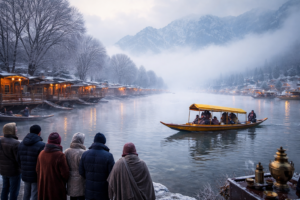
The mist doesn’t just sit over Dal Lake; it breathes. On a January morning where the mercury in Srinagar contracts to a brittle -1°C, the world is rendered in monochrome whispers. A thick, pearlescent fog swallows the familiar silhouette of the distant Zabarwan mountains, turning the iconic shikaras and houseboats into ghostly outlines. The water, usually a vibrant mirror to the sky, is a sheet of smoked glass. For most, this is the very definition of a cold wave to be endured. But for a growing number of visitors gathered at the lake’s edge, layered in pashmina and parkas, this is not an ordeal—it’s an unveiling. They have come not in spite of the cold, but for it, seeking the unique, captivating allure of Kashmir in its deep winter slumber.
This scene, playing out in the heart of January 2026, is more than a weather update. It is a narrative of shifting perceptions, resilient beauty, and the quiet, human moments that flourish under the frost. While the India Meteorological Department (IMD) charts dips and forecasts light rain, the real story is etched in the experiences of those who walk the misty boulevards. Vikas Yadav, a work traveller from Delhi, voices a sentiment that has become increasingly common: “It is bitterly cold here… but it is absolutely safe to travel.” His words are a powerful testament to a changing reality, where the dominant imagery of the valley is slowly being complemented, if not replaced, by firsthand accounts of normalcy, cleanliness, and the reassuring presence of routine life and security patrols.
The cold, severe as it is, acts as a clarifying agent. It strips the landscape down to its essentials. The ornate beauty of summer blooms is gone, revealing the elegant, skeletal structure of chinar trees laced with frost. The bustling tourist throngs of autumn have dissipated, offering a rare intimacy with the place. The soundscape changes: the lap of water against shikara wood is sharper, the call of a vendor carrying kahwa (traditional saffron tea) cuts clearer through the crisp air, and the crunch of frost underfoot is a constant companion. This is the “distinct allure” tourists speak of—a chance to witness not just a place, but its raw, untranslated essence.
However, within this poetic freeze lies a pressing, liquid concern. Gulshan Kumar, another professional on an official visit, echoes a duality felt by many observant travellers. He praises Srinagar’s maintained infrastructure, a nod to developmental strides, but his gaze turns critical towards the lake itself. “Dal Lake needs urgent cleaning,” he states, highlighting a tension between progress and preservation. For the locals whose lives are intricately woven with the lake—from the shikara rower and the water-borne vendor to the artisan selling crafts—the health of Dal Lake is not scenic; it is existential. The fog may veil its surface, but it cannot mask the ongoing challenges of pollution and encroachment. The tourist’s quest for beauty is inextricably linked to the resident’s need for sustainability. Enjoying the lake’s frosty morning beauty comes with the implicit responsibility of advocating for its future.
This winter interlude also challenges the quintessential postcard expectation of Kashmir—a blanket of fresh snow. The disappointment of visitors like Gulshan, who arrived hoping for a snow-domed spectacle but found only a harsh frost, points to the larger, creeping shadow of global warming. The region’s climate patterns are shifting, and the traditional winter calendar is becoming less predictable. What remains steadfast, however, is the adaptability of both the land and its people. The houseboats are still warmly furnished, the kangris (traditional fire pots) still glow with embers tucked under phirans, and hospitality still flows as warmly as the kahwa. The experience shifts from a passive viewing of snowfall to an active engagement with a living, breathing winter culture.
The practical realities of the cold wave are undeniable. The IMD’ reports of dense fog reducing visibility to a few metres are serious advisories, not mere footnotes. Authorities rightly urge caution, limiting outdoor exposure to protect health in the hazardous air quality. Yet, within these necessary boundaries, life persists and even thrives in a different rhythm. It moves indoors to the warmth of carpeted rooms and samovar-steamed conversations. It happens in the quiet exchanges between a shikara owner and a tourist haggling not just over price, but over shared stories of the cold.
Srinagar in this deep freeze offers a profound metaphor. Just as the fog eventually lifts—as it always does—revealing the enduring grandeur of the lake and mountains, the contemporary experience of visiting Kashmir is one where temporary challenges are giving way to a clearer, more stable reality. The cold wave, in its starkness, washes away the residual noise of past conflicts, allowing the fundamental virtues of the place to stand out: its breathtaking, if severe, natural beauty, the resilience of its people, and the undeniable peace that accompanies a securely governed space.
To stand by Dal Lake on such a morning is to understand that Kashmir’s appeal is not conditional on perfect weather or perpetual spring. Its soul is year-round. Winter here is not a closing, but a different kind of opening—a season that demands more from the visitor and, in return, offers a more authentic, unvarnished connection. The tourists braving the chill are not just sightseers; they are participants in a new chapter, one where the narrative is no longer dominated by fear, but by the simple, powerful act of witnessing a resilient land in its most introspective season, and finding, against all odds, a piercing, frost-kissed warmth.
You must be logged in to post a comment.