
Beyond the Checkpoints: Unpacking a Day of Coordinated Escalation in the West Bank
The events of March 30 reveal a coordinated Israeli strategy across the West Bank that goes beyond isolated military raids, blending paramilitary settler expansion with bureaucratic coercion to systematically tighten control over Palestinian land and life. In Sinjil, settlers established a new illegal outpost under army protection, using infrastructure work and false claims of “structural expansion” to slowly besiege the town, while in Umm Tuba a Palestinian family was forced to demolish part of its own home under the guise of zoning violations—part of a broader pattern of administrative displacement. In the northern and southern West Bank, military raids, settler-led provocations, and field interrogations in areas like Masafer Yatta illustrated a symbiotic relationship where settlers act as the vanguard and the army provides cover. Meanwhile, the 30th consecutive day of restricting Palestinian access to Al‑Aqsa, coupled with extremist attempts to bring Passover sacrifices into the compound, underscored the religious dimension of the pressure campaign. Together, these tactics form a slow‑motion annexation that, while overshadowed by the war in Gaza, represents a deliberate effort to fragment Palestinian communities and foreclose the possibility of a contiguous sovereign state.
Beyond the Checkpoints: Unpacking a Day of Coordinated Escalation in the West Bank
In the shadow of the international community’s laser focus on Gaza, a meticulously coordinated campaign is tightening its grip across the Occupied West Bank. While headlines often reduce the conflict to a binary of military raids and stone-throwing, the reality on the ground—as evidenced by events this past Sunday—reveals a far more complex and sinister strategy: a slow-motion annexation driven by a symbiotic relationship between the Israeli military and paramilitary settler movements.
On March 30, 2026, a pattern that has become distressingly familiar to Palestinian communities unfolded from the hills of Ramallah to the outskirts of Hebron. But to view the day’s events as mere isolated incidents—a bulldozer here, a checkpoint there—is to miss the forest for the trees. What occurred on Sunday was a demonstration of systematic policy, where military might cleared the path for ideological expansion, and administrative coercion was used to break the spirit of a population under siege.
The Blueprint of a Land Grab: The Sinjil Outpost
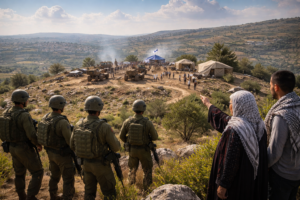
The most telling event of the day occurred in the central West Bank, near the town of Sinjil. Here, the occupation was not defined by the sudden incursion of tanks, but by the patient, deliberate work of bulldozers. According to local journalist Mohamed Ghafri, the establishment of a new illegal colonial outpost in the “Aghraba” area was not a spontaneous act of violence, but the culmination of two months of careful preparation.
This is the blueprint of modern settlement expansion. It begins not with a declaration, but with infrastructure: the construction of a dirt road linking an established colony—in this case, Maale Levona—to a new strategic hilltop. Once the artery is built, the paramilitary settlers arrive, erecting iron barricades and tents under the watchful, and often direct, protection of Israeli Defense Forces (IDF) bulldozers and infantry.
What makes this specific move in Sinjil so insidious is the official justification. As Ghafri notes, the Israeli authorities attempted to camouflage the new outpost as a mere “expansion of the structural plan” of the existing Maale Levona colony. This linguistic sleight of hand is a common tactic used to blur the lines between existing settlements (which even much of the international community views as illegal under international law) and new, unauthorized outposts. By reclassifying a land grab as a simple zoning adjustment, the occupation seeks to normalize the seizure of Palestinian land.
For the residents of Sinjil, this is not just about losing dirt; it is about the eradication of a future. The stated goal of the outpost is to “tighten control” and “impose a siege” on the town. This translates to a choking of urban expansion, the severing of agricultural communities from their ancestral farmlands, and the creation of a “buffer zone” where Palestinian presence is criminalized. The fact that the residents note a similar attempt failed in 2020 due to local steadfastness highlights the cyclical nature of this struggle: the occupation never stops pushing; it simply waits for a moment of global distraction to try again.
The Weaponization of Administrative Law
While bulldozers represent the physical destruction of Palestinian life, the demolition in Umm Tuba, southeast of Jerusalem, represents the bureaucratic destruction. Here, Attia Abu Teir was forced to demolish a section of his own home—a 30-square-meter section of a house that has stood since 2014. He did so under the threat of an even harsher penalty if he refused.
This is the cruel calculus of the occupation in Area C and East Jerusalem. The Israeli authorities make it functionally impossible for Palestinians to obtain building permits. The process is labyrinthine, exorbitantly expensive, and overwhelmingly denied. Consequently, Palestinians are forced to build “illegally” simply to accommodate growing families. The result is a constant state of precarity, where a family of five (as in the Abu Teir household) can wake up to find their home reduced to rubble under the pretext of “planning violations.”
The statistics released by the Jerusalem Governorate for February alone paint a picture of industrial-scale displacement: 49 demolition operations, 143 notifications of punitive action. These numbers are not random acts of enforcement; they are a deliberate policy of “demographic containment.” By making it impossible for Palestinians to build or maintain homes, the occupation aims to push them out of the city core and its surrounding villages, clearing the way for an exclusively Jewish presence in an area Israel claims as its “eternal, undivided capital.”
Confrontation and Control: From Qalqilya to Masafer Yatta
In the northern West Bank, the pattern shifted from construction to direct confrontation. The storming of Qalqilya, the assault on a young man near the annexation wall, and the settler invasion of Bita illustrate the daily violence that has become normalized. The “Al-Marj” area in Qalqilya is particularly significant; situated near the separation wall, it is a flashpoint where the physical barrier of concrete meets the human barrier of checkpoints, often resulting in friction that leaves Palestinians beaten and detained.
Further south, in the Masafer Yatta region, the occupation’s tactics blend military raids with settler-led provocation. The abduction of Mohammed Musa Makhamra and his two sons is a case study in this dynamic. According to reports, the escalation began with settlers destroying a fence and releasing livestock onto Palestinian orchards. When the landowner responded, the military arrived—not to arrest the trespassing settlers, but to violently detain the Palestinian family. This “security symbiosis” is a hallmark of the West Bank’s most volatile areas. Settlers act as the provocateurs, the IDF acts as the enforcement arm, and the Palestinian civilian is left with a choice: abandon their land or face arrest.
The situation in Masafer Yatta is particularly acute. Designated by the Israeli military as a “firing zone,” the area has seen a protracted legal battle aimed at displacing thousands of Palestinian residents. The daily reality, as described by activist Osama Makhamra, involves a relentless churn of raids, home invasions, and “field investigations”—a euphemism for interrogations conducted under the barrel of a gun, often without legal representation.
The Religious Dimension: Al-Aqsa Under Siege
As the material and physical pressures mount, the occupation also continues its assault on the spiritual heart of Palestinian life. Sunday marked the 30th consecutive day of preventing Palestinians from entering the Al-Aqsa Mosque compound. Simultaneously, extremist settler groups intensified their attempts to bring a “Passover sacrifice” into the compound—a provocative act that traditionally serves as a flashpoint for massive escalation.
This religious coercion serves a dual purpose. On one hand, it is an act of dispossession, denying Muslims access to one of their holiest sites. On the other, it is a deliberate attempt to alter the longstanding “status quo” governing the site, which has historically allowed only Muslim prayer there. By pushing for Jewish ritual slaughter on the compound, extremists are not merely engaging in provocation; they are attempting to ignite a religious war that would force the international community to view the conflict through a purely sectarian lens, potentially justifying further escalatory measures.
Conclusion: A Strategy of Continuity
As the world watches Gaza, the events of March 30 serve as a stark reminder that the West Bank is not a secondary front; it is the primary theater for the long-term project of territorial expansion. The strategy is clear and multifaceted: use military force to provide cover for paramilitary settler groups to establish new facts on the ground; utilize the bureaucracy of zoning and permits to render Palestinian residency illegal; and employ nightly raids and abductions to ensure that the population remains too exhausted and traumatized to resist.
The footage of released detainee Omar Amer embracing his father after 24 months in Israeli prisons is a poignant counter-narrative to the violence. It underscores the human cost—the families torn apart, the years lost—that underpin every statistic.
For Palestinians in Sinjil, Bita, Umm Tuba, and Masafer Yatta, Sunday was not an escalation; it was a continuation. It was another day in a war of attrition where the goal is not just to defeat an enemy on a battlefield, but to make life so untenable that the very idea of a contiguous, sovereign Palestinian state becomes an impossibility. As the paramilitary colonists lay their barricades and the military bulldozers clear the way, the world is left with a choice: to continue looking away, or to recognize that the fate of the West Bank is not a separate issue from the war in Gaza, but its logical extension.
You must be logged in to post a comment.