
Beyond the Checkpoint: The Anatomy of a Routine Assault North of Jerusalem
Beyond the Checkpoint: The Anatomy of a Routine Assault North of Jerusalem
In the sprawling, often contradictory landscape of the occupied West Bank, a line is drawn daily at the Qalandia military checkpoint. For the thousands of Palestinians who pass through its narrow, caged walkways between Jerusalem and Ramallah, it is a place of ritualized submission—a bottleneck of identity cards, steel turnstiles, and the ever-present hum of surveillance. But on the morning of March 27, 2026, that line turned into a site of violence once again.
According to official reports and local eyewitnesses, a Palestinian man was shot and injured by Israeli army forces north of Jerusalem. While the initial news brief lists the incident tersely—a bullet, an injury, a location—the reality of such events is never simple. To understand what happened north of Jerusalem is to strip away the clinical language of conflict reports and step into the dust, the fear, and the systemic pressures that turn a routine morning into a life-altering trauma.
The Incident: A Snapshot of Escalation
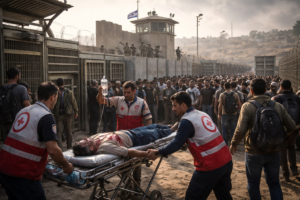
The violence occurred at a military checkpoint situated along a critical artery connecting the Jerusalem governorate to the central West Bank. Witnesses who spoke to local media outlets described a scene of sudden chaos. The victim, whose identity has been withheld pending family notification, was reportedly part of a group of laborers waiting to cross into Jerusalem for work. Such crossings begin in the pre-dawn darkness; men gather as early as 3:00 AM, hoping to pass through the metal cages before the morning rush, often standing for hours under the sun or rain depending on the season.
According to accounts from the Palestinian Red Crescent, the man sustained a live bullet wound. Medics arriving at the scene faced the standard delays that have become a hallmark of such incidents—coordination with military authorities to reach the wounded, the negotiation of safe passage, and the frantic race to a hospital in Ramallah or East Jerusalem.
For those who witnessed it, the shooting was not an isolated act of aggression but the culmination of a tense atmosphere that has gripped the region since the start of the holy month of Ramadan and the recent escalation of Israeli military raids across the northern West Bank. The Israeli military, in a standard statement released to press later in the day, claimed that “suspects hurled objects” at soldiers, leading forces to respond with “riot dispersal means” and “live fire.” However, such official accounts are frequently disputed by human rights organizations, which note that the use of lethal force in situations that do not pose an imminent threat to life often violates international protocols governing law enforcement in occupied territory.
The Broader Context: A Week of Unrelenting Pressure
The injury north of Jerusalem did not occur in a vacuum. It is part of a broader, intensifying pattern of military operations across the West Bank that have accelerated dramatically over the past eighteen months. The very same day this man was shot, Israeli forces were engaged in a series of operations that paint a picture of a territory under siege.
In Nablus, military bulldozers demolished the home of a Palestinian who had been killed in a previous confrontation—a punitive measure widely condemned by human rights groups as collective punishment, which is illegal under international law. Further south, near Bethlehem, another checkpoint was erected, temporarily sealing off communities and trapping residents between barriers. Meanwhile, the skies over southern Lebanon and the Bekaa Valley were rocked by Israeli airstrikes, a stark reminder that the violence of this period has the potential to spiral beyond the borders of the West Bank and Gaza.
For the residents of the villages north of Jerusalem—places like Kafr Aqab, Al-Ram, and Hizma—this interconnected web of conflict defines daily existence. They are caught in a jurisdictional gray zone: technically part of the Jerusalem municipality but separated by the Separation Wall. They hold Jerusalem identity cards, granting them the “right” to live in the city, yet they are severed from it by concrete barriers and military checkpoints that treat them as security threats simply for moving between their homes and their workplaces.
Human Insight: The Economics of the Checkpoint
To add genuine value to this story, one must look beyond the political rhetoric and examine the economic brutality of the checkpoint system. The man injured on Friday was likely a laborer. The majority of Palestinians who cross checkpoints north of Jerusalem do so because they have no other choice. Unemployment in the West Bank hovers at stubbornly high rates, while the economy of East Jerusalem offers slightly better wages.
For a father of three, crossing Qalandia is not a political act; it is a survival mechanism. When a soldier’s bullet finds its mark, it does not just tear through flesh; it dismantles a family’s economic foundation. A single injury means weeks, months, or even a lifetime of lost income. The Palestinian Ministry of Health often bears the burden of treatment, but the hidden cost is the family left behind—the children pulled out of school to help support the household, the rent that goes unpaid.
The psychological toll of these near-daily incursions is equally devastating. Psychologists in Ramallah report a dramatic rise in post-traumatic stress disorder (PTSD) among communities surrounding checkpoints. Children growing up in villages like Al-Ram or Anata often develop stutters or bedwetting issues not because of anything happening in the home, but because of the hyper-vigilance required to navigate the journey to school. Every time a soldier raises a rifle at a checkpoint, the trauma is transmitted to everyone in the queue, not just the individual at whom the gun is pointed.
The Response: Silencing the Narrative
In the aftermath of the shooting, the usual dance of diplomatic language began. The Palestinian Presidency issued a condemnation, calling on the international community to intervene against what it termed “escalating field executions.” The Prisoners’ and Former Prisoners’ Affairs Authority began documenting the incident, adding it to a growing dossier of what they classify as war crimes.
Yet, on the ground, the response is far less formal. For the family of the injured man, the hours following the shooting were a blur of hospitals, bureaucratic paperwork, and the terrifying uncertainty of whether their loved one would survive surgery. In the streets of the nearby refugee camps, young men gathered, throwing stones at military jeeps that patrolled the perimeter, a symbolic but largely futile gesture of defiance that often results in further arrests and injuries.
The Israeli government rarely comments on such specific incidents unless a soldier is killed or a high-profile operation is conducted. The silence is strategic. By treating these injuries as “operational incidents” rather than systemic human rights abuses, the military maintains a narrative of self-defense, regardless of the circumstances. Human rights organizations like B’Tselem and Amnesty International have long argued that this framework is a facade, pointing out that the West Bank is under belligerent occupation and that the use of live fire against unarmed civilians—even those throwing stones—is a violation of the Fourth Geneva Convention.
Beyond the Headline: What Comes Next?
As the sun sets over the hills north of Jerusalem, the checkpoint’s floodlights flicker on. The steel barriers that were briefly opened to allow ambulances to pass are resealed. For the laborers who were not injured, the morning’s events mean one of two things: either they will find alternative, often longer and more dangerous, routes to work, or they will simply not go. The economic siege tightens.
The man lying in a hospital bed, if he survives, faces a long recovery. His family will likely file a complaint with the Israeli military’s internal investigation unit—a process that rarely leads to prosecution. According to data compiled by Israeli human rights group Yesh Din, over 90% of complaints filed by Palestinians against soldiers are closed without indictment.
The international community, preoccupied with conflicts in Europe and instability in the broader Middle East, will likely issue a statement calling for “restraint” from both sides. But restraint is a luxury not afforded to the man who was shot while trying to go to work. Restraint does not pay for his surgery or comfort his children.
Conclusion: The Unseen Scars
The news brief that sparked this story—“Palestinian man injured in Israeli army assault north of Jerusalem”—is one of hundreds filed every year. In the current climate, it is almost routine. But transforming that brief into a deeper understanding reveals a truth that is often lost in the churn of the 24-hour news cycle: this is not merely a conflict of armies and governments. It is a conflict of daily life, of checkpoints and ambulances, of fathers trying to feed their families in the shadow of concrete walls.
The violence on March 27 was not an aberration; it was a symptom. As long as the occupation persists, with its network of barriers, its military courts, and its policy of collective punishment, the cycle of injury, retaliation, and grief will continue. The bullet that struck the man north of Jerusalem did not just wound a single individual; it sent a message to every Palestinian waiting in line that morning: your presence is the provocation, and your survival is the question left unanswered.
Until the deeper structures of the occupation are addressed—the checkpoints, the home demolitions, the military raids—these headlines will continue to scroll by, each one a story of a life interrupted, and each one demanding a humanity that is often in short supply when power meets the powerless at the barrel of a gun.
By: Correspondent
Date: March 27, 2026
In the sprawling, often contradictory landscape of the occupied West Bank, a line is drawn daily at the Qalandia military checkpoint. For the thousands of Palestinians who pass through its narrow, caged walkways between Jerusalem and Ramallah, it is a place of ritualized submission—a bottleneck of identity cards, steel turnstiles, and the ever-present hum of surveillance. But on the morning of March 27, 2026, that line turned into a site of violence once again.
According to official reports and local eyewitnesses, a Palestinian man was shot and injured by Israeli army forces north of Jerusalem. While the initial news brief lists the incident tersely—a bullet, an injury, a location—the reality of such events is never simple. To understand what happened north of Jerusalem is to strip away the clinical language of conflict reports and step into the dust, the fear, and the systemic pressures that turn a routine morning into a life-altering trauma.
The Incident: A Snapshot of Escalation
The violence occurred at a military checkpoint situated along a critical artery connecting the Jerusalem governorate to the central West Bank. Witnesses who spoke to local media outlets described a scene of sudden chaos. The victim, whose identity has been withheld pending family notification, was reportedly part of a group of laborers waiting to cross into Jerusalem for work. Such crossings begin in the pre-dawn darkness; men gather as early as 3:00 AM, hoping to pass through the metal cages before the morning rush, often standing for hours under the sun or rain depending on the season.
According to accounts from the Palestinian Red Crescent, the man sustained a live bullet wound. Medics arriving at the scene faced the standard delays that have become a hallmark of such incidents—coordination with military authorities to reach the wounded, the negotiation of safe passage, and the frantic race to a hospital in Ramallah or East Jerusalem.
For those who witnessed it, the shooting was not an isolated act of aggression but the culmination of a tense atmosphere that has gripped the region since the start of the holy month of Ramadan and the recent escalation of Israeli military raids across the northern West Bank. The Israeli military, in a standard statement released to press later in the day, claimed that “suspects hurled objects” at soldiers, leading forces to respond with “riot dispersal means” and “live fire.” However, such official accounts are frequently disputed by human rights organizations, which note that the use of lethal force in situations that do not pose an imminent threat to life often violates international protocols governing law enforcement in occupied territory.
The Broader Context: A Week of Unrelenting Pressure
The injury north of Jerusalem did not occur in a vacuum. It is part of a broader, intensifying pattern of military operations across the West Bank that have accelerated dramatically over the past eighteen months. The very same day this man was shot, Israeli forces were engaged in a series of operations that paint a picture of a territory under siege.
In Nablus, military bulldozers demolished the home of a Palestinian who had been killed in a previous confrontation—a punitive measure widely condemned by human rights groups as collective punishment, which is illegal under international law. Further south, near Bethlehem, another checkpoint was erected, temporarily sealing off communities and trapping residents between barriers. Meanwhile, the skies over southern Lebanon and the Bekaa Valley were rocked by Israeli airstrikes, a stark reminder that the violence of this period has the potential to spiral beyond the borders of the West Bank and Gaza.
For the residents of the villages north of Jerusalem—places like Kafr Aqab, Al-Ram, and Hizma—this interconnected web of conflict defines daily existence. They are caught in a jurisdictional gray zone: technically part of the Jerusalem municipality but separated by the Separation Wall. They hold Jerusalem identity cards, granting them the “right” to live in the city, yet they are severed from it by concrete barriers and military checkpoints that treat them as security threats simply for moving between their homes and their workplaces.
Human Insight: The Economics of the Checkpoint
To add genuine value to this story, one must look beyond the political rhetoric and examine the economic brutality of the checkpoint system. The man injured on Friday was likely a laborer. The majority of Palestinians who cross checkpoints north of Jerusalem do so because they have no other choice. Unemployment in the West Bank hovers at stubbornly high rates, while the economy of East Jerusalem offers slightly better wages.
For a father of three, crossing Qalandia is not a political act; it is a survival mechanism. When a soldier’s bullet finds its mark, it does not just tear through flesh; it dismantles a family’s economic foundation. A single injury means weeks, months, or even a lifetime of lost income. The Palestinian Ministry of Health often bears the burden of treatment, but the hidden cost is the family left behind—the children pulled out of school to help support the household, the rent that goes unpaid.
The psychological toll of these near-daily incursions is equally devastating. Psychologists in Ramallah report a dramatic rise in post-traumatic stress disorder (PTSD) among communities surrounding checkpoints. Children growing up in villages like Al-Ram or Anata often develop stutters or bedwetting issues not because of anything happening in the home, but because of the hyper-vigilance required to navigate the journey to school. Every time a soldier raises a rifle at a checkpoint, the trauma is transmitted to everyone in the queue, not just the individual at whom the gun is pointed.
The Response: Silencing the Narrative
In the aftermath of the shooting, the usual dance of diplomatic language began. The Palestinian Presidency issued a condemnation, calling on the international community to intervene against what it termed “escalating field executions.” The Prisoners’ and Former Prisoners’ Affairs Authority began documenting the incident, adding it to a growing dossier of what they classify as war crimes.
Yet, on the ground, the response is far less formal. For the family of the injured man, the hours following the shooting were a blur of hospitals, bureaucratic paperwork, and the terrifying uncertainty of whether their loved one would survive surgery. In the streets of the nearby refugee camps, young men gathered, throwing stones at military jeeps that patrolled the perimeter, a symbolic but largely futile gesture of defiance that often results in further arrests and injuries.
The Israeli government rarely comments on such specific incidents unless a soldier is killed or a high-profile operation is conducted. The silence is strategic. By treating these injuries as “operational incidents” rather than systemic human rights abuses, the military maintains a narrative of self-defense, regardless of the circumstances. Human rights organizations like B’Tselem and Amnesty International have long argued that this framework is a facade, pointing out that the West Bank is under belligerent occupation and that the use of live fire against unarmed civilians—even those throwing stones—is a violation of the Fourth Geneva Convention.
Beyond the Headline: What Comes Next?
As the sun sets over the hills north of Jerusalem, the checkpoint’s floodlights flicker on. The steel barriers that were briefly opened to allow ambulances to pass are resealed. For the laborers who were not injured, the morning’s events mean one of two things: either they will find alternative, often longer and more dangerous, routes to work, or they will simply not go. The economic siege tightens.
The man lying in a hospital bed, if he survives, faces a long recovery. His family will likely file a complaint with the Israeli military’s internal investigation unit—a process that rarely leads to prosecution. According to data compiled by Israeli human rights group Yesh Din, over 90% of complaints filed by Palestinians against soldiers are closed without indictment.
The international community, preoccupied with conflicts in Europe and instability in the broader Middle East, will likely issue a statement calling for “restraint” from both sides. But restraint is a luxury not afforded to the man who was shot while trying to go to work. Restraint does not pay for his surgery or comfort his children.
Conclusion: The Unseen Scars
The news brief that sparked this story—“Palestinian man injured in Israeli army assault north of Jerusalem”—is one of hundreds filed every year. In the current climate, it is almost routine. But transforming that brief into a deeper understanding reveals a truth that is often lost in the churn of the 24-hour news cycle: this is not merely a conflict of armies and governments. It is a conflict of daily life, of checkpoints and ambulances, of fathers trying to feed their families in the shadow of concrete walls.
The violence on March 27 was not an aberration; it was a symptom. As long as the occupation persists, with its network of barriers, its military courts, and its policy of collective punishment, the cycle of injury, retaliation, and grief will continue. The bullet that struck the man north of Jerusalem did not just wound a single individual; it sent a message to every Palestinian waiting in line that morning: your presence is the provocation, and your survival is the question left unanswered.
Until the deeper structures of the occupation are addressed—the checkpoints, the home demolitions, the military raids—these headlines will continue to scroll by, each one a story of a life interrupted, and each one demanding a humanity that is often in short supply when power meets the powerless at the barrel of a gun.
You must be logged in to post a comment.