
Beyond the Checkout Counter: How Reliance Retail’s New Discovery Platform Aims to Rewrite the Rules of Shopping in India
Reliance Retail is piloting a new in-store search-and-discovery platform accessed via QR code at its apparel outlets, aiming to fuse its massive physical footprint with digital personalization to counter the rising threat of e-commerce and quick-commerce competitors. By allowing customers to find products tailored to their preferences, the initiative transforms physical stores into data-rich, interactive spaces, using insights from its JioMart online service to enhance the offline experience and build customer loyalty. This strategic move represents a fundamental shift from traditional retail towards a unified “phygital” ecosystem, where the store becomes a dynamic discovery engine rather than just a point of transaction.
Beyond the Checkout Counter: How Reliance Retail’s New Discovery Platform Aims to Rewrite the Rules of Shopping in India
In the bustling, chaotic theatre of Indian retail, the lines between the physical and the digital are not just blurring—they are being deliberately erased. On Monday, at the Retail Leadership Summit in Mumbai, Damodar Mall, the CEO of Grocery Retail for Reliance Retail, sketched out the company’s latest strategic move: a pilot for a search-and-discovery platform designed to weave a digital thread through its sprawling network of brick-and-mortar stores.
On the surface, the announcement from India’s largest retailer is a tactical response to an intensely competitive landscape. With a network of 19,340 stores and a customer base exceeding 349 million, Reliance Retail is a behemoth. Yet, even giants must adapt when the ground shifts beneath them. And the ground in India is shifting faster than ever, eroded by the relentless tides of e-commerce giants like Amazon and Walmart-backed Flipkart, and more recently, flooded by the tsunami of quick-commerce players such as Blinkit, Zepto, and Swiggy’s Instamart.
But to view this new platform merely as a defensive play against the “10-minute delivery” culture would be to miss the larger, more ambitious picture. This initiative, quietly launching in apparel chains like Trends and Yousta before a planned rollout at the grocery chain Smart Bazaar, represents a fundamental philosophical shift in how one of the world’s most complex retail operations views its own existence. It is an admission that the store, in its traditional static form, is no longer enough. And it is a declaration that the future of retail dominance belongs to those who can turn every square foot of physical space into a data-rich, interactive portal.
The Context: A Retail Colossus Under Pressure
To understand the significance of this move, one must first appreciate the paradox of modern Indian retail. On one hand, the market is a story of boundless growth. As Mall himself noted at the summit, the consumption market is still expanding, allowing for shifts in market share without necessarily constricting overall growth. It’s a rising tide that, in theory, lifts all boats.
On the other hand, the currents are treacherous. The third-quarter earnings for Reliance Retail reflected this tension. Festive discounting, necessary to compete with online rivals, and significant investments in hyperlocal delivery infrastructure—specifically through JioMart’s foray into the 10-minute delivery segment in 2025—have squeezed margins. Core margins at the retail business dipped to 8% from 8.6% the previous year, a tangible signal of the cost of war.
This is the new reality. Quick commerce has recalibrated the Indian consumer’s expectation of “convenience.” Why plan a weekly shop when you can have a pint of ice cream and a packet of chips materialize at your doorstep before your favorite movie intermission begins? For a retailer built on the model of vast supermarkets and neighborhood stores, the challenge is existential: how do you make the physical act of “going to the store” not just relevant, but indispensable?
Decoding the “Search-and-Discovery” Platform
The answer, Reliance believes, lies in transforming the store from a passive repository of goods into an active, personalized discovery engine.
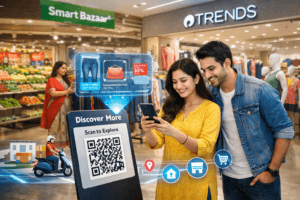
The mechanics, as described by Mall, are elegantly simple: a customer walks into a Trends or Yousta store, scans a QR code, and is instantly granted access to a digital platform that tailors their shopping journey. But the underlying strategy is profoundly complex.
- Bridging the “Discovery Gap”:The greatest advantage of an e-commerce platform like Amazon is its ability tofacilitate discovery. A customer looking for a pair of jeans can be shown matching shirts, accessories, or alternative styles based on their browsing history, purchase patterns, and the behavior of millions of other shoppers. In a physical store, this “discovery” is limited by the physical arrangement of products and the bandwidth of the sales staff.
This new platform aims to bridge that gap. By scanning a QR code, the customer’s phone becomes a smart shopping companion. It can surface products that are in stock but perhaps tucked away on a high shelf or in a back aisle. It can recommend complementary items, creating a “bought together” basket that feels intuitive rather than pushy. It turns a routine trip for a pair of trousers into a curated style session.
- The DataSymbiosis: Online Intelligence for Offline Spaces: For years, the holy grail of retail has been the unification of customer data. In the pre-digital era, a store manager knew his regular customers by name and preference. That intimacy was lost in the age of scale. Today, JioMart, Reliance’s online grocery arm, has a wealth of data on what customers buy, when they buy it, and what they search for but don’t find.
The new platform allows Reliance to apply that digital intelligence to its physical shelves. If the data shows that a customer frequently buys organic snacks via JioMart, scanning a QR code at Smart Bazaar could immediately highlight new organic arrivals or provide a digital coupon for that section. The platform becomes the connective tissue between the online profile and the in-person experience, making the physical store feel as personalized as a mobile app.
- Empowering the “Omnichannel” Inventory:One of the most frustrating experiences for a modern shopper is the “online vs. offline” inventory gap—seeing a product available online only to findit’s out of stock at the local store. This platform could be the key to unlocking a truly unified inventory. By linking the digital discovery tool to real-time stock keeping units (SKUs), the customer knows exactly what’s available before they even ask a store associate. If their size isn’t available, the platform could guide them to a nearby Reliance store that has it, or place an order for home delivery on the spot, turning a potential lost sale into a seamless fulfillment transaction.
The Strategic Masterstroke: Reinforcing the Fortress
While the consumer-facing benefits are clear, the strategic implications for Reliance Retail are even more profound. This initiative is a multi-pronged assault on the very problems that plague large-format physical retail.
- Defending Against Quick Commerce:Quick commerce wins on speed, but itloses on experience. You cannot “discover” a new brand of artisanal pasta on a quick-commerce app as organically as you can while walking down an aisle. By making the in-store experience more interactive and personalized, Reliance is doubling down on the experiential value that quick commerce cannot replicate. It’s encouraging the “slow shopping” trip—the weekend family outing—by making it more rewarding and efficient.
- The “Phygital” Lock-In:The platform creates a stickier ecosystem. The more a customer uses the QR code, the more data Reliance gathers, and the better thesubsequent personalization becomes. This creates a powerful feedback loop. A customer who has built a rich preference profile on the Reliance ecosystem—across JioMart, Trends, and Smart Bazaar—is far less likely to defect to a competitor. They are investing their data in exchange for a superior experience, a trade-off that builds long-term loyalty.
- A Training Ground for AI:Mall’s mention of “products tailored to their preferences” is the quiet engine driving this entire operation. Every scan, every search, every click within the platform feeds the machine. It teaches Reliance’s algorithms about the nuanced preferences of the Indian consumer across different regions, income groups, and cultural contexts. This data is not just valuable for suggesting a shirt;it’s invaluable for predicting fashion trends, optimizing supply chains, and deciding which products to stock in which stores. It turns Reliance Retail into a learning organization, with its 19,000+ stores acting as sensors in the real world.
The Human Element: Why the Sales Associate Still Matters
In an era obsessed with automation, it’s worth noting what this platform is not. It’s not a replacement for the human touch. In fact, a well-designed discovery tool could be the best friend a sales associate ever had.
Currently, a store associate in a busy apparel outlet might have minutes to understand a customer’s needs. With this platform, the customer can self-serve their discovery, arriving at the trial room with a curated selection. The associate can then step in at the moment of highest value—providing fit advice, offering a styling opinion, or handling the final transaction—rather than spending their time acting as a human search engine. It augments the staff, elevating their role from information provider to experience enhancer.
The Road Ahead: From Smart Bazaar to Smarter Retail
The pilot at Trends and Yousta is a calculated, low-risk entry point. Apparel is a high-involvement, discovery-driven category, perfect for testing such a tool. The true test, however, will come with its rollout at Smart Bazaar later this year.
Grocery retail is a different beast. It’s high-frequency, often utilitarian, and driven by habit. Can a discovery platform convince a customer to try a new brand of rice or a different type of lentil? Can it make the chore of weekly shopping feel less like a chore and more like an exploration? If Reliance can crack the code in groceries, they will have built a moat that quick-commerce players, with their limited selection and focus on speed, will find very hard to cross.
The platform is also a signal to the market and to investors. It says that Reliance Retail is not content to be a passive giant, content to let its scale do the talking. It is investing in the intangible but critical assets of the 21st century: data, personalization, and user experience.
Conclusion: A Preview of Retail’s Future
India’s retail sector is often described as a battlefield, with legacy players and digital insurgents locked in a fight for the consumer’s wallet. But the Reliance Retail pilot suggests a more nuanced future. It is not a battle between online and offline, but a merger of the two.
This search-and-discovery platform is a bet on the enduring power of physical retail, but a physical retail that has been fundamentally reimagined for the digital age. It’s an acknowledgment that a store is no longer just a place to buy things; it is a media channel, a data center, and a discovery hub.
As the QR code becomes as common in a Reliance store as the shopping cart, the company is quietly engineering a future where the most valuable real estate isn’t just the shelf space, but the connection between the store and the smartphone in the customer’s hand. For the 349 million customers who already walk through its doors, the shopping experience is about to get a lot more personal. And for its competitors, the message is clear: the giant is not just awake; it’s learning, adapting, and building the next-generation mall, one scan at a time.
You must be logged in to post a comment.