
Beyond the Checklist: How Technology and Stricter Compliance Are Redefining Bank Branch Audits
The feature article expands on the ICAI Bengaluru seminar, emphasizing the transformative shift in bank branch auditing from routine compliance to a technology-driven, risk-focused discipline. Experts highlighted the need for “Smart Audits” using data analytics and AI to enhance Long Form Audit Reports, the critical importance of precise income recognition and asset classification under RBI norms, and the practical challenges of documentation and fieldwork. The overarching message is that modern auditors must evolve into tech-savvy gatekeepers of financial stability, balancing rigorous regulatory adherence with proactive risk assessment to safeguard the banking sector.
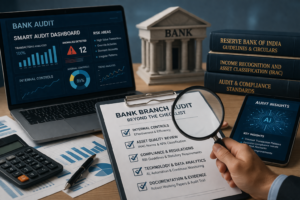
Beyond the Checklist: How Technology and Stricter Compliance Are Redefining Bank Branch Audits
The days of the bank auditor merely ticking boxes and verifying cash balances are fading fast. In a landmark seminar held in Bengaluru, industry leaders and accounting experts made it clear that the future of bank branch audits lies at the intersection of cutting-edge technology, forensic scrutiny, and an unwavering commitment to regulatory compliance.
Bengaluru, often hailed as India’s financial technology capital, recently played host to a pivotal gathering of the country’s auditing minds. The Bengaluru Branch of the Institute of Chartered Accountants of India (ICAI), under the aegis of the Southern India Regional Council (SIRC), organized a comprehensive One-Day Seminar on Bank Branch Audit. Held at The Chancery Pavilion, the event was more than just a routine knowledge-sharing session; it served as a critical recalibration point for Chartered Accountants (CAs) navigating the increasingly complex landscape of banking finance.
With the banking sector acting as the circulatory system of the Indian economy, the accuracy and integrity of bank audits have never been more critical. The seminar underscored a paradigm shift: the auditor is no longer just a compliance officer but a frontline guardian of financial stability.
The Evolving Mandate: From Number-Cruncher to Gatekeeper
The seminar commenced with an inaugural session that set the tone for the day’s deep dive. The Chief Guest, Joohi Smita Sinha, Chief General Manager (CGM) at the State Bank of India (SBI), delivered a keynote that resonated throughout the corridors of The Chancery Pavilion. Addressing a room filled with practitioners, she emphasized that the role of auditors is undergoing a rapid evolution.
Ms. Sinha highlighted that in an era where banking frauds can destabilize institutions and non-performing assets (NPAs) can hinder economic growth, the auditor’s lens must be sharper than ever. She stressed that true financial discipline is not just about identifying discrepancies post-facto but about embedding a culture of transparency and proactive risk assessment. Her message was clear: the banking sector relies on auditors to be the sentinels who spot the subtle cracks before they become structural failures.
This sentiment was echoed by the local branch leadership, including CA Kavitha Paramesh, Chairperson, and CA Shripad Hulgol Narayan, Secretary of the ICAI Bengaluru Branch. They reiterated that continuous learning is non-negotiable in a profession where regulations are updated almost quarterly and the volume of data to be scrutinized doubles every few years.
The “Smart” Audit: Integrating Technology and Controls
The first technical session, led by CA Vijay Srinivas Kothapalli, tackled the buzzword that dominated the seminar: the “Smart Branch Audit.” Moving away from traditional manual sampling methods, Kothapalli introduced participants to a framework where technology, controls, and assurance converge.
In the context of a bank branch, “smart” auditing involves leveraging data analytics to test 100% of transactions rather than a select sample. It means using automated tools to reconcile ledgers in real-time and employing Artificial Intelligence (AI) to flag anomalies in transaction patterns that a human eye might miss.
Kothapalli’s session focused heavily on the Long Form Audit Report (LFAR) , a critical document that goes beyond the standard balance sheet verification. LFAR requires auditors to comment on the internal controls, operational efficiencies, and systemic weaknesses of a branch. In a “Smart Audit” scenario, technology assists in populating these reports with empirical data, allowing the auditor to focus more on qualitative analysis—such as why a control failed—rather than spending weeks manually gathering evidence of the failure.
The discussion highlighted that for CAs, adapting to this new reality requires a dual skill set: deep accounting knowledge coupled with a working understanding of Core Banking Solutions (CBS) and data interrogation tools. The era of the auditor who fears technology is ending; the era of the tech-savvy auditor is here.
Navigating the Minefield: Asset Classification and Income Recognition
One of the most legally and financially sensitive areas of bank audit revolves around Income Recognition and Asset Classification (IRAC) . This was the focus of a session led by CA Sundararajan, who provided a masterclass in navigating the prudential norms set by the Reserve Bank of India (RBI).
For a bank, correctly classifying an asset as a Standard, Sub-standard, Doubtful, or Loss asset determines its profitability, provisioning requirements, and overall health. Misclassification can lead to catastrophic consequences, including the underreporting of NPAs and the inflation of profits.
CA Sundararajan delved into the complexities of recent RBI circulars, emphasizing that auditors must exercise professional skepticism. He guided participants through the nuances of identifying incipient stress in borrower accounts, long before they slip into the NPA category. The session covered the critical aspect of “evergreening” of loans—a practice where fresh loans are given to defaulting borrowers to ensure the old loans don’t turn into NPAs—and how auditors can spot such irregularities through cash flow analysis and scrutiny of end-use of funds.
The takeaway was stark: in the current regulatory environment, ignorance is not a defense. An auditor’s judgment on asset classification can have a direct impact on a bank’s stock price and its credibility with the public. Therefore, precision, backed by meticulous documentation, is paramount.
Bridging Theory and Practice: The Nuts and Bolts of Execution
While high-level concepts and regulations are essential, the true value of a seminar often lies in the practical, “in-the-trenches” wisdom shared by veterans. CA Niranjan Vijay Joshi delivered what many attendees described as the most actionable session of the day: Practical Aspects of Bank Audit.
Joshi stripped away the theoretical layers to focus on the reality of the audit cycle. He covered the critical importance of planning—specifically, the need for auditors to understand the branch’s profile, the nature of its clientele, and the volume of priority sector lending before stepping onto the premises.
His session placed a heavy emphasis on documentation. In an age of regulatory inspections and peer reviews, audit quality is often measured by the robustness of the working papers. Joshi advised on best practices for maintaining audit evidence, ensuring that for every judgment call made, there is a trail of documentation to support it.
Furthermore, he addressed the logistical challenges of a bank branch audit—the tight deadlines, the pressure from branch management, and the coordination required to verify physical cash, securities, and stationary. He provided a roadmap for managing these pressures while maintaining the independence and integrity required by the Chartered Accountancy profession.
The Bigger Picture: A Profession at the Crossroads
The seminar concluded with interactive discussions that revealed a community eager to adapt but also seeking clarity in a fast-changing world. The integration of technology, while empowering, brings challenges such as data privacy concerns and the high cost of advanced audit software. Similarly, while stricter compliance raises the bar for quality, it also increases the litigation risk for auditors.
Events like this seminar serve a dual purpose. On one hand, they equip members with the technical knowledge required to handle complex audits. On the other, they foster a sense of community and ethical grounding. As the banking sector undergoes digital transformation—with the rise of fintech, neo-banks, and digital lending—the foundational role of the auditor remains constant: to provide assurance.
For the participants—the Chartered Accountants of Bengaluru—the message was clear. To survive and thrive, they must evolve from being historians who report on what happened last year to being diagnosticians who assess the current health of the bank and forecast future risks.
By successfully hosting this seminar, the ICAI Bengaluru Branch has reinforced its commitment to professional excellence. It has provided a blueprint for how the profession can remain relevant, ensuring that as the banking sector evolves, the guardians of its financial integrity evolve right along with it.
You must be logged in to post a comment.