
Beyond the Certificate: How 1,000 UP Students Just Got a Blueprint for the AI Economy
In a significant push for digital employability, Samsung India certified 1,000 students in Artificial Intelligence, Coding, and Internet of Things under its Samsung Innovation Campus (SIC) program at Khwaja Moinuddin Chishti Language University, an event attended by Uttar Pradesh’s Higher Education Minister Shri Yogendra Upadhyaya. With this milestone, the total number of SIC-certified students in the state reaches 4,900, underscoring Uttar Pradesh’s emergence as a key hub for future-tech skilling. The cohort—drawn from three institutions including Government Girls’ Polytechnic and Dr. Ambedkar Institute of Technology for Divyangjan—received training that blends technical expertise with soft skills and placement support, reflecting a growing public-private partnership aimed at bridging the employability gap. The program, which targets 20,000 youth nationally and has maintained nearly 45% women participation, is part of Samsung’s broader ecosystem of initiatives designed to ensure India’s young talent not only enters but actively shapes the global digital economy.
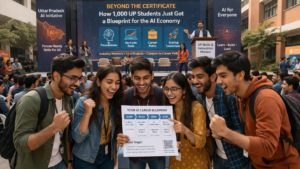
Beyond the Certificate: How 1,000 UP Students Just Got a Blueprint for the AI Economy
Lead: The future of work isn’t coming; it’s already here, and for 1,000 students in Uttar Pradesh, it just became a lot less intimidating.
Lucknow, March 24, 2026 – There is a specific sound that fills a university auditorium when 1,000 young people realize they are no longer just students, but certified professionals. It’s a blend of quiet pride, nervous excitement, and the rustle of paper as credentials change hands. At the Khwaja Moinuddin Chishti Language University today, that sound marked a significant milestone for the state’s ambitions in the technology sector.
In the presence of Shri Yogendra Upadhyaya, Uttar Pradesh’s Minister of Higher Education, Samsung India certified a new cohort of 1,000 students under its flagship Samsung Innovation Campus (SIC) program. This wasn’t just another graduation ceremony; it was a snapshot of a carefully orchestrated effort to bridge the widening gap between academic theory and the relentless demands of the global job market.
With this latest batch, the total number of SIC-certified students in Uttar Pradesh has surged to 4,900, positioning the state as a critical hub for Samsung’s national skilling initiative. The program, which has been running in India since 2022, is rapidly moving from a corporate social responsibility initiative to a crucial pillar of the state’s employment strategy.
A Curriculum Built for the Present
The 1,000 students who walked across the stage—or rather, had their certifications conferred virtually and in person—came from three distinct institutions: Khwaja Moinuddin Chishti Language University, Government Girls’ Polytechnic, and Dr. Ambedkar Institute of Technology for Divyangjan. Their training was not a generic overview of technology. It was a specialized deep dive into three disciplines that are currently reshaping industries:
- Artificial Intelligence (AI): 600 students were trained in AI, learning not just the theory of machine learning, but how to apply it to solve real-world problems.
- Coding & Programming: 300 students honed their skills in the language of the digital age.
- Internet of Things (IoT): 100 students learned how to connect the physical world to the digital one.
What makes this program different from a traditional university course is its pragmatism. Samsung Innovation Campus is designed to do more than just impart technical knowledge. It integrates “soft skills development and structured placement support” into its core curriculum. This is the part that employers often lament is missing from fresh graduates—the ability to communicate, collaborate, and navigate a professional environment.
“Universities today cannot afford to be spectators as the world of work is being restructured around automation and digital intelligence,” said Shri Yogendra Upadhyaya, addressing the gathering. His words struck a chord with the audience of deans, professors, and young graduates. He emphasized that the partnership with Samsung is a direct response to a new reality: employers are no longer just seeking degrees; they are demanding applied capabilities.
The Minister’s Vision and the Corporate Bridge
Shri Upadhyaya’s presence at the event was significant. In many states, higher education and industrial skilling operate in silos. But here, the government is signaling a shift. By endorsing a corporate-led skilling program, the Minister is acknowledging that the state’s expansive young population needs alternative pathways to employment beyond the traditional lecture hall.
For Samsung, the program is about building a talent pipeline that serves the broader ecosystem, not just its own hiring needs. Shubham Mukherjee, Head of CSR & Corporate Communications at Samsung Southwest Asia, articulated the long-term vision: “India’s economic ambitions in the technology sector will ultimately be defined by how many young people are equipped with the right skills at the right time. These students from Samsung Innovation Campus represent a clear commitment to ensuring that Uttar Pradesh’s young talent participates in, and shapes, the global digital economy.”
This is a crucial point. It’s one thing to train someone for a job; it’s another to train them to “shape” an economy. The curriculum at SIC is designed to foster a sense of agency. By focusing on emerging tech like AI and IoT, Samsung is betting that these students won’t just be consumers of technology, but builders of it.
Inclusivity as a Cornerstone
One of the most compelling aspects of the Samsung Innovation Campus is its demographic makeup. Nationally, the program has recorded around 45% women participation. This isn’t an accident. By partnering with institutions like Government Girls’ Polytechnic and the Dr. Ambedkar Institute of Technology for Divyangjan (a dedicated institute for persons with disabilities), Samsung is actively ensuring that the tech revolution in India is inclusive.
In a country where the tech sector has historically faced challenges with gender diversity and accessibility, this approach is deliberate. It sends a clear message that future-tech skills are not the preserve of a privileged few, but a right for all talented individuals, regardless of gender or physical ability.
What’s Next?
This certification is not the finish line; it’s the starting block. With structured placement support integrated into the program, these 1,000 students are now entering a pipeline that connects them directly to potential employers. They join a national cohort that Samsung aims to expand to 20,000 youth across the country.
For the students of Khwaja Moinuddin Chishti Language University, Government Girls’ Polytechnic, and Dr. Ambedkar Institute of Technology, today’s certificate is a passport. It is proof that they can speak the language of the future—AI, code, and connectivity. As the global economy pivots further toward automation and digital intelligence, Uttar Pradesh is betting that its youth won’t just be ready for the future; they will be the ones building it.
You must be logged in to post a comment.