
Beyond the Ceasefire: Why Japan’s Recognition of Palestine is the Next Crucial Test for Lasting Peace
In an exclusive interview following the Gaza ceasefire, Palestinian Authority President Mahmoud Abbas urgently called on Japan to recognize Palestinian statehood, framing it not as an antagonistic move against Israel but as a critical step for Middle East peace and a strategic necessity to bolster the legitimacy of the Palestinian Authority in the impending postwar order. He emphasized that any U.S.-led reconstruction efforts or security mechanisms, like the new Civil-Military Coordination Center, must not sideline the PA, warning that bypassing the sovereign Palestinian government would undermine Gaza’s long-term stability. Abbas also outlined a path for Hamas to transition into a purely political entity under PA rule while condemning ongoing West Bank settlement violence, ultimately positioning Japan’s diplomatic choice as pivotal in determining whether the peace process leads to a sustainable two-state solution or a fragmented, unstable interim arrangement.
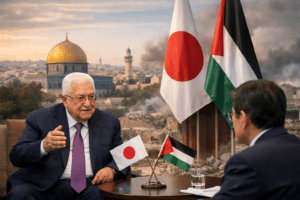
Beyond the Ceasefire: Why Japan’s Recognition of Palestine is the Next Crucial Test for Lasting Peace
The dust in Gaza has not settled. While a fragile truce has halted the most intense fighting, the landscape—both physical and political—remains one of devastation and deep uncertainty. In this precarious moment, a non-traditional player is being called to center stage: Japan.
In his first exclusive interview with international media since the October ceasefire, Palestinian Authority (PA) President Mahmoud Abbas, 90, presented a clear and urgent appeal to Tokyo: recognize the State of Palestine. Speaking from Ramallah, Abbas framed this not as a hostile act towards Israel, but as a necessary step for “peace in the Middle East.” This call transcends diplomatic protocol; it is a strategic gambit aimed at reshaping the foundations of the impending, and fraught, peace process led by the United States.
The Stakes: More Than a Symbolic Gesture
Japan’s potential recognition carries weight precisely because of what Japan is not. It is not a former colonial power in the region, nor is it blindly aligned in the polarized U.S.-Israel axis. Japan is a global economic powerhouse with a legacy of pacifism and developmental aid. Its recognition would signal a profound shift within the Group of Seven (G7) industrialized nations.
When Britain, Canada, and France recognized Palestine in September 2025, they cracked a diplomatic dam. For Japan, a nation whose foreign policy is often characterized by cautious consensus, to follow suit would represent a flood. It would legitimize the two-state solution not as a distant ideal, but as an immediate political reality, placing immense pressure on holdouts like the United States and Germany. Abbas’s plea is an attempt to leverage Japan’s unique moral and economic capital to anchor the peace process in a principle that much of the world already accepts: Palestinian sovereignty.
The Gaza Reconstruction Power Struggle
Beneath the statehood appeal lies a more immediate battle: who will control Gaza’s rebirth? The ceasefire has unveiled not one, but competing visions for the territory’s future.
The U.S.-led plan involves a “Board of Peace” and an “International Stabilization Force.” Parallel to this, the Civil-Military Coordination Center (CMCC) in southern Israel coordinates aid from 50 nations—noticeably excluding the Palestinian Authority. To Abbas, this architecture risks sidelining the PA, rendering it irrelevant in its own territory.
“Any reconstruction or coordination mechanism must complement the role of the Palestinian Authority, not replace it,” Abbas asserted. His warning is stark: bypassing the PA “undermines stability and weakens prospects for long-term success.” This is the core insight. Reconstruction is not merely an engineering challenge; it is a political one. Pouring billions into Gaza through channels that circumvent the Palestinians’ own governing body creates a vacuum—one that history shows extremist groups can fill. Japan, expected to send personnel to the CMCC, now faces a dilemma: participate in a U.S.-led mechanism that marginalizes the PA, or use its involvement to advocate for the Authority’s central role.
The “One Authority” Principle and the Hamas Conundrum
Abbas was unequivocal in insisting on the principle of “one authority, one law, and one legitimate weapon.” This is a direct challenge to Hamas’s rule in Gaza and its armed wing. He labeled the disarmament of Hamas and the end of its rule as “an essential part” of the peace plan’s second phase.
However, he left a nuanced opening, stating that “the door remains open for Palestinian factions to participate in political and democratic life, provided they transform into political parties.” This is a critical distinction. It suggests a potential path where Hamas, the entity that sparked the war, could have a political future, but only by disarming and submitting to the PA’s sovereignty and the rule of law. It’s a tall order, but it outlines the only plausible endpoint for sustainable internal Palestinian unity: the subjugation of militias to a single, civil state authority.
The West Bank: The Forgotten Front
While the world’s gaze is fixed on Gaza, Abbas urgently highlighted the crisis simmering in the West Bank. Since October 2023, intensified Israeli military operations and a surge in settler violence have created an atmosphere of pervasive fear and fragmentation. Abbas condemned these actions as “a deliberate undermining of the two-state solution.”
This point underscores a vital, often missed, insight: peace cannot be compartmentalized. A Gaza solution built while the West Bank burns is doomed. Settlement expansion and violence erode the very territory and trust upon which a future Palestinian state would be built. Japan’s foreign policy, which heavily emphasizes the rule of law and peaceful conflict resolution, is uniquely positioned to address this “forgotten front” with a consistency that other major powers often lack.
Japan’s Pivotal Choice
As Japanese Foreign Minister Toshimitsu Motegi prepares for a January visit to the region, his government’s choices will resonate far beyond bilateral relations.
Recognizing Palestine would be a bold assertion of Japan’s independent diplomatic vision. It would align Tokyo with the majority of the international community and strengthen its hand as an honest broker committed to a rules-based order. Conversely, hesitation could be seen as acquiescence to a U.S.-led process that many Palestinians and Arab states view with deep suspicion.
Abbas’s message to Japan is ultimately about legacy. He is not just asking for a diplomatic stamp. He is asking Japan to invest its considerable prestige in the type of peace that follows. Will it be a peace imposed through temporary security arrangements that neglect political sovereignty, or one built on the recognition of fundamental rights and the central role of a reformed, legitimate Palestinian government?
The reconstruction of Gaza is imminent. The question is what will be rebuilt alongside the homes and hospitals: the same unstable foundations of conflict, or the cornerstones of a sovereign state? Japan’s answer will help decide.
You must be logged in to post a comment.