
Beyond the Ceasefire Count: The Human Toll of the Jabalia and Khan Younis Drone Strikes
Two Palestinians, identified as Majed Abul-Awf in Jabalia refugee camp and 46-year-old Osama an-Najjar in Qizan al-Najjar near Khan Younis, were killed in separate Israeli drone strikes on Saturday, raising the death toll since the October 11 ceasefire to 614. These targeted killings, which also wounded four others, highlight the fragile and violent nature of the truce, as residents continue to live under the constant threat of drones amidst a devastating humanitarian crisis marked by widespread displacement, agricultural collapse, and overwhelmed hospitals struggling to function.
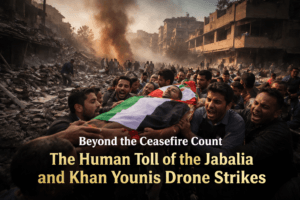
Beyond the Ceasefire Count: The Human Toll of the Jabalia and Khan Younis Drone Strikes
GAZA CITY — The word “ceasefire” implies an end to hostility, a quieting of the guns. But for the residents of Jabalia refugee camp in the north and the Bedouin community of Qizan al-Najjar south of Khan Younis, Saturday, February 21, 2026, was not a day of peace. It was a day of fire from the sky, of sudden death, and of a grief that has become tragically familiar in the Gaza Strip .
According to medical sources and the official Palestinian news agency (WAFA), two Palestinian men were killed in separate Israeli drone strikes on Saturday afternoon. One strike targeted a location in Jabalia, while the other hit the Qizan al-Najjar area . With these deaths, the grim mathematics of the post-October 11 ceasefire period updated once more: 614 Palestinians killed, 1,640 wounded, and 726 bodies pulled from the rubble of previous bombardments . But behind these numbers lie individual stories, shattered families, and a community living under the constant hum of drones, wondering if this is what “calm” sounds like.
This report delves deeper than the headline, using eyewitness accounts and humanitarian data to paint a picture of life and death in Gaza’s “ceasefire.”
The Victims: Beyond the Statistics
While initial reports from WAFA listed the deaths as two unidentified Palestinians, subsequent reporting from the ground has begun to put names and ages to the statistics. These details transform abstract numbers into human beings with pasts, professions, and families who now mourn them.
In the southern strike at Qizan al-Najjar, the victim was identified as Osama an-Najjar, 46 . The name “an-Najjar” is common in this area, a testament to the familial and tribal nature of this region. Qizan al-Najjar is not a city or a formal refugee camp, but an agricultural area east of Khan Younis, home to families who have lived off the land for generations. It is also an area that has seen repeated incursions and shelling throughout the conflict, its proximity to the border making it a volatile frontier. For Osama an-Najjar, a middle-aged man, Saturday was just another day until an Israeli drone strike ended his life.
In the north, the drone strike in Jabalia refugee camp killed Majed Abul-Awf, described as a “young man” . Jabalia is the largest refugee camp in Palestine, a dense warren of concrete buildings and narrow alleys that has become a byword for suffering in this war. It has been the target of numerous Israeli ground operations and airstrikes. To be killed by a drone in Jabalia is to be killed in a place that has already seen so much death.
The strikes also left a wake of injury. In addition to the two fatalities, four others were wounded in Saturday’s attacks . Among them was a young woman who sustained a neck injury after being shot by Israeli forces near the Holy Family Church east of Gaza City, a rare incident in an area that is usually considered a relative safe haven . Three additional civilians were wounded by gunfire in the ash-Shuja’iya neighborhood, a historic district east of Gaza City that has been a flashpoint in past conflicts .
A Ceasefire Under Constant Pressure
The deaths of Osama an-Najjar and Majed Abul-Awf did not happen in a vacuum. They are part of a pattern of near-daily violence that has characterized the ceasefire since it was brokered in October 2025 . To understand the environment in which they lived and died, one must look at the preceding days.
Just a week prior, on February 14, Gaza’s Civil Defence reported that at least 11 Palestinians were killed in Israeli airstrikes across the enclave. Among those killed was Sami al-Dahdouh, a member of the Islamic Jihad movement, who was struck by a drone in the Tel al-Hawa neighborhood of Gaza City . On that same day, three people were seriously wounded in a separate drone strike west of Beit Lahia in the north. Perhaps most tragically, 10 people were killed in two airstrikes that hit a tent sheltering displaced people in Jabalia and a gathering in Khan Younis .
The Israeli military has described such actions as responses to “violations” of the truce, stating that troops had identified “armed terrorists” emerging from underground infrastructure or engaging in hostile activities . Hamas, in turn, has accused Israel of committing “massacres” in a “serious breach” of the agreement .
This cycle of violation and counter-violation creates an atmosphere of profound uncertainty for civilians. The first day of Ramadan, a holy month meant for reflection and peace, was marred by violence this year. On February 18, Israeli forces killed a Palestinian man in Khan Younis, and witnesses described heavy fire from Israeli military vehicles. In a separate incident on the same day, 14-year-old Muhanned al-Najjar was killed by Israeli fire in east of Khan Younis, his funeral procession a stark image of grief during what should have been a celebratory time .
For the people of Gaza, the ceasefire has not meant a return to normal life. It has meant a shift from full-scale war to a low-intensity conflict where death comes not from massive 2,000-pound bombs leveling entire apartment blocks, but from the precision strike of a drone or a sniper’s bullet. It is a slower, more insidious form of attrition.
Life Among the Rubble: The Humanitarian Catastrophe
The ongoing strikes and military activity are not happening in a vacuum. They are taking place against the backdrop of a humanitarian disaster of epic proportions. The United Nations Office for the Coordination of Humanitarian Affairs (OCHA) reported that between 11 and 19 February alone, airstrikes, shelling, and gunfire resulted in 20 Palestinian deaths and 52 injuries, contributing to the mounting total .
The physical landscape of Gaza is unrecognizable. The UN’s Food and Agriculture Organization (FAO) has painted a dire picture of the agricultural sector: livestock survival rates have plummeted, with only 33% of goats, 20% of sheep, and a mere 11% of poultry remaining. Furthermore, only 37% of cropland is currently accessible, and just 4% is both accessible and undamaged enough to be immediately cultivable . This means that even if the guns fall silent forever, the threat of famine will persist for years.
Displacement remains a central feature of life. Between 1 and 14 February, the Site Management Cluster recorded approximately 6,450 population movements within the Gaza Strip. Since the ceasefire, nearly 833,000 movements have been observed, with over 694,000 being returns from the south to the north . Families are returning to find their homes reduced to rubble, forcing them to live in the shadow of their former lives. The UN estimates that at least two-thirds of the population—1.4 million people—are living in about 1,000 displacement sites, crowded into makeshift tents that offer little protection from the winter cold or the summer heat .
These overcrowded camps are tinderboxes—literally. Since November 2025, at least 12 fires have been recorded in displacement sites, caused by accidents during cooking or faulty wiring. Shelters, 80% of which are makeshift, are packed closely together, leaving no space for safety. Families of six often live in a single 20-square-meter tent where cooking, sleeping, and storage all occur in the same confined area. When a fire breaks out, civil defense teams, lacking equipment and facing congested pathways, struggle to respond .
The Ramadan That Wasn’t
As the Muslim holy month of Ramadan began in mid-February, the contrast between tradition and reality was stark. In the historic Zawiya market in Gaza City, shopkeepers put out lanterns and decorations, but many families passed by without buying. “The price of this lantern used to be 30 shekels, but now it has reached 60 shekels,” explained Luay Al-Jamasi, a shop owner. “The price has doubled because of the lack of goods entering the country” .
For the displaced, like Walid Al-Assi, who lives with his family in a tent next to the rubble of their Gaza City home, the holy month is a reminder of loss. “Everything has changed now,” he told UN News. “We have been deprived of all these things. Today, I see goods in stores, and I turn my face away from them because I do not have the money to buy them” .
Amal Al-Samri, another displaced woman, tried to create a festive atmosphere in her tent for her three children, dressing them in clothes that looked new. But she struggles to hide the reality. “Today, there is nothing,” she said. “We are living in a tragedy. There is no electricity or water. We were displaced from our homes from one place to another, and in one place, the sea water flooded us and swept away our tents” .
It is into this world of tents and tragedy that the drones came on Saturday. In Jabalia and Khan Younis, they found men who were likely just trying to survive another day of a “ceasefire”—perhaps fetching water, checking on a relative, or simply standing in the wrong place at the wrong time.
The International Response and the Road Ahead
The international community’s focus has largely shifted away from Gaza since the ceasefire was announced. The UN and its partners continue to work, but they are hamstrung. Between 12 and 19 February, the United Nations coordinated 67 humanitarian missions with Israeli authorities. Of these, nine (13%) were denied outright, and another nine (13%) were approved but faced impediments such as long delays .
Medical evacuations, a lifeline for the critically ill, have resumed through the Rafah Crossing, but the process is slow and fraught with difficulty. Between 11 and 18 February, WHO supported the evacuation of 118 patients, but the access road is in disrepair, and facilities at the crossing lack basic amenities . For the vast majority of the wounded, including those injured in Saturday’s strikes, the best available care is in overwhelmed hospitals running on minimal supplies.
As of February 18, only 252 of 611 health service points were functioning across the Strip, and most of those were only partially operational . Nasser Hospital in Khan Younis and Al-Shifa Hospital in Gaza City, which received the bodies of Saturday’s victims, are shadows of their former selves, struggling to treat trauma cases with dwindling supplies of medicine and fuel .
The killing of Osama an-Najjar and Majed Abul-Awf brings the total death toll since the war began on October 7, 2023, to 72,070 . It is a number so large it is almost incomprehensible. It represents more than 3% of Gaza’s pre-war population. It represents entire families wiped from the civil registry.
For the family of the young woman shot near the Holy Family Church, for the three wounded in Shuja’iya, and for the countless others who flinched at the sound of the drone on Saturday, the ceasefire is a legal term, not a lived reality.
As the sun set over Gaza on Saturday, the people of Jabalia and Qizan al-Najjar buried their dead. In the north, the body of Majed Abul-Awf was carried through the narrow alleys of the camp. In the south, Osama an-Najjar was laid to rest in the sandy soil his family has tended for generations. They became two more names in an ever-growing list, two more faces on makeshift posters, two more voids in a community choked by grief.
The ceasefire, now in its 133rd day, holds officially. But for the people on the ground, it offers little protection. The drones still fly. The guns still fire. And the count of 614—as of Saturday afternoon—is not final. It is just the last number recorded before the next strike .
You must be logged in to post a comment.