
Beyond the Canvas: How the Grand Masters Show 2026 Became a Living Dialogue Between India’s Past and Future
The Grand Masters Show 2026, inaugurated on February 27th at Galleria VSB in Delhi’s Saket district by the House of VSB, masterfully bridged India’s rich artistic heritage with its burgeoning future by displaying works from legendary figures like Raja Ravi Varma, Amrita Sher-Gil, and M.F. Husain alongside the culmination of its Emerging Artist Competition, which awarded financial prizes to ten promising new voices from across the country. Curated by Vandana and Varun Bhargava, the elegantly staged evening attracted a diverse crowd of industrialists, diplomats, and art patrons, who moved through a thoughtfully lit space where the masterpieces were given room to resonate and a striking display of Mercedes-Benz vehicles created a compelling dialogue between artistic expression and precision engineering. Beyond the glamorous preview, the exhibition’s true value lies in its month-long public run until March 31st at the Square One Mall, democratizing access to these cultural treasures and ensuring that the legacy of the grand masters serves as an ongoing inspiration, while the recognition of new talents signals a confident and vibrant future for Indian art.
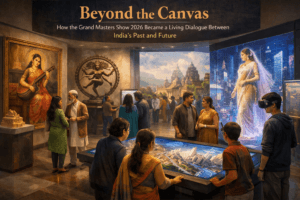
Beyond the Canvas: How the Grand Masters Show 2026 Became a Living Dialogue Between India’s Past and Future
The air in South Delhi often hums with a particular kind of energy—a blend of old money, new ambition, and an insatiable appetite for culture. But on the evening of February 27th, 2026, inside the gleaming, modern contours of the Square One Mall in Saket, that hum was replaced by a reverent hush. It was the sound of people encountering history.
The occasion was the inaugural night of The Grand Masters Show 2026, presented by the House of VSB at their Galleria VSB. While the press release would later crisply note the who’s who of attendees and the impressive roster of artists, what it couldn’t capture was the palpable sense of a continuum. This wasn’t just another exhibition opening; it was a carefully staged conversation between titans and tyros, a moment where the weight of India’s artistic legacy was gently placed into the eager hands of its future.
The Grandeur of Proximity
To walk into Galleria VSB that night was to step into a sanctuary of light and shadow. The curatorial hand of Vandana Bhargava, Founder and Chairperson of House of VSB, was evident in every detail. The lighting was not harsh but soft, almost like candlelight, creating intimate pools around each artwork. There was a deliberate generosity to the space—”breathing room,” as the saying goes—allowing each piece to hold its own court, free from the visual clutter that plagues many group shows.
Here, a luminous Raja Ravi Varma reproduction, with its god-like figures rendered in such mortal, delicate detail, seemed to glow with a quiet divinity. A few steps away, the raw, emotional intensity of an Amrita Sher-Gil work served as a powerful counterpoint, a reminder that Indian modernism was forged not just in tradition, but in profound, personal introspection. The journey continued through the lyrical landscapes of Rabindranath Tagore’s later works, the foundational discipline of Nandalal Bose, and the sculptural dynamism of Ramkinkar Baij.
Then, the viewer would round a corner and be confronted by the raw energy of a Husain, its horses seemingly ready to gallop off the canvas, or the geometric meditation of a Raza, his bindu a silent, powerful anchor for the soul. The savage figuration of F.N. Souza and the metaphysical depths of Akbar Padamsee were not just displayed; they were in dialogue. It was a masterclass in curatorial storytelling, presenting not a linear history lesson but a vibrant, interconnected ecosystem of Indian art.
The guests, a curated mix of industrialists like Purushottam Bhaggeria, journalists like HT’s Shishir Gupta, education entrepreneur Shantanu Prakash, and a smattering of diplomats, moved through this ecosystem with a quiet reverence. They weren’t just there to be seen; they were there to witness. Conversations were hushed, punctuated by the pointing of a finger at a favourite detail, or the quiet click of a photograph being taken—not for social media validation, but as a personal memento of an encounter.
A Fusion of Form and Function
Adding an unexpected, yet strikingly harmonious, element to the evening was the presence of T&T Motors Mercedes-Benz. A sleek, precision-engineered vehicle stood at the venue’s entrance, its metallic sheen catching the soft gallery light. At first glance, the juxtaposition seemed bold: the deeply personal, analogue expression of a master’s hand against the cool, collective perfection of industrial design.
Yet, the connection ran deeper. The organisers had deliberately created a space where “brushstrokes and engineering precision” could be seen as parallel pursuits of human excellence. Both the artist and the engineer start with a vision, a spark of an idea. Both labour over form, function, and detail. The car, like a great painting, is a sculpture of its time, a testament to the human desire to create something beautiful and enduring. The display was a subtle reminder that the patronage of art and the appreciation of fine engineering often spring from the same well of cultural sophistication. It was a dialogue between centuries-old craft and modern craftsmanship, and it worked seamlessly.
The Baton is Passed: The Emerging Artist Awards
While the masters provided the gravitational pull, the true heart of the evening beat to a different, more nascent rhythm. The culmination of the Emerging Artist Competition 2025 was the event’s emotional core. This initiative by Galleria VSB was conceived not as a mere contest, but as a scouting mission, a deep dive into the vast and often uncharted creative territories of India, from its bustling art school classrooms to its remote tribal villages.
For months, submissions had poured in, each canvas, sculpture, and installation a story waiting to be told. The selection process was rigorous, judging not just technical skill but a unique voice, a spark of originality that suggested a future master in the making.
As Vandana Bhargava took to the small podium, the murmur of the crowd settled. She spoke not of sales or prestige, but of a responsibility. She thanked the artists and patrons for supporting the gallery’s vision—a vision that clearly extended beyond commerce to cultivation. It was a vision of nurturing the soil from which the next generation of giants would grow.
When the names were announced, the applause was genuine and warm. The top three winners—awarded Rs 1 lakh, Rs 50,000, and Rs 25,000 respectively—stepped forward, their faces a mixture of disbelief and exhilaration. For them, the money was a crucial enabler, a means to buy more canvas, more pigment, more time. But standing in that room, surrounded by the ghosts of Husain and the grace of Ravi Varma, the real prize was something far more profound: validation. They were being anointed, in a very public way, as the inheritors of a magnificent tradition. The seven other finalists, each receiving Rs 10,000, shared in this moment of collective recognition. They were no longer just students or struggling artists; they were finalists in a show that bore the names of gods.
In that moment, the exhibition’s title, Grand Masters Show, took on a double meaning. It was not just a showcase of the old grand masters, but a prophecy. Standing in the soft light of Galleria VSB, surrounded by discerning collectors and art lovers, one could almost feel the baton being passed. The evening was a powerful testament to the idea that a legacy is not something you simply look back on; it is something you actively build, by seeking out new voices and giving them a platform alongside the pillars of the past.
An Invitation to the City
The single-night preview was a glittering affair for the who’s who of Delhi. But the true democratic spirit of the Grand Masters Show 2026 lies in what follows. The exhibition will remain open to the public until March 31st, 2026, on the third floor of the Square One Mall. In choosing a mall as the venue, the House of VSB has made a profound statement about accessibility. It positions art not in an ivory tower, but in the flow of everyday life.
A family out for a movie can wander in. A group of college students can spend an afternoon wandering from a Souza to a tribal artwork. A young professional on a lunch break can steal a moment of quiet contemplation with a Tagore. This is where the real value of the show lies—in its ability to seed inspiration in the most unexpected places.
The Grand Masters Show 2026 is more than just an exhibition; it is a cultural milestone for Delhi this season. It is an evening of art and elegance that has transformed into a month-long public celebration. It reminds us that the great artists are not relics in a museum, but living presences whose work continues to speak, challenge, and inspire. And more importantly, it assures us that the conversation is far from over. New voices are rising, ready to add their own verses to the grand, unfolding story of Indian art. The invitation is open for everyone to come, listen, and be a part of it.
You must be logged in to post a comment.