
Beyond the Canvas: How Rabindranath Tagore’s Record Sale and David Byrne’s Philosophy Reveal the Enduring Power of the Polymath
The recent record-setting $1.2 million auction of Rabindranath Tagore’s 1937 painting, coupled with David Byrne’s reflections on cross-disciplinary artistry, highlights a compelling modern reassessment of the polymath, where value is increasingly found in authentic, idea-driven work that transcends specialized categories. Tagore’s late-life, untutored canvases—elevated by his poetic legacy and protected as national treasure—signal a market deeply investing in cultural narrative and emotional authenticity, while Byrne’s philosophy of “exploring and sometimes failing” across mediums underscores a creative lineage where innovation flourishes at the borders between disciplines, together reminding us that the most resonant cultural contributions often emerge from minds that synthesize, rather than separate, diverse forms of human expression.
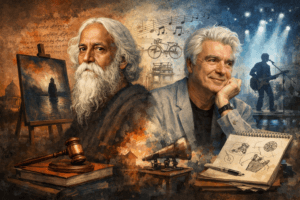
Beyond the Canvas: How Rabindranath Tagore’s Record Sale and David Byrne’s Philosophy Reveal the Enduring Power of the Polymath
In a single week, the art world offered two seemingly disparate narratives: a 1937 painting by Bengali poet Rabindranath Tagore shattered auction estimates, while musician-artist David Byrne mused on the creative freedom of ignoring artistic categories. Separated by nearly a century and discipline, these stories are, in fact, connected threads in a richer tapestry. They speak to a growing market and cultural appetite for work that defies simple classification, reminding us that the most profound human expression often emerges from minds unwilling to be confined.
The Tagore Effect: Late Bloomers and National Treasures
Rabindranath Tagore’s From Across the Dark achieving $1.2 million at AstaGuru is a market event with deep cultural resonance. The sale isn’t merely about a number; it’s a validation of a unique artistic voice that began only in the seventh decade of his life. Tagore, a Nobel laureate in literature, approached the canvas without formal training, which paradoxically became his strength. His dreamlike, often melancholic figures and landscapes, compared to Kandinsky and Klee, emerged from an internal well of poetic and philosophical thought, not academic tradition.
This record underscores several key trends. First, the robust and deepening market for Indian Modernism. Collectors are moving beyond the well-trodden paths of Western modern art, seeking narratives and aesthetics rooted in different cultural and spiritual soil. Tagore’s work offers this in abundance, infused with the ethos of the Bengali Renaissance. Second, it highlights the appeal of the “outsider” perspective—the artist who creates from pure compulsion rather than careerist calculation. His late start adds a layer of authentic, untutored genius that the market finds increasingly compelling.
However, Tagore’s story carries a unique tension: his designation as a National Treasure in 1976 means his works cannot leave India. This creates a fascinating dynamic where his market is both fiercely protected and intrinsically localized. While it may limit global circulation, it also concentrates demand within a powerful domestic collecting base and frames his work not just as art, but as patrimony. The auction result signals that Indian collectors are willing to invest substantially in securing their own cultural legacy, a sign of both economic confidence and national pride.
David Byrne: The Conscious Polymath
Parallel to this, David Byrne’s reflective interview offers a contemporary manifesto for the artistic spirit Tagore embodied. Byrne—musician, writer, visual artist, installation creator—explicitly champions the act of “exploring, and sometimes failing” across disciplines. His journey mirrors Tagore’s in its refusal of categories. He dropped out of art school not out of disillusionment with art, but because he found its siloed structure limiting. Like Tagore, who channeled his poetic vision into visual form, Byrne’s drawings and photographs are “immediate” expressions, parallel to his songwriting process.
Byrne’s insights are crucial for understanding the modern polymath. It’s not mere dilettantism. It’s a coherent philosophy where different mediums become tools to probe the same central questions: human perception, societal oddities, and the joy of discovery. He lists museums of broken relationships, jurassic technology, and folk art as inspirations—spaces that celebrate niche, human-centric stories. This eclectic curiosity is the engine of his creativity.
When Byrne notes that artists he admired, like Warhol or Cocteau, worked across fields, he points to a lineage that Tagore also fits into. These figures teach us that innovation often happens at the borders between disciplines. A poet’s painting carries a narrative weight different from a painter’s. A musician’s visual art often possesses a rhythmic, compositional quality all its own.
The Connecting Thread: Value Beyond Specialization
What links Tagore’s auction triumph and Byrne’s commentary is a shifting definition of artistic value. In a world that increasingly incentivizes hyper-specialization, the market and public sentiment are showing a renewed appreciation for the Renaissance mind.
- Authenticity Over Technique: Both artists prioritize conceptual and emotional authenticity over technical perfection. Tagore’s “distinctive style” emerged from emotional charge, not rigorous draftsmanship. Byrne values the rough sketch that captures an idea’s immediacy. The market’s enthusiastic response to Tagore suggests collectors are seeking this raw, ideational power.
- The Narrative of the Creator: An artwork’s story is inseparable from its maker’s story. Tagore’s identity as a poet and philosopher imbues his paintings with a narrative that amplifies their allure. Byrne’s entire artistic persona—from Talking Heads to public installations—creates a context that makes his drawings more resonant. The work is not viewed in isolation, but as a point in a broader creative constellation.
- Cultural and Intellectual Context: The interest in Tagore’s Modernism isn’t just aesthetic; it’s intellectual. It invites engagement with Indian history, philosophy, and anti-colonial thought. Similarly, Byrne’s work prompts questions about neuroscience, urban design, and human sociology. The art becomes a gateway to bigger ideas, which in an information-rich age, adds profound value.
The Modern Lesson: Cultivating Cross-Pollination
For contemporary artists and cultural observers, the twin tales of Tagore and Byrne offer a vital lesson: silos are stifling. The most dynamic creative and market futures may belong to those who cultivate cross-pollination.
For institutions, this means supporting interdisciplinary programs and exhibitions that break down walls between mediums. For collectors, it means looking beyond an artist’s primary fame—a lesson heeded by the bidders on Tagore’s painting. For the public, it’s an invitation to engage with art more holistically, following an artist’s journey across different forms to better understand their core vision.
Rabindranath Tagore’s record-breaking sale is a posthumous affirmation of a life lived in creative breadth. David Byrne’s reflections provide the active, ongoing dialogue for that same principle. Together, they remind us that the most enduring artifacts of culture often come not from specialists, but from synthesizers—those rare minds that see the world not as a collection of separate categories, but as an interconnected whole waiting to be interpreted through every tool at our disposal. In celebrating them, we don’t just invest in art; we invest in a richer, more capacious way of understanding human creativity itself.
You must be logged in to post a comment.