
Beyond the Canals: The Venice Biennale’s Reckoning with Art, Genocide, and Complicity
The article explores the growing controversy surrounding the 61st Venice Biennale, where nearly 200 participating artists have called for Israel’s exclusion over its actions in Gaza, arguing that the prestigious art event cannot remain politically neutral in the face of alleged human rights violations. Led by the Art Not Genocide Alliance (ANGA), the protest highlights deeper structural issues within the Biennale’s national pavilion system, which reflects global power imbalances—especially Palestine’s lack of official representation. Drawing parallels with past political stances, such as the boycott of apartheid South Africa and solidarity with Chile, critics accuse the Biennale of double standards, particularly in its handling of Russia versus Israel. The piece ultimately frames the situation as a moral crossroads for both the institution and its artists, raising urgent questions about complicity, conscience, and the role of art in times of conflict.
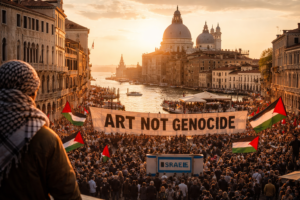
Beyond the Canals: The Venice Biennale’s Reckoning with Art, Genocide, and Complicity
The opening of the Venice Biennale is usually a time of gilded anticipation, a carnival of national pride and artistic ambition set against the dreamlike backdrop of crumbling palazzos and serene canals. But as the 61st International Art Exhibition approaches, a familiar, uncomfortable tension hangs in the lagoon air. It is the sound of nearly 200 of its own participants—the artists, curators, and thinkers who are the lifeblood of the event—saying, “Not with us.”
Their message, delivered in a stark new open letter from the collective Art Not Genocide Alliance (ANGA), is a direct challenge to the Biennale’s leadership: exclude Israel from this year’s program. The demand, signed by a who’s who of upcoming participants including France’s Yto Barrada, Ireland’s Isabel Nolan, and central exhibition artists like Carolina Caycedo and Alfredo Jaar, is not a simple request. It is a moral ultimatum, forcing the world’s most prestigious cultural institution to confront a question it has long tried to sidestep: Can art exist in a vacuum, untouched by the wars and atrocities committed by the nations that sponsor it?
This is not the first time this question has been posed to the Biennale, but it arrives with a new, desperate urgency. The letter is a cry against what its signatories see as “complicity with the attempted destruction of Palestinian life.” It cites the ongoing Israeli military campaign in Gaza, which, despite a fragile ceasefire, continues to claim lives and deepen a humanitarian catastrophe. It points to a recent report in The Lancet estimating over 75,000 violent Palestinian deaths in the first 15 months of the conflict. For the artists who have signed, to walk the same polished floors, to attend the same VIP vernissage, to share the same institutional platform as the representative of a state accused of genocide before the International Court of Justice, is to be “dragged into a position of complicity.”
A Pavilion in Name Only: The Symbolism of Space
The focus of the protest is the Israeli pavilion. But in a move that adds a layer of geographical irony, the permanent Israeli pavilion in the Giardini—the historic heart of the Biennale—is currently under renovation. This year, Israel’s representative, Romanian-born sculptor Belu-Simion Fainaru, will be housed in a temporary space within the Arsenale complex.
For ANGA and its supporters, the temporary nature of the space is irrelevant. The pavilion system, established in 1907, is fundamentally a political one. Nations purchase plots of land and build permanent structures to project cultural soft power. To exhibit in a national pavilion is to be an unofficial cultural ambassador, your work implicitly sanctioned by—and sanctioning—the government that sent you. Palestine has no such pavilion. It never has. It has been relegated to collateral events, its artists applying for space like any other independent collective, a constant, painful reminder of its statelessness.
This structural inequity is the bedrock of the protest. As the ANGA collective argued in a recent opinion piece, the Biennale is “actively ensuring the presence and participation of a state that was founded on the ethnic cleansing and illegal occupation of Palestine.” By hosting Israel while Palestine has no official platform, the argument goes, the Biennale isn’t neutral; it is endorsing a specific political reality.
The Ghosts of Biennales Past: When Art Took a Stand
The artists’ letter invokes the Biennale’s own history to make its case, reminding the institution that it has not always been a neutral arbiter. In 1974, the entire Biennale was transformed into a massive act of solidarity with Chile, following the CIA-backed coup that overthrew Salvador Allende and installed General Pinochet. The exhibition was titled “Freedom to Chile” and became a platform for political protest, a moment when the Biennale explicitly chose a side.
More pertinent is the long exclusion of apartheid South Africa. From 1968 until the fall of the regime in 1993, South Africa was not welcome at the Venice Biennale. It was an international cultural boycott that sent a clear message: the horrors of institutionalized racism were not something to be celebrated or normalized under the guise of art. For ANGA, the parallel is glaring. If the Biennale could take a stand against apartheid for 25 years, why does it balk at taking a stand against a state that multiple leading human rights organizations, including Amnesty International and Human Rights Watch, have designated as practicing apartheid?
This historical precedent is thrown into even sharper relief by the Biennale’s recent, bungled handling of another pariah state: Russia. After being absent in 2022 and 2024 following its full-scale invasion of Ukraine, the Foundation confirmed Russia’s return for the 61st Biennale. The backlash was immediate and severe, threatening EU financial support and creating a political firestorm in Italy. The Foundation eventually had to scramble, but the damage was done. The incident, as ANGA’s press statement notes, “revealed two facts that can no longer be concealed: first, that the Biennale is not a neutral platform but a political space; and second, that it continues to operate through clear double standards.”
Why is one war a reason for exclusion, and another not? Why is Russia’s aggression condemned while Israel’s is, at least in the eyes of the Biennale administration, ignored? This inconsistency is the fuel for the current fire. It suggests that the decisions are not based on principle, but on political convenience and geopolitical pressure, a charge that deeply undermines the Biennale’s moral authority.
The Artist’s Burden: Conscience, Career, and Complicity
For the individual artist, signing such a letter is rarely a simple act. It carries professional risk, potentially alienating collectors, institutions, and even fellow artists. It invites public scrutiny and can overshadow the very art they are being celebrated for.
Colombian artist Carolina Caycedo, known for her stunning, environmentally engaged installations, articulated her reasoning with a quiet clarity. “Signing this letter is the minimum I can do in the face of genocide and ecocide,” she told Hyperallergic. Her words underscore a feeling shared by many signatories: that silence is not an option. For artists like Caycedo, whose work deals with the exploitation of land and communities, the connection between environmental destruction and the erasure of people in Gaza is not a stretch; it is part of the same system of violence. Her piece in the central exhibition, the hanging sculpture Coca Chacana, a beautiful net made of hand-dyed materials, becomes an even more potent symbol when juxtaposed with her political stance—a tool for catching and holding, a metaphor for the fragile web of life that conflict so easily tears.
Matteo Norzi, co-curator of the Peruvian pavilion, turned the question of signing back on those who didn’t. “In light of the horror that has happened, and continues to happen, it is difficult to understand how one could choose not to sign,” he said. His pavilion’s artist, Soi Biri (Sara Flores), a Shipibo-Konibo artist whose work is deeply rooted in ancestral tradition and the patterns of the natural world, also signed. Her participation in the protest is a reminder that this is not just a conflict between Western liberal values; it is a global Indigenous call for justice, a refusal to let culture be a veneer for violence.
And then there are the 2,000 signatories of ANGA’s 2024 petition who had participated in previous Biennales. These are not outsiders; they are the institution’s own alumni, its former stars. Their collective voice is a haunting reminder that the Biennale’s legacy is now tied to the companies it keeps.
The Uncomfortable Silence of the Administration
The Biennale Foundation, led by President Pietrangelo Buttafuoco and artistic director Adriano Pedrosa, has thus far remained silent on the new letter. Their position, as stated in 2024, is that any nation recognized by the Italian Republic is welcome to participate. It is a legalistic defense, a retreat behind the letter of the law to avoid the messy, complicated demands of justice. It is a strategy of procedural neutrality, but in a context as charged as this, procedure itself becomes a political stance.
This silence is deafening, especially when compared to the Foundation’s more reactive posture regarding Russia. It creates a vacuum that the protesting artists are more than willing to fill. They are not just demanding Israel’s exclusion; they are demanding that the Biennale live up to the ideals it claims to represent—freedom of expression, human rights, international solidarity. They are asking the institution to be as brave as its own history.
The response from the Israeli pavilion’s team in 2024, when artists Ruth Patir, Mira Lapidot, and Tamar Margalit closed the pavilion until a ceasefire and hostage release was reached, was a powerful symbolic gesture. But for ANGA and the BDS movement, symbolism is no longer enough. A closed pavilion is still a pavilion. Its presence on the map, its claim to the space, remains. The call now is for total, unequivocal exclusion.
What Does It Mean to Refuse?
As the April opening draws near, the Biennale finds itself at a crossroads, the stakes higher than a mere diplomatic spat. This is a battle for the soul of the institution. To ignore the artists’ plea is to risk a festival shadowed by protest, boycotts, and a corrosive sense of moral rot. It would be an opening defined not by the art on the walls, but by the silence of the administration and the outrage of its most important participants.
To accede to the demand would be an unprecedented, radical act, shattering the convention of the national pavilion system and setting a powerful new precedent. It would invite accusations of antisemitism, a charge the protesters are bracing for, but which they argue is a deliberate conflation of anti-Zionism with hatred of Jews. They would counter that they are protesting the actions of a state, not a people, and that true safety for all—Israelis, Palestinians, and everyone in between—lies in justice and equal rights.
For now, the canals of Venice are still. The art is being packed and shipped. The statements are being written. But beneath the surface, a current of profound unease is swirling. The 61st Venice Biennale will open in a matter of weeks. The question is no longer just about the art. It is about what it means, in 2026, to be an artist in the world, and what it means for a great institution to refuse to look away. The artists have made their choice. Now, the Biennale must make its own.
You must be logged in to post a comment.