
Beyond the Buzzword: Why India’s National AI Skilling Initiative is a Blueprint for the Future of Work
The National AI Skilling Initiative, launched by India’s Ministry of Information and Broadcasting in partnership with Google and YouTube, is a strategic effort to equip 15,000 creative professionals with future-ready AI skills through a two-phase program—foundational learning via Google Career Certificates followed by hands-on, project-based specialization in AVGC and media technology—implemented by the Indian Institute of Creative Technologies. More than just a skilling scheme, it signals a shift toward treating AI as a foundational literacy, aiming to transform Indian creators from consumers into AI-augmented innovators while serving as a replicable model for public-private collaboration in navigating the Fourth Industrial Revolution.
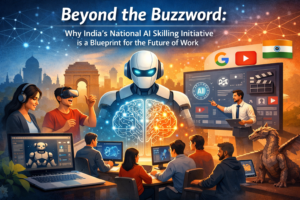
Beyond the Buzzword: Why India’s National AI Skilling Initiative is a Blueprint for the Future of Work
In the relentless churn of daily news, government initiatives often get reduced to bullet points—a ministry here, a partnership there, a number of beneficiaries. But every so often, an announcement emerges that signals a subtle but profound shift in how a nation prepares for the future. The launch of the National AI Skilling Initiative by the Ministry of Information and Broadcasting, in partnership with tech giants Google and YouTube, is one such moment.
While the headline targets the Animation, Visual Effects, Gaming, and Comics (AVGC) sector, the implications of this program stretch far beyond the creative industries. It represents a strategic pivot: a recognition that Artificial Intelligence is no longer just a tool for coders and data scientists, but a foundational literacy for the modern workforce. As the Union Minister unveiled this initiative on March 24, 2026, it became clear that India is attempting to solve its most persistent challenge—the gap between academic learning and industry requirements—through a lens of public-private partnership.
This article delves deeper than the press release, exploring the architecture of the initiative, its strategic significance for India’s creative economy, and what it means for the 15,000 participants who will soon embark on this learning journey.
The Genesis: Why the Creative Sector?
To understand the importance of this initiative, one must first understand the target sector: AVGC and Media Technology. Often dismissed as “just entertainment,” the AVGC sector is actually a high-value economic engine. India is already a global hub for animation and VFX outsourcing, powering Hollywood blockbusters and global gaming franchises. However, the industry is currently at a crossroads.
Generative AI is disrupting the creative process. Tools that can generate scripts, storyboards, mid-journey animations, and even voiceovers are becoming ubiquitous. For a nation that prides itself on “jugaad” (frugal innovation) and a massive pool of English-speaking creative talent, the threat is twofold: either Indian professionals become obsolete by being replaced by AI, or they become the global leaders in how AI is used to create.
The National AI Skilling Initiative is a bet on the latter. By focusing on creative technology, the government is acknowledging that the next wave of economic growth will not come from manufacturing alone, but from “creator economy” skills augmented by AI. It is an effort to future-proof a workforce that contributes significantly to exports and employs millions of young Indians.
A Deep Dive into the Structure: Learning by Doing
The success of any skilling initiative lies in its structure. Too often, government-run programs suffer from outdated curricula or a lack of industry relevance. This initiative, implemented through the Indian Institute of Creative Technologies (IICT) , attempts to bypass these pitfalls through a well-defined two-phase model.
Phase I: Foundational Literacy at Scale
The first phase is a masterclass in modern pedagogy. Rather than starting with complex coding, the program begins with foundational concepts offered through Google Career Certificates and Google Cloud Generative AI learning paths.
Participants will engage with courses like AI Essentials, Prompting Essentials, and Introduction to Generative AI. This is a crucial step. The ability to write a good prompt—to communicate effectively with an AI—is becoming as essential as typing skills were in the 1990s. By making this phase mandatory for progression, the initiative ensures that participants don’t just learn to use specific software; they understand the underlying mechanics of the technology they are wielding.
This phase democratizes access. For a student in a tier-2 city who dreams of working in gaming but lacks access to expensive proprietary software, these foundational certifications offer a globally recognized credential that can open doors.
Phase II: Project-Based Specialization
The second phase is where the magic happens. Theory without application is inert. Phase II focuses on advanced, hands-on, project-based specialization tailored specifically for the creative industry.
This is not a classroom lecture; it is a simulation of a real-world studio environment. Participants will likely work on projects involving generative AI for character design, AI-assisted editing for VFX, or leveraging large language models (LLMs) to create non-linear gaming narratives. By conducting this training in major cities across the country, the program taps into existing creative clusters, fostering a community of practice where peers can learn from each other and industry mentors.
The Tripartite Alliance: Government, Big Tech, and Academia
One of the most compelling aspects of this news is the partnership structure. The Ministry of Information and Broadcasting acts as the policy anchor, providing the mandate and reach. Google and YouTube bring the technical credibility, the cloud infrastructure, and, perhaps most importantly, the platform. YouTube, in particular, serves as a dual-purpose tool: it is the medium for delivering education and the ultimate marketplace where creators can monetize their AI-enhanced skills.
The implementation by the Indian Institute of Creative Technologies (IICT) acts as the bridge, ensuring that the high-level tech from Google is translated into digestible, culturally relevant content for the Indian creative mind. This model—government vision, private sector technology, and specialized institute execution—creates a flywheel effect that is often missing in traditional skilling programs.
Beyond the 15,000: The Ripple Effect
While the initiative aims to train 15,000 participants directly, the real significance lies in the “ripple effect.” In the Indian context, knowledge is communal. When a student in a college in Pune learns how to integrate generative AI into their animation workflow, they teach their peers. When a professional in Mumbai uses AI to cut a post-production timeline from days to hours, they force their entire studio to adapt.
Furthermore, the curriculum developed for this initiative—particularly the AI Essentials and Prompting Essentials—is likely to become a template. Educational institutions across the country may adopt similar structures, leading to a systemic upgrade in how AI is taught in undergraduate and vocational programs.
Challenges and the Road Ahead
No analysis would be complete without acknowledging the hurdles. While the initiative is laudable, its success hinges on execution. The first challenge is digital infrastructure. While major cities are covered, ensuring that participants have reliable internet and computing resources to run advanced AI models is crucial.
Second, there is the issue of ethical AI. The creative industry is currently grappling with copyright, intellectual property, and the ethical implications of AI-generated art. A robust skilling initiative must include modules on the responsible use of AI—teaching creators not just how to use AI, but when it is appropriate and how to avoid biases inherent in large language models.
Finally, there is the pace of change. AI technology evolves at a speed that government tenders and curriculum approvals cannot match. The partnership with Google allows for agility; the curriculum can be updated as new tools emerge. However, maintaining this agility over the long term will be the true test of the initiative’s sustainability.
Conclusion: A Case Study in Human-AI Collaboration
As the UPSC Prelims 2026 approaches, aspirants often look for current affairs topics to file under “Government Schemes” or “Science & Technology.” But the National AI Skilling Initiative deserves more than a bullet point in a notebook. It serves as a case study in how governments can navigate the Fourth Industrial Revolution.
By focusing on the creative sector, India is leaning into its greatest strength: its human capital. The goal is not to replace the artist with a machine, but to create a new class of “AI-Augmented Creators”—professionals who can leverage machine speed to enhance human creativity.
For the 15,000 participants who will undergo this training, the outcome will be more than a certificate. It will be a transformation from being a consumer of AI tools to being a shaper of AI-powered experiences. For India, the success of this initiative could set the standard for how nations prepare their workforce for an era where adaptability, creativity, and technical fluency are no longer separate disciplines, but a single, unified skillset.
As we watch this program roll out in the coming months, it will serve as a litmus test for the future of work in India: can we skill fast enough to lead the world? The National AI Skilling Initiative suggests that, for the first time, we might just have the right strategy to try.
You must be logged in to post a comment.