
Beyond the Buzz: Decoding Why India Became the Unmissable Stage for Global Tech at Davos 2026
At the 2026 World Economic Forum in Davos, Union Minister Ashwini Vaishnaw captured a definitive shift in global tech sentiment, revealing that India is no longer viewed merely as a vast market but has become an indispensable strategic partner and innovation epicenter. This transformation is driven by India’s proactive move towards sovereign AI—developing its own foundational models to retain control over data and solutions—coupled with its deeply embedded, high-value role in global semiconductor design. Enhanced by clear, consultative regulatory signals and a demographic-digital synergy, India now offers global technology players a unique confluence of execution credibility, scalable talent, and full-stack ambition, compelling them to evolve from seeking a market presence to engaging in deep, co-creative partnerships for shaping the future of technology.
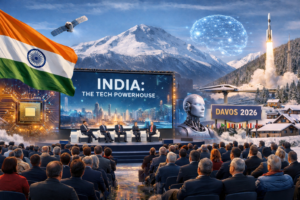
Beyond the Buzz: Decoding Why India Became the Unmissable Stage for Global Tech at Davos 2026
The air in Davos is always thick with anticipation, but this year, a distinct and powerful current was palpable among the global elite: a decisive, unequivocal pivot towards India. The statement by Union Minister Ashwini Vaishnaw that “all major global technology players want to have a big presence in India” is more than just diplomatic optimism; it is the crystallization of a multi-year strategic shift that has finally reached a critical mass. This isn’t about mere market entry anymore. It’s about integration, co-creation, and securing a seat at the table in what is now universally recognized as the world’s most significant digital laboratory.
So, what changed? The narrative has moved decisively beyond India’s colossal market potential—a story told for decades. The new chapter is about India as a strategic partner, an innovation catalyst, and a sovereign rule-maker in the technologies that will define the 21st century.
The Sovereign AI Gambit: Beyond Consumption to Creation
Minister Vaishnaw’s announcement that India will showcase 6-7 sovereign AI models at the upcoming India AI Impact Summit is the cornerstone of this new posture. Sovereign AI isn’t just a buzzword; it’s a philosophical and strategic declaration. While global AI giants offer powerful tools, they often come as black boxes, built on foreign data and aligned with non-domestic priorities.
India’s push for sovereign models signals a profound understanding that true technological power lies in ownership of the stack—from foundational data trained on diverse Indian languages and contexts, to the algorithms optimized for local challenges in healthcare, agriculture, governance, and education. This moves India from being the world’s largest “testing ground” for AI to being an “architect” of solutions that are scalable, affordable, and relevant to much of the developing world.
For global AI leaders, this creates a compelling dual opportunity. First, they can partner with the Indian government and startups to refine their own models with India’s vast and unique datasets. Second, they can build on top of India’s public AI infrastructure, tailoring applications for sectors ripe for disruption. The message is clear: come to India not just to sell, but to collaborate and build the future of AI with India.
Semiconductors: The Silent “Designs-Within” Revolution
Perhaps the most underreported revelation from the Minister’s conversation is that India’s semiconductor design ecosystem is already embedded in some of the world’s most complex chips. This is a masterstroke in narrative reframing. While the world watches the physical construction of semiconductor fabs (which remains a crucial, long-term goal), India has been quietly conquering the high-value, intellectual core of the industry: design.
Think of it as the difference between printing a book and writing it. India has become a prolific author of chip “plots.” This deep, embedded design talent is a magnet for global chipmakers. It offers them access to a high-skill talent reservoir capable of tackling cutting-edge R&D in areas like precision design, photonics, and packaging. It de-risks their global operations and provides a critical innovation node. The momentum isn’t just about a future factory; it’s about the proven, present-day intellectual horsepower that makes India an indispensable link in the global semiconductor supply chain.
The Regulatory Signal: Clarity Over Bans
The timeline of 15 days for publishing gaming law rules after industry consultation is another powerful signal to global boardrooms. It demonstrates a mature, consultative approach to regulating fast-evolving digital sectors. Instead of reactive bans or perpetual uncertainty, the government is moving towards a framework that aims to balance innovation, user safety, and economic growth.
This predictability is catnip for investors. It shows that India is learning from global tech regulatory missteps and seeking to create a stable environment where businesses can plan, invest, and grow with a clear understanding of the rules of the game. For the gaming and interactive media sector—a global behemoth—this opens the door for serious investments in development studios, esports infrastructure, and immersive tech like AR/VR, with India as both a market and a production hub.
The “India-Hosted Davos” Idea: A Symbolic Power Shift
The mere floating of an India-hosted Davos-style meeting is rich with symbolism. It’s not just about logistics or tourism. It represents a confident assertion that the epicenter of discussions on technology, development, and global growth is shifting. The “India story” is now complex, multi-layered, and critical enough to warrant its own global convening power. It suggests that to understand the future of technology, global CEOs need to walk the streets of Bengaluru and Hyderabad, not just ski the slopes of Davos.
The Confluence: Why the Mood is “Very Positive”
The “very positive” mood Minister Vaishnaw notes is the result of a unique confluence:
- Execution Credibility: Grand announcements (PLI schemes, Digital Public Infrastructure) have been followed by tangible, large-scale execution. The success of UPI and Aadhaar are globally studied cases.
- Demographic-Digital Synergy: A young, tech-aspirational population isn’t just consuming; it’s coding, building startups, and creating global products.
- Geopolitical Rebalancing: In a world of fragmented tech stacks and supply chains, India’s stable democracy, non-aligned stance, and vast scale make it the most reliable partner for both Western and Eastern tech firms looking to de-risk.
- Full-Stack Ambition: India is no longer focusing on just one layer (IT services). It is building capability across the stack—from semiconductor design and manufacturing (aspiration) to sovereign AI, quantum computing, and space tech.
The Road Ahead: From Presence to Partnership
The desire for a “big presence” is just the starting point. The real value for India—and the enduring opportunity for global tech—will be in evolving that presence into deep, symbiotic partnership. This means:
- Moving beyond GCCs: From Global Capability Centers focused on cost arbitrage to Global Innovation Centers driving core product R&D.
- Co-developing for the World: Using India as a launchpad to build affordable, scalable tech solutions for the Global South.
- Two-Way Talent Flow: Enhancing the exchange where global experts come to India to work on groundbreaking problems, and Indian talent leads global tech divisions.
Davos 2026 will be remembered as the moment the global tech narrative on India matured. The question for CEOs is no longer “Should we be in India?” but “How deeply and meaningfully can we embed ourselves in India’s tech destiny?” The nation has moved from being an optional market to an essential partner in building the technological future. The world isn’t just coming to sell; it’s coming to co-create, and that changes everything.
You must be logged in to post a comment.