
Beyond the Bulletin: How a Western Disturbance Writes India’s Winter Story
Beyond the Bulletin: How a Western Disturbance Writes India’s Winter Story
The daily weather bulletin is a masterclass in understatement. It distills vast, churning atmospheric systems into neat bullet points: “Low-pressure area likely to form over southeast Bay of Bengal… Western Disturbances to affect Western Himalayan region… Minimum temperatures below normal in parts of south peninsular India.” It’s precise, it’s informative, and it’s utterly devoid of the human drama that these meteorological events actually represent.
To read the India Meteorological Department (IMD) update from February 13, 2026, is to see the skeleton of India’s winter weather. But the flesh, the blood, the very life of this forecast lies in what happens next. It’s in the farmer in Uttarakhand who glances at the sky, a mix of hope and worry on his face as he calculates the risk of untimely snow on his ready-to-harvest crop. It’s in the municipal worker in Delhi who knows that the “no significant change” in minimum temperatures means another night of bone-chill for the city’s vulnerable. It’s in the quiet anticipation of a child in the hills, praying for a snow day.
This isn’t just a forecast; it’s the opening scene of a recurring drama that shapes the rhythm of life, economy, and culture across the Indian subcontinent. Let’s look beyond the bulletin and unpack the real story of what a Western Disturbance means for India.
The Anatomy of an Atmospheric Conveyor Belt
At its core, the story begins thousands of kilometres away, in the Mediterranean Sea or the Atlantic Ocean. Here, a mass of moisture-laden air is stirred into motion. This is a Western Disturbance—an extra-tropical storm that gets its name from its origin in the west and its penchant for disrupting the status quo. It travels across the Middle East, picking up additional moisture, before slamming into the most formidable weather barrier on Earth: the Himalayas.
The bulletin mentions a “strong subtropical westerly jet stream, with wind speeds of around 130 knots.” This jet stream is the expressway that guides these disturbances. At 12.6 km above sea level, it’s a river of air powerful enough to dictate the path of these storms. When the IMD announces the arrival of a Western Disturbance, it’s tracking the first ripple in this powerful current. The first system arriving on February 13 and the second following close behind on February 16 aren’t just isolated events; they are pulses in a larger atmospheric rhythm.
The Ripple Effect: From Snow-Capped Peaks to Parched Plains
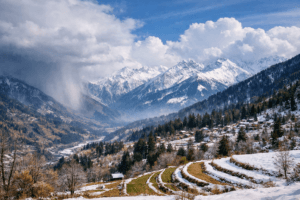
The forecast for the Western Himalayan region—Jammu & Kashmir, Ladakh, Himachal Pradesh, and Uttarakhand—is for isolated rainfall and snowfall. For a tourist in Gulmarg looking for fresh powder, this is cause for celebration. But for the local communities, it’s far more complex.
Consider the apple orchards of Himachal Pradesh. The region is currently in the midst of its crucial pruning season. A sudden, heavy snowfall can weigh down branches, causing irreparable damage. The “rain and snow” predicted for February 16-18 is a double-edged sword. It replenishes the glaciers and water tables that will feed the rivers in the summer—the lifeblood of the northern plains. This snowpack is essentially a frozen reservoir. The slower it melts, the more consistent the water supply for irrigation and hydropower for the rest of the year. So, while an apple farmer might curse a late-February snow, a wheat farmer in Punjab, hundreds of miles away, is silently blessing it.
The bulletin then extends the forecast to the plains: “Isolated rainfall accompanied by thunderstorm and lightning is likely over Punjab, Haryana, Chandigarh, West Uttar Pradesh and north Rajasthan on February 17.” This seemingly minor detail is a critical line for the Rabi crop. February is a sensitive time for wheat and mustard. Warm, dry weather can stress the plants, but a timely, gentle rain—what farmers call ‘munh ki khushk’ (literally, “the happiness of the mouth”)—can be the difference between a bumper harvest and a mediocre one. It washes the dust off the leaves, replenishes soil moisture, and provides a final boost before the grain-filling stage. The thunder and lightning, however, are a reminder of nature’s fury, a potential threat to life and livestock for those caught unprepared.
Delhi’s Air and the Temperature Tapestry
“The lowest minimum temperature in the plains was recorded at Amritsar at 6.9°C.” Sandwiched between reports of Himalayan snow and a low-pressure area in the Bay of Bengal, this statistic for Amritsar might seem like a local footnote. But it’s a thread in a vast national tapestry.
The bulletin notes a fascinating dichotomy: minimum temperatures are below normal in parts of south peninsular India, while being above normal across many areas of the western Himalayan region, Rajasthan, and Gujarat. This is the classic winter seesaw. A strong Western Disturbance pulls cold air from the Arctic and Siberia down into its wake. As it moves eastward, it creates a circulation that can actually draw warm air up from the south into northwestern India, temporarily raising night-time lows. Meanwhile, the same system can send a chill further south.
And then there’s Delhi. The bulletin states that Delhi’s air quality “remains moderate.” But anyone living in the capital knows the weather is the city’s primary atmospheric cleanser. The mention of “isolated rainfall” in the region on February 17 is more than just a weather event; it’s a potential health event. A good, steady rain can wash pollutants out of the air, providing a respite that no government policy can replicate. The anticipation of that rain is palpable among Delhiites, who watch the forecast with as much interest in the AQI (Air Quality Index) as in the temperature.
The South-West Monsoon’s Distant Cousin
The bulletin’s mention of a low-pressure area forming over the east Equatorial Indian Ocean and the southeast Bay of Bengal around February 15 is a subtle but significant plot twist. While the north is preoccupied with Western Disturbances, this is the early stirrings of the other major weather system that defines India: the southwest monsoon.
This low-pressure area, currently a faint whisper in the equatorial trough, is the precursor to the powerful systems that will, in a few months, unleash the monsoon rains over Kerala. Its formation in February is part of the normal seasonal cycle, a reminder that India’s weather is a year-round symphony, not a series of isolated jingles. The IMD is tracking it now, laying the groundwork for predictions that will become national headlines by June. It hints at the vast, interconnected nature of our climate, where a disturbance in the Bay of Bengal and a storm from the Mediterranean can be discussed in the same breath.
Fog, Humidity, and the Colour of “Normal”
The bulletin’s final alerts—dense fog in Meghalaya and hot, humid conditions over coastal Karnataka—paint a picture of a country experiencing vastly different seasons simultaneously. While one part of the country is bracing for snow, another is being warned of heat and humidity. This is India’s defining climatic feature: its staggering diversity.
For the people of Meghalaya, “dense fog” is not just a visibility issue. It can shut down the only roads connecting villages, disrupt life in the world’s wettest place, and create a haunting, beautiful landscape that isolates communities for days. For the residents of coastal Karnataka, “hot and humid” conditions signal discomfort, a spike in electricity demand for cooling, and potential health advisories for the elderly and infants.
All of these are framed by the concept of “normal.” The IMD uses historical data to define what the temperature should be. Deviations from this normal—whether above or below—are what we register as extreme or unusual. The bulletin notes that minimum temperatures in south peninsular India are below normal. This isn’t just a statistic; it’s a data point in the long-term study of climate change. Are these deviations becoming more frequent? More severe? Each bulletin adds a line to that crucial, unfolding story.
The Human Forecast
Ultimately, the IMD’s weather update is a document of profound practicality, but its true value is unlocked by human interpretation. It is a tool for a Transport Minister in the hills to pre-position snow-clearing equipment. It is a guide for a parent in the plains to decide if their child needs an extra blanket. It is a warning for a fisherman in Tamil Nadu, alerted by the changing pressure patterns over the Bay of Bengal. It is a sliver of hope for a city suffocated by smog.
The next time you read a weather bulletin, pause for a moment. Don’t just see the data. See the stories within it. See the vast, invisible hands of the jet stream reaching down from the Arctic. See the snowpack building on a distant mountain, destined to become drinking water for a megacity. See the farmer, the truck driver, the street vendor, and the school child, all living their lives in the shadow of a Western Disturbance. The forecast isn’t just about the weather; it’s about us. And in that context, a few millimetres of rain or a two-degree temperature change is never just a number—it’s the world.
You must be logged in to post a comment.