
Beyond the Breaking Point: 2025’s Climate Record and the Human Cost of Inaction
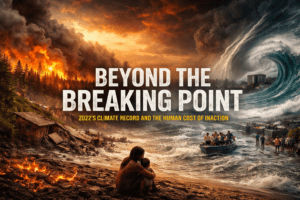
Beyond the Breaking Point: 2025’s Climate Record and the Human Cost of Inaction
The data, stark and unequivocal, now tells a story we can no longer ignore. The year 2025 has cemented itself not as an anomaly, but as a dire milestone, ranking among the three hottest years ever recorded by modern science. This isn’t merely a statistical blip on a graph; it is the lived reality of billions, a year where the theoretical thresholds of climate negotiations became the breached barriers of our daily lives. For the first time, the three-year global average temperature has crept above the 1.5°C limit set by the landmark 2015 Paris Agreement—a target once deemed the critical guardrail against the most catastrophic impacts of climate change.
This breach is the backdrop to a year of relentless climatic violence. An analysis by the World Weather Attribution (WWA) consortium, scrutinizing the most severe events, paints a harrowing picture: 157 extreme weather disasters met grim criteria, from death tolls exceeding 100 to events that crippled more than half a region’s population. From these, 22 were put under the microscope, revealing a fingerprint of human influence so clear it renders denial not just ignorant, but dangerous.
The Anatomy of a Hotter World: Heat, Floods, and Fury
The most visceral and widespread symptom has been extreme heat. In India, from the plains of Prayagraj to bustling megacities, heatwaves transformed daily life into a struggle for survival, with millions seeking refuge from a sun turned hostile. Crucially, scientists like Dr. Friederike Otto of Imperial College London point out that these are no longer rare events. The heatwaves experienced in 2025 are “quite common events in our climate today,” but crucially, they “would have been almost impossible to occur without human-induced climate change.” Some were found to be ten times more likely now than just a decade ago. This isn’t just a shift in weather; it’s a fundamental reshaping of our planet’s baseline.
But the crisis is hydra-headed. While some regions baked, others drowned. Prolonged drought, a silent and creeping disaster, parched landscapes in Greece and Turkey, turning forests into tinderboxes for wildfires that consumed not just trees but homes and livelihoods. Meanwhile, torrential rains unleashed catastrophic flooding in Mexico, turning streets into rivers, and severe monsoon floods triggered devastating landslides across parts of India. In the Philippines, Super Typhoon Fung-wong demonstrated the intensified power of cyclonic systems in a warmer ocean.
Perhaps most emblematic of the new era of climate volatility was Hurricane Melissa. Its terrifyingly rapid intensification near landfall overwhelmed forecasting models and disaster agencies, leaving Jamaica, Cuba, and Haiti with precious little time to prepare. This event laid bare the concept scientists term the “limits of adaptation.” There is a point, they warn, where extremes arrive so fast, so fierce, and so frequently that even the best-prepared communities—lacking time, resources, or warning—are simply overwhelmed. Millions globally now live on the precipice of this limit.
The Political Storm: Cloudy Forecasts and Missed Opportunities
Against this backdrop of climatic turmoil, the geopolitical weather remained, as Dr. Otto noted, “very cloudy.” The 2025 UN climate talks in Brazil ended in familiar discord, failing to produce a clear, binding agreement to phase out fossil fuels—the very root cause of the emergency. While promises of adaptation funding were made, their slow implementation offers cold comfort to communities rebuilding today.
Global progress is frustratingly uneven. China, while a renewable energy deployment leader, continues its parallel investment in coal. Europe, battered by consecutive years of extremes, sees climate action advance, yet it remains tangled in debates over economic cost. In the United States, a policy pivot under the Trump administration has actively championed coal, oil, and gas, sidelining clean energy transitions. This fragmentation, coupled with what experts identify as a pervasive storm of misinformation, has created a dangerous inertia at the very moment acceleration is vital.
“We must do more,” urges Andrew Kruczkiewicz of Columbia University, highlighting a critical insight: disasters are increasingly striking regions “unused to extreme events.” This underscores an urgent, global need for robust early warning systems and innovative approaches to response and recovery that are as agile and interconnected as the climate threats themselves.
The Path from the Precipice: Beyond Resignation
Conceding the 1.5°C target will be exceeded is not an invitation to surrender; it is a call for clear-eyed realism and redoubled effort. Every fraction of a degree beyond this point exponentially increases human suffering and ecological loss. The goal must now be a fierce, determined clawback—to peak warming as low as possible and return below 1.5°C by century’s end.
This requires a fundamental rewiring of our economies and priorities. It means treating renewable energy not as an alternative, but as the urgent, foundational replacement for fossil fuels. It demands that climate adaptation—from building flood-resilient infrastructure to creating urban green cool zones—receives funding and focus equal to the scale of the threat. It calls for insulating climate policy from the volatile winds of political change and confronting misinformation with transparent, accessible science.
The record heat of 2025 is more than a headline; it is an autopsy of a planet under stress and a prognosis for our collective future. The data from this year is the canary in the coal mine, fallen silent. We are past the point of gentle warnings. The message now is one of visceral urgency: the cost of inaction is measured in vanished coastlines, collapsed harvests, shattered communities, and countless lives. The solutions—justice-led, clean energy-powered, and globally coordinated—are in our hands. The question 2025 leaves us with is not one of capability, but of courage. Will we listen to the science, learn from the scars of this year, and act? Our shared future, quite literally, depends on the answer.
You must be logged in to post a comment.