
Beyond the Boycott: Inside the Cornell Student Assembly’s Reckoning with Complicity
The Cornell Student Assembly meeting became a heated forum for debating two contentious resolutions—one calling for the university to end its partnership with the Technion-Israel Institute of Technology over alleged involvement in military technologies tied to human rights violations, and another condemning the administration for hosting speakers accused of war crimes, referencing a past event featuring former Israeli official Tzipi Livni—drawing a packed room where public comment revealed deep divisions, with supporters framing the votes as a moral test of institutional complicity in oppression and opponents arguing the measures were selectively targeted, procedurally overreaching (particularly regarding an undergraduate body deciding on a graduate campus issue), and threatening to academic freedom, culminating in a raw moment when a Kashmiri student personalized the stakes by linking the military technology to violence in his homeland, before the Assembly ultimately delayed a final decision by moving both resolutions to future readings.
Beyond the Boycott: Inside the Cornell Student Assembly’s Reckoning with Complicity
By a Senior Contributor
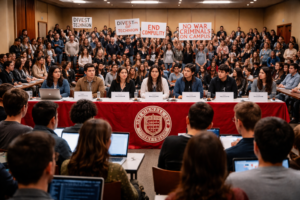
The fluorescent lights of the memorial room hummed with a nervous energy on Thursday night, a stark contrast to the usual procedural drone of student government. The student organizers had done their job. The Instagram posts had been shared, the group chats mobilized. By the time the Student Assembly’s gavel fell, the room was packed to the fire-code limit, a living, breathing testament to a campus deeply divided.
This wasn’t a debate about funding for a new club sport or a change to the meal plan. The two resolutions on the docket—one calling for Cornell to sever its partnership with an Israeli technical institute, the other condemning the university for platforming speakers accused of war crimes—had transformed a routine legislative meeting into a moral tribunal. For nearly two hours, the public comment period became a raw, unfiltered forum where the theoretical ethics of international politics collided with the lived reality of students on an Ithaca hill.
What unfolded wasn’t just a debate about policies, but a profound and often painful reckoning with what it means to be a student at an institution whose tendrils of influence stretch across the globe. It was a night when academic jargon gave way to visceral pleas, and the abstract concept of “institutional partnerships” was reframed as a matter of life and death.
A Clash of Moral Visions
The two resolutions, 61 and 55, are separate but ideologically intertwined. Resolution 61 targets the very architecture of Cornell’s global ambitions. It focuses on the Joan and Irwin Jacobs Technion-Cornell Institute, the crown jewel of Cornell Tech in New York City, a partnership with the Technion-Israel Institute of Technology. The resolution’s language is sharp, accusing Technion of being “involved in the development of military technologies connected to human rights violations” and arguing that such a partnership is “inconsistent with Cornell University’s stated educational mission.”
Resolution 55, on the other hand, addresses the university’s symbolic power. It condemns the administration for inviting speakers like Tzipi Livni, a former Israeli foreign minister, to campus for a “Pathways to Peace” event. Livni has faced war crimes allegations related to the 2008-2009 Gaza offensive, Operation Cast Lead. The resolution argues that by lending its name and prestige to such figures, the university creates a hostile environment, “endanger[ing] student well-being.”
To the resolution’s supporters, these are two sides of the same coin: Cornell’s active and passive complicity in a system they view as oppressive. To their opponents, the resolutions represent a dangerous politicization of the university, a selective application of moral outrage that threatens to stifle academic exchange and chill discourse.
The Human Voice in the Chamber
The public comment period stripped away the formal language of the resolutions and revealed the human beings at the center of the storm.
Adriana Vink ’27, speaking in support of both measures, framed the issue in starkly binary terms. As president of Progressives at Cornell and co-president of Students for Justice in Palestine, she argued that the vote was a fundamental test of the university’s soul. It’s a “[question] of whether you believe the institution that you attend and fund should use its institutional power to prop up more crimes and more criminals, or to prioritize the student experience and its mission to do the greatest good.”
Vink’s words, delivered with the practiced poise of a seasoned activist, were met with nods of agreement from a significant portion of the room. For these students, the issue is not geopolitical abstraction. It is about the psychological safety of walking onto a campus whose brand, they believe, is intertwined with suffering. They see the Technion partnership as a direct pipeline for technologies used in military operations they oppose, and speakers like Livni as a form of institutional gaslighting, forcing them to sit politely while the university honors people they consider war criminals.
Then came Francis Burns ’27, who sought to preempt one of the most common criticisms of the speakers’ resolution. He was careful to distinguish between the broad principle of free speech and the specific action of institutional endorsement. “This is not a call to restrict speech or to avoid controversial figures,” Burns asserted, his voice clear above the murmurs. “Students, student groups and faculty retain the right to invite, host and engage with a wide range of speakers. This resolution addresses a narrower question — whether the University itself, with its name, its funds and its institutional prestige, should be lending its endorsement to individuals facing credible accusations of war crimes.”
This distinction was a crucial rhetorical move. It attempted to build a bridge to those who value academic freedom, arguing that the resolution protects the marketplace of ideas by ensuring the university isn’t using its weight to tip the scales in favor of one, potentially problematic, narrative.
But the bridge was met with staunch opposition from the other side. Levi Schmuel ’27 voiced a suspicion that hung in the air for many. He pointed to the resolution’s “ambiguous language” and its seemingly “selective focus.” He challenged the Assembly: the resolution mentions no criteria for vetting speakers, nor does it call out problematic figures from other conflicts or regimes with which Cornell might have ties. “I have trouble believing that this resolution is actually concerned with human rights or correcting justice,” Schmuel argued, “but with silencing speakers with whom the author disagrees.”
This is the central fault line in campus debates across the country. Is this a principled, consistent application of human rights standards, or is it a targeted political campaign dressed in the language of ethics? For Schmuel and those who share his view, the silence on other issues—from U.S. foreign policy to partnerships with nations with their own human rights records—betrays a political motive that has little to do with universal justice.
The Question of Representation and Ripple Effects
Perhaps the most piercing critique came not from the ideological trenches, but from a place of procedural and representational concern. Graduate student Hannah DeFelice stood up and delivered a dose of sobering reality to the undergraduate-heavy Assembly.
She argued that the undergraduate Student Assembly had no business voting on Resolution 61. “The people most impacted are just not here,” she stated flatly. “They’re not members of the voting body. They’re not here on campus to speak to you.”
DeFelice’s point was a powerful one. Cornell Tech is a graduate and professional campus in New York City. Its students, faculty, and postdoctoral researchers are the ones who would be most directly affected by the dissolution of the partnership with Technion. Their degrees, their research collaborations, their professional networks are all tied up in the Jacobs Institute. Yet, a body of undergraduates in Ithaca was being asked to decide its fate. This raised a thorny question about the very structure of shared governance: can a student government whose constituency is geographically and academically distinct from the affected population legitimately speak on their behalf? DeFelice’s comment highlighted a potential blind spot in the activist strategy, a reminder that the “community” they sought to mobilize for was not a monolith.
A Moment of Unfiltered Pain
All the careful arguments about process, representation, and the definition of academic freedom were momentarily swept away by the final public comment of the evening. Hasham Khan ’26 stepped forward. He didn’t offer a nuanced critique of Resolution 61’s wording. Instead, he personalized the conflict in a way that left the room in a stunned, heavy silence.
Khan spoke of Technion’s development of military technology and its use in the Middle East. Then, he pivoted to his own heritage. “Now, fun fact, element systems test their weapons on Kashmir, the region that I’m from,” Khan said. His voice was not angry, but carried a weight of profound sorrow and frustration. He then delivered a line that cut through the parliamentary procedure like a knife: “So why duck around the corner? If you want to support Israel tech, and if you want to support our partnership, kill me now. Kill my people now. What’s stopping you?”
It was a moment of raw, unmediated testimony. Khan had taken the abstract language of the resolution—”ethical concerns,” “human rights violations,” “military technologies”—and distilled it down to a single, unbearable question for the assembled representatives. He was not asking them to vote a certain way based on a policy paper; he was asking them to look at him and reckon with the direct, human consequences of their potential inaction. For those in support of the resolution, it was a heartbreaking validation of their cause. For those opposed, it was a difficult and uncomfortable moment, a challenge to see beyond political labels and witness the personal anguish that fuels this activism.
The Machinery of Delay
After more than an hour of this raw emotional and ideological exchange, the meeting transitioned back to the cold mechanics of Robert’s Rules of Order. The passion of the public comments seemed to hang in the air, a ghost at the feast, as the Assembly members deliberated.
The outcome was a testament to the complexity of the issue. Resolution 61, the call to end the Technion partnership, was not voted down. It was not voted up. It was moved to a third reading, kicking the can down the road for at least another week. This procedural move, while common, felt like an anti-climax after the evening’s drama. It allowed the Assembly to avoid an immediate, definitive “yes” or “no” on a resolution that had just been framed by one student as a matter of survival for his people.
Resolution 55, the speakers’ resolution, suffered a similar fate, stalled on the calendar due to time constraints. The meeting ended not with a bang, but with a whimper of parliamentary procedure. The students who had packed the room filed out, their arguments heard but the ultimate decision deferred.
What Happens Next?
The night’s events at the Cornell Student Assembly were a microcosm of a larger struggle playing out on university campuses nationwide. The students who spoke were not just debating two pieces of paper; they were wrestling with fundamental questions about the role of the modern university. Is it a neutral platform for all ideas, no matter how contentious? Or does it have a moral obligation to ensure its immense power and prestige are not used to legitimize actions its community finds abhorrent?
The procedural delay offers a temporary reprieve, but the underlying tensions remain. The administration will be watching closely. The students who packed the Assembly will return next week, their resolve likely steeled by the public comments. And those who feel their voices were not heard, or were unfairly targeted, will continue to organize.
One thing is certain: the debate over Resolutions 55 and 61 is far from over. It has moved from the abstract pages of a student government agenda into the hearts and minds of the student body. It is no longer just about Cornell’s partnership with Technion or a single speaker at an event. It is about who the university is for, whose pain it acknowledges, and what it means to be a community in a world where the local is irrevocably global. The gavel may have fallen on the meeting, but the reckoning has only just begun.
You must be logged in to post a comment.