
Beyond the Bottleneck: How Swedish Ingenuity Could Unlock India’s Clean Energy Future
Swedish clean-tech company KonveGas, led by founder Alexander Enulescu, is entering the Indian market to address the critical energy storage bottleneck hindering India’s transition to a gas-based and green hydrogen economy. The company will introduce its advanced Type 4 composite cylinders—which are lightweight, corrosion-resistant, and offer a superior safety profile—at India Energy Week 2026. Targeting key industrial hubs in Delhi, Pune, and Gujarat, KonveGas aims to localize supply chains under a “Make in India” model and forge strategic partnerships. By providing a more efficient and durable storage solution for gases like CNG and hydrogen, the technology promises to reduce logistical carbon footprints, improve payload efficiency for transport, and accelerate the deployment of decentralized clean energy systems across the country.
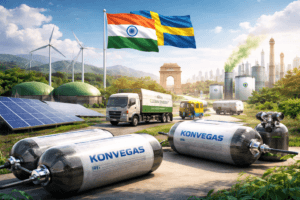
Beyond the Bottleneck: How Swedish Ingenuity Could Unlock India’s Clean Energy Future
India stands at a precipice of profound transformation. Its ambitious targets for a gas-based economy and global green hydrogen leadership are clear, but the path is obstructed by a stubborn, tangible hurdle: the storage bottleneck. It’s one thing to produce clean energy; it’s another to move it, store it safely, and deploy it efficiently across a vast and diverse nation. Enter KonveGas, a Swedish clean-tech pioneer whose strategic entry into the Indian market isn’t just a business expansion—it’s a potential key to unlocking a critical logjam in the world’s most populous democracy.
The Core of the Challenge: Why Storage is the Linchpin
To understand the significance of KonveGas’s move, one must first grasp the anatomy of India’s storage problem. The country has made laudable strides in renewable energy generation, with solar parks and wind farms proliferating. However, energy, especially in gaseous forms like compressed natural gas (CNG), biogas, and the future-fuel green hydrogen, is not always produced where or when it is needed.
The traditional workhorse for this storage and transport has been the Type 1 steel cylinder—heavy, prone to corrosion, and with a limited payload-to-weight ratio. This inefficiency cascades through the supply chain. It means more trucks on the road just to transport the heavy containers themselves, higher fuel consumption, increased wear on infrastructure, and ultimately, a higher carbon footprint for the very clean energy it’s meant to enable. In the context of hydrogen, which requires even higher pressures or complex conditions, these limitations are magnified. This is the bottleneck: a logistical and technological constraint that throttles the flow of clean energy.
KonveGas: The Swedish Prescription of Precision and Performance
Under the leadership of founder Alexander Enulescu, KonveGas arrives with a solution that embodies Swedish design principles: minimalist efficiency, unwavering safety, and long-term sustainability. Their specialization lies in Type 4 composite cylinders. To demystify the jargon, imagine moving from a solid iron vault to a high-strength, lightweight carbon-fiber reinforced suitcase.
A Type 4 cylinder consists of a seamless polymer liner (typically high-density polyethylene) that holds the gas, wrapped in a full-composite shell of carbon fiber or hybrid fibers resin-impregnated. This architecture confers decisive advantages:
- Drastic Weight Reduction: They can be up to 70% lighter than their steel counterparts. This translates directly into more energy payload per trip, fewer trips required, and lower operational emissions.
- Inherent Corrosion Resistance: Unlike metal, the composite materials are immune to rust, a crucial factor in India’s varied climatic zones, especially humid coastal regions like Gujarat. This extends lifecycle dramatically and enhances safety.
- Enhanced Safety Profile: The composite shell, when damaged, tends to leak rather than rupture catastrophically. Combined with their fatigue resistance, this makes them exceptionally safe for high-pressure applications.
As Enulescu states, the mission is to “minimize lifecycle carbon impact.” This is a full-system perspective. It’s not just about the cylinder’s use, but about the total emissions from its manufacture, through its decades of service, to its end-of-life. This holistic view aligns perfectly with India’s need for solutions that are not only effective today but sustainably integrated for tomorrow.
Strategic Grounding: More Than Just an Export Model
KonveGas’s approach reveals a nuanced understanding of the Indian market. Their choice of initial hubs—Delhi (the political and CNG vehicle pioneer), Pune (an automotive and engineering nucleus), and Gujarat (an industrial and renewable energy powerhouse)—shows a targeted strategy aimed at the heart of demand.
Crucially, the company is not merely planning to ship products. Their three-pillar strategy for integration is telling:
- Leveraging Global Benchmarks: Arriving with international certifications (like UN ECE R134 for hydrogen) builds immediate credibility with Indian regulators and large corporate buyers who operate on global standards.
- Pursuing ‘Make in India’: Actively evaluating local raw material sourcing is the masterstroke. It addresses cost sensitivity, reduces geopolitical supply chain risks, and aligns with national policy. Success here could transform KonveGas from an importer to a domestic manufacturer, fostering local jobs and expertise.
- Openness to Strategic Partnerships: Expressing flexibility for JVs or technical agreements shows pragmatism. The Indian market, with its established industrial gas giants and burgeoning clean-tech startups, requires partnership. Collaborating with an Indian entity could provide vital distribution networks, market insight, and regulatory navigation.
The Human and Economic Insight: A Ripple Effect
The potential impact of this technology transcends the immediate energy sector. Consider the auto-rickshaw driver in Delhi switching to CNG, or the future trucker using hydrogen. A lighter cylinder means their vehicle carries less dead weight, improving range and fuel economy, directly boosting their livelihood. For an industrial unit in Pune using industrial gases, it means safer, more efficient on-site storage and lower handling costs.
Moreover, by solving the storage and transport bottleneck, KonveGas’s technology can accelerate the viability of decentralized energy models. A biogas plant in a rural cluster can efficiently store and send its output. A small-scale hydrogen production unit becomes more feasible. This democratizes energy access and enhances national energy security.
The Road Ahead: Cautious Optimism and Key Hurdles
The announcement ahead of India Energy Week 2026 sets the stage, but the real work begins now. The next six months, as KonveGas aims to become operational, will be critical. Key challenges remain:
- Cost vs. Perception: The initial capex for Type 4 cylinders is higher than for Type 1. Converting the market requires clearly communicating the total cost of ownership—savings in transport, maintenance, and lifecycle.
- Building a Domestic Ecosystem: Sourcing consistent, high-grade carbon fiber within India is a challenge. This will be a key test for their localization pledge.
- Regulatory Harmonization: While global standards are a start, ensuring full compliance and smooth approval from Indian standards bodies like the Petroleum and Explosives Safety Organisation (PESO) is essential.
Conclusion: A Synergy of Strengths
KonveGas’s entry represents a compelling synergy. It brings Swedish precision engineering and deep material science expertise to bear on one of India’s most pressing infrastructural challenges. For India, it represents access to cutting-edge technology that can de-risk its green energy ambitions. For KonveGas, India offers a scale of application and a test-bed of extremes unlike any other.
This is more than a corporate press release. It’s a case study in how targeted technological innovation, when coupled with a smart, localized market strategy, can address a national-level impediment. If successful, the lightweight composite cylinders from KonveGas won’t just store gas; they will carry a significant part of India’s clean energy future on their shoulders, making the journey towards a gas-based and green hydrogen economy not just imaginable, but logistically achievable. The bottleneck may soon be a thing of the past.
You must be logged in to post a comment.