
Beyond the Boom: How India’s 2025 Infrastructure Surge is Rewriting the Rules of Building
India’s construction and infrastructure sector in 2025 demonstrated remarkable growth, with the market reaching approximately ₹5.31 lakh crore, fueled by aggressive government spending and strong private investment. Beyond mere expansion, the year marked a transformative shift toward industrialized, technology-driven delivery—embracing prefabrication, BIM, and digital workflows to enhance speed, reduce waste, and improve margins. Sustainability and lifecycle performance became central, with clients demanding designs that lower energy use and carbon footprint, while interiors evolved into flexible, value-preserving assets. Looking ahead, the convergence of modular construction, measurable ESG compliance, and productized services is setting the stage for a more efficient, integrated, and resilient industry, positioning India for sustained, multi-year growth driven by smart, sustainable building practices.
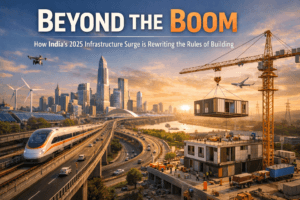
Beyond the Boom: How India’s 2025 Infrastructure Surge is Rewriting the Rules of Building
The narrative of Indian infrastructure has long been one of ambition versus execution. But as 2025 draws to a close, a new story is being cemented into the national consciousness—one where scale is matched by sophistication, and growth is galvanized by a fundamental rethinking of how we build. With the sector’s value piercing the ₹5.31 lakh crore mark, the headline is undeniable resilience. Yet, the true revelation of 2025 lies not in the sheer volume of concrete poured or steel erected, but in the quiet revolution unfolding within the construction ecosystem itself. This is a surge defined by smart timelines, sustainable calculus, and a seismic shift from building as a craft to building as a precision industry.
The Foundation: More Than Just Government Spending
While the aggressive government capex—up 8.2% in the first half of the fiscal year—provided the rocket fuel, the mission trajectory has changed. Flagship programs like the National Infrastructure Pipeline (NIP) have evolved from mere funding conduits into frameworks demanding new paradigms. The transport and rail sectors, accounting for 38% of infrastructure activity, are no longer just about connecting point A to B; they are about creating integrated economic corridors powered by renewable energy and digital monitoring.
The critical differentiator in 2025 has been the convergence of public ambition with private innovation. Private capital, projected to see among the highest CAGRs through 2030, is no longer a passive investor but an active driver of efficiency. This partnership is moving beyond the financial (PPP models, infrastructure bonds) to the operational, forcing an unprecedented focus on lifecycle value over lowest bid.
The New Currency: Speed, Sustainability, and Synchronicity
The pressure to deliver “faster, greener, better” has crystallized into a non-negotiable trifecta. As Parveen Gupta of Ramacivil India aptly noted, modern construction is an orchestra. In 2025, the industry finally began reading from the same digital score.
- Industrialized Delivery Takes Center Stage:The adoption of prefabrication, modular construction, and BIM-driven planning moved from pilot projects to core strategy, especially for hospitals, data centers, and urban housing. This is not just about faster assembly; it’s about transforming muddy, chaotic sites into streamlined assembly lines. The shift minimizes weather dependencies, reduces material wastage by up to 30-40%, and crucially, decongests urban centers of heavy logistics, addressing a perennial social grievance.
- Design’s “Earned Place”:Sandeep Singh’s insight that “design has to earn its place through performance” captures a watershed moment. Architects and engineers are now tasked with “lifecycle math”—where every design choice is evaluated for its embodied carbon, operational energy use, and adaptability. The aesthetic is no longer the primary deliverable; it is the outcome of a performance-driven process. This has spurred demand for parametric design tools and early collaboration between designers, material scientists, and MEP (Mechanical, Electrical, Plumbing) engineers.
- The Interiors Revolution:Manish Bansal’s observation that interiors are “longevity engines” underscores a radical reassessment. In commercial and mixed-use developments, interiors are now a strategic asset. The demand is for systems that can evolve: demountable partitions, raised access floors with integrated service ducts, and surfaces that endure high use with minimal maintenance. This shift turns Capex into smarter OpEx, protecting asset value across decades and multiple tenancies.
The Human and Technological Engine: Construction 4.0 in Indian Overalls
Beneath the cranes and scaffolding, a digital backbone is forming. The nascent “Construction 4.0” ecosystem—a blend of IoT sensors, telematics for equipment, AI-powered project management platforms, and drone-based progress monitoring—is solving age-old Indian problems.
- Labor Productivity: Rather than replacing labor, technology is augmenting it. Skilled workers using AR-assisted tools for accurate installations or managers using real-time dashboards to pre-empt bottlenecks are becoming common. This tech infusion is making construction careers more appealing to a tech-savvy generation.
- Transparency and Trust: Blockchain for material provenance, digital twin models for facility management, and transparent procurement platforms are slowly eroding the opacity that has plagued the sector. This builds investor confidence and improves risk allocation.
The 2026 Horizon: Integration, Measurability, and Productization
The trajectory for the coming year is clear. The themes that gained voice in 2025 will become the dominant language in 2026.
- Measurable Sustainability: ESG is moving from a report to a real-time metric. The focus will sharpen on embodied carbon accounting—tracking the carbon footprint of materials from manufacture to transport. Net-zero operational targets will be baked into construction contracts. Green certifications like LEED and IGBC will become baseline expectations, not differentiators.
- Productized Services: The industry will see the rise of standardized, repeatable “kits of parts”—pre-engineered facade systems, modular bathroom pods, and plug-and-play interior modules for offices or hospitals. This productization drastically reduces design iteration time, ensures consistent quality, and simplifies maintenance.
- Full-Stack Integration: The ultimate winners will be firms that offer integrated service delivery, from civil works and core & shell to fit-outs and facility management. This end-to-end control is the only way to guarantee the seamless orchestration required for the speed and performance clients now demand.
The Persistent Challenges: The Other Side of the Boom
This surge is not without its headwinds. Skilling the massive workforce for this tech-augmented environment remains a Herculean task. Geopolitical volatility continues to impact the cost and supply of key materials. Furthermore, the intense focus on large-scale projects must not come at the cost of rural and last-mile infrastructure, which is vital for equitable growth.
Conclusion: Building a Legacy, Not Just Structures
India’s 2025 infrastructure story is ultimately one of maturation. The sector is transitioning from being a cyclical economic lever to a strategic, value-creating industry. It’s building not just roads and rails, but a new DNA for the economy—one that is efficient, sustainable, and resilient.
The projects completed in 2025 will stand for decades. But the more enduring legacy may well be the processes, partnerships, and philosophies forged this year: where every stakeholder, from the policy maker to the site engineer, is aligned not just by the deadline, but by a shared blueprint for a smarter, more sustainable future. The infra surge of 2025, therefore, is building more than concrete and steel; it is building a new Indian industrial ethos.
You must be logged in to post a comment.