
Beyond the Blueprint: How Infineon and Zenergize Are Forging the Silicon Heart of India’s Energy Transition
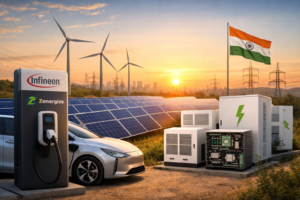
Beyond the Blueprint: How Infineon and Zenergize Are Forging the Silicon Heart of India’s Energy Transition
New Delhi: As the final day of the Bharat Electricity Summit 2026 unfolded at the Yashobhoomi convention centre, a quiet but significant announcement rippled through the exhibition halls. It wasn’t a flashy merger or a billion-dollar funding round. Instead, it was a strategic technology partnership between German semiconductor giant Infineon Technologies and homegrown Indian power electronics firm Zenergize.
In the lexicon of corporate news, such announcements often get lost in the shuffle of quarterly earnings reports and ribbon-cutting ceremonies. But beneath the surface of this collaboration lies a narrative that speaks to the very core of India’s industrial ambitions: the intersection of global technological prowess and local manufacturing ingenuity to solve the unique puzzles of the subcontinent’s energy grid.
The Missing Link in India’s Green Puzzle
For the past decade, India’s clean energy story has been one of staggering scale. The country has added solar capacity at a world-beating pace, and the push for electric mobility has moved from pilot projects to mass adoption. Yet, as anyone on the ground floor of this transition will tell you, the biggest bottleneck is no longer just about installing panels or building charging stations; it is about control.
Power electronics—the hardware that conditions, converts, and manages electricity—is the “brain” of the clean energy ecosystem. A solar panel without an inverter is just a glass sheet collecting dust. An EV without a charger that communicates with the grid is just a parked car. The efficiency of this hardware determines how much renewable energy actually reaches the grid and how fast a car battery can be charged without degrading.
This is where the Infineon-Zenergize partnership enters the fray. By combining Infineon’s cutting-edge semiconductor architecture with Zenergize’s intimate understanding of Indian operating conditions, the alliance aims to solve a problem that has plagued the sector for years: reliability under duress.
Silicon Carbide: The Game Changer
At the heart of the technical agreement is a material that sounds like science fiction but is quickly becoming the backbone of industrial energy: Silicon Carbide (SiC).
Traditional semiconductors rely on silicon. It is cheap, abundant, and has served the industry well for decades. But as energy demands grow, silicon is reaching its physical limits. When pushed to high voltages or extreme temperatures, it leaks energy—manifesting as heat, which is essentially wasted electricity.
Infineon’s advanced wide-bandgap semiconductors, specifically Silicon Carbide, offer a paradigm shift. Unlike silicon, SiC can handle higher voltages, switch faster, and—most critically for India—operate efficiently in high ambient temperatures.
For a company like Zenergize, which designs hardware for the Indian market, this is not a trivial upgrade; it is existential. In a country where summer temperatures regularly cross 45 degrees Celsius in regions like Rajasthan or Maharashtra, electronics often fail due to thermal stress. An inverter that works in a climate-controlled lab in Munich may falter in the dust and heat of a solar farm in Bhadla.
By integrating SiC technology, Zenergize can manufacture products—solar inverters, EV chargers, and battery storage systems—that are not just “good enough” for India, but are designed for its extremes. The technology promises reduced power losses (meaning less electricity is turned into waste heat) and higher power density (meaning smaller, lighter, and more robust equipment).
The “Make in India” Nuance
The partnership is structured as a product and technology integration deal—explicitly not a joint venture. This nuance is important. It reflects a growing trend in India’s industrial landscape: the “Deep Localization” of supply chains.
For decades, the Indian manufacturing sector operated largely as an assembly hub. Components were designed elsewhere, shipped in, and screwed together. The value addition—and the intellectual property—remained outside the country.
However, the current government push for Atmanirbhar Bharat (Self-Reliant India), combined with production-linked incentive (PLI) schemes for semiconductors and automobiles, is changing that dynamic. Infineon brings the “brains” (the chips), but Zenergize retains the agency over the “body” (the system design and manufacturing).
Veer Karan Goyal, Founder and CTO of Zenergize, hinted at this dynamic when he noted that the goal is to develop products for Indian conditions with “potential for global deployment.” This is the holy grail of Indian manufacturing: leveraging the stress-test environment of the domestic market to create rugged, reliable products that can be exported to other emerging economies in Africa, Southeast Asia, and the Middle East.
From Mobility to Grid Stability
While the press release highlights solar inverters and EV charging, the strategic implications run deeper. India is currently wrestling with the challenge of grid stability. As renewable energy penetration increases, the grid becomes less predictable. Solar power dies at sunset; wind power fluctuates by the minute.
To manage this, the grid needs energy storage systems (ESS) and smart inverters capable of providing “grid-forming” capabilities—essentially, the ability to stabilize the grid even when disconnected from the main power plant.
Infineon’s SiC technology is particularly suited for these high-power, high-frequency applications. By enabling Zenergize to manufacture advanced storage systems locally, the partnership helps India reduce its reliance on imported grid-stabilization hardware. It moves the needle from merely generating green energy to managing it intelligently.
Jens Reinstaedt, Vice President of Application Management at Infineon, described India as one of the “most significant energy-transition markets globally.” That is not corporate hyperbole. India’s energy demand is projected to grow faster than any other major economy over the next decade. Any company that can establish a foothold in India’s power electronics supply chain today is positioning itself for a decade of exponential growth.
The Human Element: Beyond the Silicon Wafer
To truly appreciate the announcement, one must look beyond the technology and at the people. Infineon has had a presence in India for nearly three decades, employing over 2,500 people. This isn’t a fly-in, fly-out operation; it is a deeply integrated R&D and support ecosystem.
For Zenergize, a firm built on in-house R&D and AI-enabled hardware solutions, the partnership offers more than just components. It offers validation. In the world of industrial manufacturing, a startup’s biggest hurdle is often credibility. Securing a partnership with a Tier-1 global semiconductor leader like Infineon serves as a stamp of approval, opening doors to further investments and larger customers.
This collaboration also sends a signal to the broader engineering talent pool in India. It demonstrates that the most cutting-edge work in power electronics—the kind of work that once required moving to Silicon Valley or Stuttgart—can now be done in Pune, Bangalore, or New Delhi. For the thousands of Indian engineers graduating each year, this is a powerful incentive to stay home and build.
The Road Ahead
As the Bharat Electricity Summit wraps up and the booths are dismantled, the real work begins. The partnership between Infineon and Zenergize is not a one-off event but a blueprint for how multinational corporations can engage with India’s manufacturing renaissance.
We are moving into an era where the lines between “global technology” and “local manufacturing” are blurring. The winners in the coming decade will not be those who simply import finished goods, nor those who refuse to leverage global expertise. They will be the companies that master the art of integration—taking the best of global R&D (like Infineon’s SiC) and marrying it with agile, locally responsive manufacturing (like Zenergize’s design capabilities).
India’s goal of achieving 500 GW of renewable energy capacity by 2030 and establishing itself as an EV manufacturing hub rests on thousands of such technological nodes. From the silicon carbide inside a chip to the steel casing of an inverter, every component matters.
The Infineon-Zenergize partnership suggests that India is finally ready to stop being just a market for energy technology and start being a co-creator of it. In the sweltering heat of a New Delhi spring, a small but significant step was taken to ensure that the lights of India’s future stay on—efficiently, reliably, and indigenously.
You must be logged in to post a comment.