
Beyond the Blocked Handle: How India’s Digital Crackdown on Satire Is Redefining Free Speech
In March 2026, the Indian government invoked Section 69A of the IT Act to withhold multiple X (formerly Twitter) accounts—many run anonymously or pseudonymously—that posted satirical and critical content about the ruling establishment, removing their visibility within India while leaving them accessible abroad. Digital rights groups and opposition parties condemned the move as an alarming escalation that targets protected political speech rather than unlawful content, undermining the procedural safeguards upheld by the Supreme Court in Shreya Singhal. With reports that the government may decentralize takedown powers beyond the Ministry of Electronics and Information Technology, critics warn that the mass censorship of entire accounts for satire and dissent marks a dangerous shift toward erasing digital opposition behind a veil of administrative secrecy.
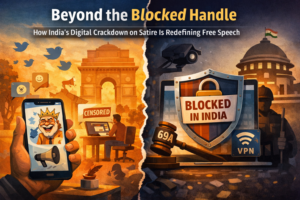
Beyond the Blocked Handle: How India’s Digital Crackdown on Satire Is Redefining Free Speech
In the early hours of March 18, 2026, a quiet digital earthquake rippled through India’s social media landscape. For hundreds of thousands of followers, the timelines of their favorite satirists and government critics didn’t just lose a post; they lost entire personas. Users who had spent years building anonymous digital avatars to critique power woke up to emails from X (formerly Twitter) stating that their accounts were now “withheld in India.”
The reason was clinical: a takedown order under Section 69A of the Information Technology Act, 2000. To a user outside India, these accounts remain vibrant, active, and full of life. But to an Indian citizen, they simply vanish—erased by a bureaucratic notice, leaving behind only the ghost of a “This account has been withheld” message.
This is not merely a story about a few blocked accounts. It is a story about the weaponization of legal frameworks designed for emergency use, the chilling effect on digital dissent, and the transformation of the Indian internet from a public square into a territorially fragmented space where the right to mock the mighty is becoming a luxury.
The Anatomy of a Digital Erasure
The recent wave of takedowns—targeting handles that collectively command lakhs of followers—represents a significant escalation. Earlier censorship efforts under the Modi government often focused on specific posts or hashtags deemed “unlawful.” But the March 2026 action is different. By targeting entire accounts rather than isolated tweets, the government has signaled a shift from content moderation to persona deletion.
For creators like Sandeep Singh, an independent content creator whose account was among those withheld, the notification was a shock. “I am challenging this decision legally, and am doing my best to reclaim my voice,” Singh said. But for many operating pseudonymously, the path to legal recourse is fraught. The anonymity that protects them from retaliation also complicates their ability to file individual appeals, leaving them reliant on digital rights groups like the Internet Freedom Foundation (IFF) to navigate a labyrinthine bureaucracy.
The IFF’s reaction was swift and scathing. They noted that the censorship targets “speech that appears political, satirical, or critical, rather than clearly unlawful.” This distinction is crucial. Under the Shreya Singhal v. Union of India (2015) judgment, the Supreme Court upheld Section 69A only because it came with procedural safeguards: written reasons, a requirement that the content must threaten national security or public order, and a mechanism for challenge. The IFF argues that secret, bulk account suspensions “defeat those safeguards in practice.”
Satire as a Threat: The New Legal Frontier
To understand what is happening, one must look at the nature of the content being erased. These are not accounts inciting violence or spreading hate speech. They are meme pages, satirical commentators, and anonymous critics who specialize in a specific genre of Indian political discourse: visual mockery of the Prime Minister and the ruling establishment.
Congress spokesperson Supriya Shrinate called it an “extremely dangerous trend,” accusing the government of deciding “what is acceptable, what is not acceptable on social media,” adding that “anything critical of the Prime Minister will have to go.”
While Shrinate’s remarks are political, the underlying concern is constitutional. The Indian Constitution protects free speech under Article 19(1)(a), with reasonable restrictions listed in Article 19(2). Satire and criticism of the government—even harsh, offensive, or vulgar satire—are historically protected categories of speech. By equating memes that “mock” the Prime Minister with threats to public order, the government is stretching the legal definition of “reasonable restrictions” to its breaking point.
The takedown of a post by The Caravan magazine, excerpting a story it published, adds another alarming dimension. It suggests that the censorship net is widening beyond anonymous handles to include independent journalism. When a legacy media outlet’s factual reporting is subjected to the same administrative takedown as a satirical meme, the line between opinion and journalism blurs, creating an environment of self-censorship.
The VPN Loophole and the Two Indias
Perhaps the most Kafkaesque aspect of these takedowns is their territoriality. The accounts are not globally removed; they are simply invisible to Indian IP addresses. For the Indian user, the content doesn’t exist. For the global user, it remains a testament to Indian dissent.
This creates a digital apartheid. As one affected user, @Nher_who, defiantly posted (visible to the world, but not to their 240,000 Indian followers): “If the govt thinks this blocking intimidation can silent [sic] me, they are heavily mistaken. Indians can’t see my post without Vpn [virtual private networks] but the world can and they will know how India has become North Korea.”
The reference to North Korea is hyperbolic, but the underlying point about digital sovereignty is valid. The government is effectively forcing citizens to choose between compliance and circumvention. For the average user, the barrier of a VPN—while technically easy—represents a psychological and legal hurdle. It transforms the act of reading a meme into an act of digital rebellion. It suggests that the government is not merely trying to remove harmful content, but to raise the friction cost of dissent so high that only the most determined citizens will attempt to access it.
The Threat of Decentralized Censorship
The timing of these takedowns coincides with a chilling rumor circulating in policy circles: the government is considering allowing other Ministries to directly issue Section 69A takedown orders, bypassing the Ministry of Electronics and Information Technology (MeitY).
Currently, MeitY acts as a central filter, theoretically ensuring some level of oversight and legal consistency before orders are sent to platforms. If censorship powers are decentralized, the risk of abuse multiplies exponentially. A Ministry of Home Affairs officer, a state government official, or a bureaucrat in the Ministry of Information and Broadcasting could, in theory, issue a takedown order without the specialized legal scrutiny that MeitY (at least in principle) provides.
The IFF’s call for the government to “halt any move to decentralize Section 69A blocking powers” is a plea to preserve what little procedural guardrails remain. If decentralization happens, India will move from a system of centralized censorship—which is already problematic—to a fragmented system where any ministry with a grievance can silence a voice.
The Silence of the Platforms
One of the most notable aspects of the current situation is the compliance of the social media platforms. X, under its current management, has positioned itself as a “free speech absolutist” in other jurisdictions, often fighting takedown orders in courts abroad. Yet, in India, the platform appears to be complying with remarkable speed.
This highlights the commercial reality of the digital age. India is a massive market for these platforms. Losing access to the Indian market is not an option. While Section 69A orders are legally binding, the platforms have historically had some room to challenge them on grounds of overreach. The fact that they are quietly complying—withholding entire accounts without public comment—suggests a strategic retreat.
For the creators, this platform complicity adds to the feeling of helplessness. The infrastructure of the internet, which was once celebrated for its ability to democratize speech, is now being used as a turnkey solution for state censorship.
Conclusion: The Price of Digital Dissent
As India hurtles toward a future where digital identity is tied to government verification (through frameworks like the upcoming Digital India Act) and where censorship can be applied with the click of a button, the events of March 2026 serve as a harbinger.
The accounts that vanished overnight were not threats to national security. They were the digital equivalent of political cartoons—sharp, funny, and often vulgar. They represented a form of engagement that has existed in democracies for centuries: the right to laugh at power.
By targeting these voices, the government is not just removing content; it is attempting to narrow the Overton window of acceptable political discourse. If satire becomes a crime, and if criticism of the Prime Minister becomes grounds for a digital death sentence, then the internet in India ceases to be a marketplace of ideas. It becomes a curated broadcast channel, where dissent is not just discouraged but rendered invisible.
As Sandeep Singh and others prepare for legal battles, the core question remains: Can the procedural safeguards of the Shreya Singhal judgment survive the brute force of administrative action? For now, the only way for an Indian citizen to see what their own government is hiding is to leave the country—digitally, if not physically.
You must be logged in to post a comment.