
Beyond the Blockade: How India Navigated the Strait of Hormuz Crisis and Secured Its Energy Lifeline
In March 2026, as Iran blockaded the Strait of Hormuz—the world’s most critical oil chokepoint—against Western vessels amid a devastating war with the US and Israel, India successfully secured safe passage for its own ships, including the Shivalik carrying 40,000 metric tonnes of LPG, through a high-stakes diplomatic blitz involving Prime Minister Modi and External Affairs Minister Jaishankar. This exemption was not a lucky break but the payoff of India’s long-cultivated policy of “strategic autonomy,” where it maintained deep ties with Iran—through investments like the Chabahar Port and centuries of cultural exchange—even while strengthening partnerships with the US and Israel. The operation was a masterclass in navigating a multipolar crisis, ensuring that 90% of India’s vital gas imports kept flowing, stabilizing its economy and protecting millions of households from energy shortages, while demonstrating that independent diplomacy, rather than alliance loyalty, is the ultimate shield in a fractured world.
Beyond the Blockade: How India Navigated the Strait of Hormuz Crisis and Secured Its Energy Lifeline
In the high-stakes arena of global geopolitics, few chokepoints are as potent and precarious as the Strait of Hormuz. A narrow, U-shaped waterway separating Iran from the Arabian Peninsula, it is the world’s most critical oil transit artery. For decades, the mere threat of its closure has been enough to send shockwaves through global markets. But in March 2026, the threat became a reality. Amidst an escalating and unprecedented conflict with the United States and Israel, Iran made good on its longstanding warning, drawing a line in the water and declaring the Strait closed to Western and Israeli vessels.
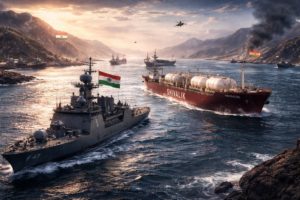
The world watched as oil prices, already volatile, skyrocketed past the $100 per barrel mark for the first time in years, triggering fears of a global energy crisis. Yet, amidst this geopolitical firestorm, one major power seemed to find a path through the inferno. On March 13, 2026, news broke that the Indian Navy was actively guiding the Shivalik, a ship carrying 40,000 metric tonnes of Liquefied Petroleum Gas (LPG), safely through the Strait of Hormuz. Another vessel was scheduled to follow within hours.
This wasn’t a lucky break or a covert military operation. It was the culmination of a frantic, high-level diplomatic blitz that reveals the complex art of survival in a multipolar world. This is the story of how India, an energy-hungry nation with deep ties to all sides of the conflict, navigated a naval blockade to secure its energy future, offering a masterclass in strategic autonomy.
The Anatomy of a Chokepoint: Why the Strait of Hormuz Matters to India
To understand the magnitude of India’s diplomatic achievement, one must first understand its vulnerability. India is the world’s third-largest oil importer and consumer, reliant on foreign sources to meet over 85% of its crude oil needs. While it has diversified its sources in recent years, the Strait of Hormuz remains a critical lifeline.
According to the provided report, a staggering 90% of India’s natural gas imports—the clean fuel powering its homes, industries, and city gas grids—transit through this narrow passage. While the figure for crude oil is lower at around 30%, the sheer volume is still massive and irreplaceable in the short term. The LPG on the Shivalik, for instance, would ultimately find its way into millions of Indian kitchens.
For India, an energy disruption in the Strait of Hormuz isn’t just an abstract economic indicator; it’s a direct threat to its domestic stability and economic growth. A sustained blockade would mean:
- Inflationary Shock: Soaring energy prices would ripple through the economy, increasing the cost of transport, manufacturing, and electricity.
- Subsidy Burden: The government would be forced to choose between passing on massive price hikes to citizens or absorbing the cost through increased subsidies, straining the public exchequer.
- Supply Chain Disruption: Industries reliant on natural gas as a feedstock, such as fertilizer and petrochemical plants, would face shutdowns, impacting agriculture and manufacturing.
When Iran slammed the door shut on Western tankers, it wasn’t just targeting the US or Israel; it was effectively holding a gun to the head of the entire global economy, with India standing directly in the line of fire.
The Red Lines and the Backchannel: A Diplomatic Blitz Unfolds
The official narrative from Tehran was one of total blockade. However, the swiftness with which India secured an exemption suggests a sophisticated understanding of the unwritten rules of West Asian geopolitics. This wasn’t a matter of sending a single message; it was a carefully orchestrated campaign at the highest levels.
The report details the diplomatic architecture of this success: three rounds of talks between India’s External Affairs Minister, Dr. S. Jaishankar, and his Iranian counterpart, Seyed Abbas Araghchi, even before the breakthrough. This wasn’t crisis management after the fact; it was proactive engagement. Following the Reuters report of a potential understanding, the engagement intensified. Prime Minister Narendra Modi personally spoke with Iranian President Masoud Pezeshkian, adding the ultimate weight of India’s leadership to the discussions. Jaishankar and Araghchi held yet another round, finalizing the details that would allow the Shivalik to pass.
This flurry of activity points to a fundamental truth of the blockade: it was never intended to be absolute. For Iran, the closure was a strategic tool of coercion and signaling, not a suicidal act of economic self-immolation. A complete shutdown would alienate its major non-Western trading partners, chief among them China and India. By allowing exceptions, Iran achieved several objectives:
- It Punished the West: The primary targets—US and Israeli-linked ships—were denied passage, inflicting economic and symbolic damage.
- It Demonstrated Power: Iran showed it could single-handedly disrupt the world’s most important waterway, forcing the global community to reckon with its military capabilities.
- It Rewarded Friends and Neutral Parties: By granting passage to nations like India, Iran reinforced the value of maintaining independent foreign policies. It sent a clear message: “Stay out of US-led coalitions, and your energy security will be protected.”
The “India Exception”: A Reward for Strategic Autonomy
Why did Iran agree to let Indian ships through? The answer lies in decades of carefully cultivated ties that transcend the current conflict. India’s relationship with Iran is a cornerstone of its “Strategic Autonomy”—the ability to pursue its national interests without being tethered to the alliances of any major power bloc.
While India has dramatically deepened its strategic and defense partnership with the United States and Israel over the past two decades, it has simultaneously maintained a functional and historically rooted relationship with Iran. This balancing act, often criticized by Western commentators as hedging, proved to be its saving grace in March 2026.
Consider the pillars of this relationship:
- The Chabahar Port: India is developing the Shahid Beheshti terminal at Iran’s Chabahar port. This project is not just commercial; it is geo-strategic. It provides India a foothold in the region and, more importantly, creates a trade corridor to Afghanistan and Central Asia that bypasses Pakistan. Iran views Chabahar as a vital economic link, and India‘s investment is a tangible asset that Tehran is loath to jeopardize.
- Historical and Cultural Ties: The bond between India and Persia is ancient, woven through centuries of trade, language, and culture. This provides a bedrock of understanding and trust that can survive political storms.
- Energy Partnership: Before US sanctions tightened the screws, Iran was India’s second-largest oil supplier. Indian refineries were configured to process Iranian crude. While imports have plummeted due to sanctions, the underlying infrastructure and commercial relationships have not been entirely dismantled.
- Shared Concerns in Afghanistan: Both nations have historically supported the anti-Taliban Northern Alliance and share a concern about the spread of extremism and instability from Afghanistan.
By maintaining these ties—by keeping the channels of communication open even when the US “maximum pressure” campaign was at its peak—India ensured it had a seat at the table when the crisis hit. It wasn’t a member of the Western alliance that Iran was targeting; it was a valuable partner with whom Iran needed to do business.
The Human Element: More Than Just a Diplomatic Win
The safe passage of the Shivalik is a story that can be told through the cold lens of barrels, geopolitics, and diplomatic cables. But its true significance is human. That 40,000 metric tonnes of LPG isn’t just a commodity; it’s millions of cooking gas cylinders. It’s a mother in Mumbai who can cook dinner, a family in a Delhi slum who can heat water during a chilly March night, and a small restaurant owner in Chennai who can keep his business running.
When Petroleum Secretary Sujata Sharma notes that 51% of India’s gas requirements are met domestically, it offers a cushion, but it doesn’t eliminate the anxiety. The remaining 49% is a vast gap that must be filled by imports. A disruption doesn’t just create a shortage; it creates uncertainty. And uncertainty is the enemy of economic planning. Industries hold back on investment, traders hoard supplies, and prices become a political tinderbox.
For the government, securing the passage of that ship was about stabilizing a system. It was a signal to markets, to industry, and to the 1.4 billion people of India that their government could protect their interests, even when the world was on fire. It was a promise delivered.
The Road Ahead: Navigating a Perilous New Normal
The immediate crisis may have been averted for India, but the underlying conflict shows no signs of abating. The Strait of Hormuz is likely to remain a militarized and unpredictable flashpoint for the foreseeable future. The world has entered an era where energy is no longer just a market commodity, but a weapon of war.
For India, this incident is a wake-up call and a validation of its strategy. The path forward will require a multi-pronged approach:
- Diplomacy as a First Line of Defense: The government must continue its policy of “multi-alignment,” engaging with all powers—the US, Israel, Iran, Russia, and the Gulf Arabs—simultaneously. This requires a nimble and experienced foreign service, capable of managing contradictory relationships without triggering a backlash.
- Energy Security as National Security: The crisis will accelerate India’s push for energy diversification. This includes:
- Increasing Strategic Reserves: Building larger emergency crude oil storages to provide a longer buffer against disruptions.
- Sourcing from New Geographies: Doubling down on imports from the US, Guyana, and other non-Gulf sources.
- Boosting Domestic Production: Continuing efforts to maximize output from domestic oil and gas fields.
- Green Energy Transition: Viewing the push for renewables, electric vehicles, and green hydrogen not just as an environmental imperative, but as a vital tool for energy independence.
- Naval Presence: The role of the Indian Navy in escorting the Shivalik is a crucial signal. It demonstrates India’s capability and resolve to protect its maritime interests, projecting power in its immediate neighborhood and beyond. This “blue water” capability is a necessary complement to its diplomacy.
Conclusion
The passage of the Shivalik through the Strait of Hormuz was a small but perfect vignette of 21st-century geopolitics. It showed that in a world divided by conflict, survival depends on the ability to build bridges across the divide. It was a triumph for the quiet, persistent work of diplomacy over the loud clamor of war.
While the world focused on the clash of titans, India found a narrow channel of its own—not just through the physical waters of the Strait, but through the treacherous geopolitical currents that surround it. It secured its energy, protected its people, and reinforced its standing as a major power that charts its own course. The crisis is far from over, but for one crucial moment, on one vital ship, India showed that in the art of navigation, principle and pragmatism can sail together.
You must be logged in to post a comment.