
Beyond the Blanket: Decoding North India’s Chilling Fog Crisis and the Urban Battle for Breath
Beyond the Blanket: Decoding North India’s Chilling Fog Crisis and the Urban Battle for Breath
A silent, suffocating blanket has descended upon North India. As December deepens, millions from Delhi to Guwahati are waking up to a world erased—a landscape where horizons disappear, monuments like the Taj Mahal fade into myth, and the simple act of breathing becomes a calculated risk. This is not merely winter; it is a complex meteorological and environmental event where a severe cold wave conspires with dense fog and entrenched pollution to create a public health and logistical perfect storm. With temperatures hovering around a biting 9°C in capitals and visibility often near zero, the region is caught in a gripping seasonal crisis that demands a closer look beyond the headlines.
The Invisible Cage: A Day in the Fog
Imagine a morning where your world shrinks to a radius of a few meters. Commuters in Karnal, Haryana, and Moradabad, Uttar Pradesh, navigate streets as spectral figures, their headlights reflecting off a milky white void. In Agra, tourists at the Taj View Point peer hopefully into the gloom, only to be denied the iconic silhouette—the fog, thick with moisture and pollutants, rendering the marble wonder invisible. This is the daily reality. The Indian Meteorological Department’s (IMD) orange alerts are not mere advisories; they are warnings of a paralyzed normalcy.
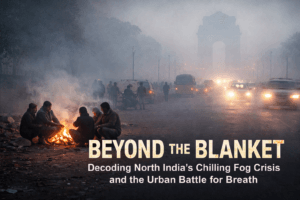
The human response is both resilient and poignant. In Kanpur, circles of people huddle around makeshift bonfires, the ancient ritual of seeking warmth becoming a necessary defiance against the cold. Yet, this very act, multiplied across millions, contributes to the particulate matter choking the air. The crisis is cyclical: the cold necessitates behaviors that, in turn, worsen the conditions. Aviation becomes a high-stakes gamble of technology versus nature. While Delhi’s Indira Gandhi International Airport managed to maintain operations till 8 PM on a recent Sunday—a testament to advanced Instrument Landing Systems—the threat of delays and cancellations looms large with every update from the airport travel advisory. On the roads, the statistics turn grim; reduced visibility leads to a spike in accidents, turning highways into hazard zones.
The Science of the Smother: Why This Fog Is Different
Not all fogs are created equal. The phenomenon currently engulfing the Indo-Gangetic Plain is a specific and dangerous breed: radiation fog. Under clear winter nights, the ground loses heat rapidly (radiation cooling). When the air near the saturated ground cools past its dew point, water vapor condenses into tiny droplets, forming fog. However, North India’s fog is now rarely just water droplets. It has evolved into a smog—a toxic cocktail of fog, smoke, and pollutants.
This “thick smoke” noted in reports is the key differentiator. The region’s cold air acts like a lid, trapping pollutants from a multitude of sources: vehicle emissions, industrial output, construction dust, and crucially, agricultural stubble burning from neighboring states. These particles (PM2.5 and PM10) provide abundant surfaces for moisture to condense upon, making the fog denser, longer-lasting, and far more hazardous to inhale. In Delhi, where the AQI nears 400—“Severe” territory—the fog becomes a poisonous brew. Breathing it is equivalent to inhaling a corrosive slurry deep into one’s lungs, exacerbating respiratory illnesses, cardiovascular problems, and posing a severe long-term health threat.
The Policy Front: Delhi’s Counteroffensive Amidst the Gloom
Recognizing that this is a battle on multiple fronts, the Delhi Cabinet, led by Chief Minister Rekha Gupta, has cleared a suite of ambitious measures. These moves signal a shift from reactive crisis management to a more holistic, if belated, environmental governance strategy.
- The ₹100 Crore Aqua-Rejuvenation Plan:Water bodies are not just scenic; they are critical ecological infrastructure. They act as natural sinks for dust and pollutants, help moderate local microclimates, and recharge groundwater. The allocation of ₹100 crore for the revival of approximately 160 government-controlled water bodies is a significant step. As Delhi Environment Minister Manjinder Singh Sirsa emphasized, their rejuvenation is directly tied to pollution control. A successfully revived pond or lake can cool its immediate vicinity, potentially discouraging fog formation, and trap particulate matter. The directive to complete the work within the year shows urgency, but the challenge will be in sustainable management and protecting these spaces from re-encroachment.
- The Pioneering E-Waste Park at Holambi Kalan:This is a forward-thinking acknowledgment of a modern pollution source. Delhi generates massive amounts of electronic waste, which is often recycled informally in hazardous, polluting ways. The approved 11.5-acre e-waste park promises a paradigm shift. By operating on a “100% recyclable, zero-waste model” with high pollution control standards, it aims to formalize and detoxify a critical supply chain. This park could set a national benchmark, turning a waste problem into a resource opportunity while directly removing a source of airborne toxins and heavy metals.
The Broader Canvas: From Guwahati’ Mists to a Warming Paradox
The crisis is not monolithic. In Guwahati, Assam, a thick fog blanket at a relatively higher 15°C tells a different story. Here, the humidity from the Brahmaputra basin plays a dominant role, creating ethereal, if disruptive, mists that are somewhat less polluted than their northwestern counterparts. This contrast underscores the diverse winter weather patterns across India, yet also hints at a disturbing macro-trend: climate volatility.
There is a poignant paradox at play. While local temperatures plummet, the broader planet is warming. Climate scientists suggest that a warming Arctic can destabilize the polar jet stream, pushing frigid air further south into the mid-latitudes—a potential factor in more intense, short-lived cold spells. Furthermore, changing precipitation patterns can affect winter moisture availability. The cold wave, therefore, cannot be viewed in isolation; it may be a piece in the complex puzzle of global climate disruption.
Human Insight: Navigating the Long Winter Ahead
For the average citizen, policy moves are background noise against the immediate struggle of a frozen, unseen morning. The real insight lies in adaptation and collective responsibility.
- Individual Agency: It extends beyond masks and air purifiers. It involves rethinking commutes, supporting sustainable local policies, and holding authorities accountable for long-term environmental plans, not just winter action plans.
- Agricultural Linkage: The fog’s toxicity is a pan-North Indian issue. Truly effective solutions require robust, farmer-centric interstate cooperation on stubble management, moving beyond blame to viable economic alternatives for crop residue.
- Urban Planning Imperative: Our cities are heat islands that also trap cold and pollution. The future demands green infrastructure—not just parks, but green corridors, permeable surfaces, and building codes that prioritize ventilation and natural heat sinks. The revival of water bodies is a step in this very direction.
Conclusion: Clearing the Air Requires More Than a Wind
The dense fog and cold wave gripping North India are more than a seasonal inconvenience; they are a stark, visible symptom of deeper environmental and climatic ailments. The chill in the air is matched by the sobering reality of an AQI nearing 400. While the immediate response involves bonfires and flight advisories, the long-term solution lies in the kind of structural change Delhi’s new policies tentatively hint at.
The true measure of success will be in the implementation of the e-waste park and the revival of water bodies, and in forging the difficult regional collaborations necessary to tackle trans-boundary pollution. As the sun struggles to pierce the haze each morning, it illuminates a clear choice: continue to endure an annual siege of smog, or fundamentally reshape our relationship with the environment. The fog, in its opaque silence, is forcing a conversation we can no longer afford to ignore.
You must be logged in to post a comment.