
Beyond the Bin: How India’s 2026 Waste Rules Demand a Fundamental Shift in Mindset
India’s newly notified Solid Waste Management Rules, 2026, mandate a fundamental shift from municipal dependence to decentralized accountability by placing stringent onus on bulk generators—defined as entities like large residential societies, government buildings, and universities that produce over 100 kg of waste daily—to process waste at source through mandatory segregation into four streams and on-site treatment of wet waste, supported by a centralized tracking portal and higher landfill fees for non-compliance, aiming to reduce the 30-40% of urban waste they contribute and foster a circular economy, though successful implementation hinges on overcoming challenges related to infrastructure costs, behavioral change, and capacity building at the local level.
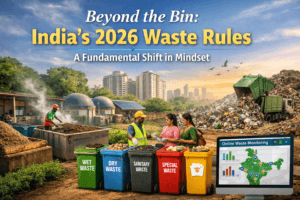
Beyond the Bin: How India’s 2026 Waste Rules Demand a Fundamental Shift in Mindset
India’s fight against its mounting waste crisis has entered a decisive new phase. The notification of the Solid Waste Management (SWM) Rules, 2026, by the Ministry of Environment, Forest and Climate Change marks more than a routine policy update; it signals a paradigm shift from a centralized, collection-driven model to a decentralized, responsibility-based framework. At its heart lies a simple yet revolutionary principle: those who generate waste in bulk must now become its primary managers. This isn’t just a new regulation—it’s a redefinition of civic duty for a significant segment of the nation.
The Burden Shift: Redefining “Bulk Generator”
The most impactful change is the precise and expanded definition of “bulk generators.” By setting clear thresholds—20,000 sq. m. of floor area, 40,000 litres of daily water consumption, or 100 kg of daily waste—the rules cast a wide net. This definition seamlessly encompasses large residential societies, university campuses, sprawling government complexes, commercial hubs, and major hostels.
Why this focus? Data reveals that these entities contribute to a staggering 30-40% of urban waste. Previously, this burden fell almost entirely on the strained resources of Urban Local Bodies (ULBs), leading to inefficient collection, overwhelmed processing plants, and overfilled landfills. The 2026 rules fundamentally challenge this dynamic. By mandating on-site processing, particularly for wet waste, the policy aims to intercept a massive waste stream before it ever hits the municipal truck. This has the potential to reduce logistical costs, curb methane emissions from transported organic waste, and dramatically lessen the load on city infrastructure.
The Mechanics of Mandated Management
The rules move beyond lofty ideals to establish a tangible, four-stream segregation system: Wet, Dry, Sanitary, and Special Care waste (like bulbs and batteries). This specificity is crucial. It moves citizens from the vague “kachra” to a precise sorting protocol, enabling proper downstream treatment.
For bulk generators, compliance involves two potential paths:
- On-Site Processing: Installing decentralized systems like composting pits, biogas plants, or organic waste converters. This is the preferred option, turning a problem (wet waste) into a resource (compost, energy).
- Extended Responsibility Certificate: Where on-site processing is genuinely infeasible, entities can obtain this certificate by formally engaging authorized waste processors and ensuring end-to-end tracking. This introduces a market-based accountability mechanism, creating demand for professional waste management services.
The introduction of a centralized online portal for tracking is a masterstroke. It promises transparency, allowing regulators and citizens to monitor compliance in real-time. This data is gold for future planning, enabling smarter logistics and evidence-based policy tweaks.
The Carrot, the Stick, and the Steep Climb Ahead
The rules are not without teeth. The calibrated landfill fee structure is a clever economic disincentive. By making it more expensive for ULBs to dump unsegregated waste than to process segregated streams, the policy aligns municipal finances with ecological goals. Simultaneously, the power granted to hilly and island regions to levy tourist fees is an acknowledgment of the unique waste burdens posed by tourism, promoting a “pay-to-pollute” principle for visitors.
However, the path to implementation is strewn with familiar challenges:
- Capital Costs: Who bears the upfront investment for on-site processing infrastructure in a residential society or a government building? While long-term savings exist, facilitating access to financing or grants will be critical.
- Behavioral Change: The success of segregation hinges on resident and employee participation. This requires sustained education and convenient, well-marked collection systems within complexes.
- Capacity Building: Resident Welfare Associations (RWAs) and building managers are now de facto waste officers. They will need training and support to navigate technical choices and vendor management.
- Ensuring Equity: The focus on bulk generators is logical, but the rules must ensure that municipal services for smaller households and slums do not deteriorate as attention shifts.
From Linear to Circular: The Bigger Picture
The 2026 rules are firmly anchored in the waste hierarchy, where prevention is paramount, and disposal is the last resort. The push for using waste as fuel in boilers or cement kilns is a direct nudge toward a circular economy, where waste is viewed not as an endpoint but as feedstock for another process. This industrial linkage is vital for managing dry, non-recyclable plastic waste.
When contrasted with the 2016 rules, the progression is clear. The earlier set laid the groundwork for segregation and door-to-door collection. The 2026 edition builds on this by enforcing accountability at the source, leveraging technology for monitoring, and creating economic levers to make proper management the cheapest option.
Conclusion: A Foundation for a Cleaner Future
The Solid Waste Management Rules, 2026, provide a robust and thoughtful legislative framework. They recognize that India’s waste problem cannot be solved by municipalities alone; it requires a collective, distributed effort. By placing the onus on bulk generators, the policy democratizes—and decentralizes—environmental responsibility.
As Priyanka Singh of CEEW notes, proper implementation can transform waste management in Indian cities. The real work begins now: in the committee meetings of housing societies, the procurement offices of government departments, and the daily habits of millions. The rulebook is ready. It’s time for a nationwide shift in mindset—from “out of sight, out of mind” to “in my space, my responsibility.” The success of this transformation will determine not just the cleanliness of our cities, but the very sustainability of our urban future.
You must be logged in to post a comment.