
Beyond the Battlefield: How the Shadow War with Iran is Reshaping the Middle East
The escalating conflict between Israel and Iran has transcended a bilateral military confrontation, evolving into a multi-layered regional crisis that is destabilizing the entire Middle East, as evidenced by an Israeli strike on a Lebanese paramedic in Sidon, persistent drone attacks on US interests in Baghdad by Iran-aligned Iraqi militias, a sweeping internal security crackdown in Iran against alleged foreign spies, and NATO’s bolstering of air defences in Türkiye out of fear of spillover; while this broader war reshapes alliances and forces nations like Iraq and Lebanon into impossible diplomatic positions, the original epicentre in Gaza remains a site of unrelenting daily violence, with hundreds killed since a nominal “ceasefire,” illustrating how the conflict has created a web of interconnected battles where civilian populations across the region now live under constant threat.
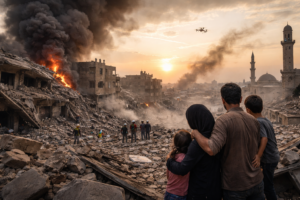
Beyond the Battlefield: How the Shadow War with Iran is Reshaping the Middle East
The crackle of gunfire and the distant thump of artillery have become the grim soundtrack to daily life for millions across the Middle East. But as the conflict between Israel and Iran escalates from a shadow war into a direct confrontation, the human story is no longer confined to the front lines of Gaza or the strikes on Beirut. It’s playing out in the terrified eyes of a family in Nahariya, northern Israel, staring at the ashes of their home; in the tense calculations of diplomats in Baghdad trying to placate both Washington and Tehran; and in the silent, deadly cat-and-mouse game of espionage unfolding in the provinces of Iran.
The news ticker on a given day—an Israeli strike in Sidon, an intercepted drone over the Green Zone, an Iranian intelligence sweep—tells us what is happening. But to understand the profound shift in the region, we must look at how these seemingly disparate events are weaving a new, more dangerous tapestry of conflict. This is no longer a war between two nations; it is a multi-layered crisis that is redrawing alliances, testing the limits of international military cooperation, and placing civilians in an ever-tightening vice.
The Northern Front: Lebanon’s Precarious Tightrope Walk
The Israeli air strike on a car near Sidon’s waterfront that killed a paramedic is a stark illustration of how the conflict is metastasizing. For weeks, the world’s focus has been on the border region of southern Lebanon, a known Hezbollah stronghold. But Sidon is different. It’s a major coastal city, a historical and commercial hub. Striking there sends a clear message: no part of Lebanon is off the table.
For the people of Sidon, a city already grappling with a devastating economic collapse, this is a nightmare scenario. The victim was not a fighter; he was a first responder, a symbol of civic duty in a state that has all but collapsed. His death reverberates through a community already living in a state of hyper-vigilance. “Every car engine that backfires, every loud motorcycle, makes you flinch,” says Rana, a shop owner in Sidon who asked that her full name not be used for fear of reprisal. “We are watching a ghost war become very, very real.”
This strike, coupled with the rising death toll from the attack on Baalbek, exposes the impossible position Lebanon finds itself in. Its government is weak, its army is outgunned, and it is beholden to Hezbollah, a group with its own military agenda. The country is effectively being held hostage by a conflict it did not choose, its sovereignty violated with impunity. The human cost is not measured in headlines, but in the families mourning in the rubble of Baalbek and the paramedics who now go to work wondering if their ambulance is a target.
The Iraqi Chessboard: A Delicate Balance of Powers
The situation in Iraq is even more complex. The overnight drone attacks on the Green Zone in Baghdad and near Victory Base are not new, but their persistence reveals a fundamental truth: Iraq is the central battleground in the US-Iranian proxy war.
When smoke rose from the US embassy compound following an intercepted attack, it wasn’t just an assault on a building; it was a calculated message from Iran-aligned factions within Iraq’s Popular Mobilisation Forces (PMF). These groups, which receive state funding and are officially part of the Iraqi security apparatus, are increasingly acting as an independent arm of Tehran’s strategy.
“The challenge is that these aren’t just rogue militars hiding in the mountains,” explains a Baghdad-based political analyst who requested anonymity due to the sensitivity of the subject. “They are part of the state. They have offices, salaries, and political representation. The Iraqi government is in an impossible position. It condemns the attacks publicly, but it cannot—or will not—move against the groups launching them without risking a civil war.”
This places Prime Minister Mohammed Shia al-Sudani in an unenviable position, forced to perform a high-wire act between his key security partner, the United States, and his powerful neighbour, Iran. For the average Iraqi, the Green Zone is a symbol of the political elite’s isolation. But when it becomes a war zone, it shatters the illusion of stability. The fire caused by falling drone debris near the embassy is a reminder that this is not a sterile conflict. It spills onto public roads, endangers ordinary people, and further destabilises a nation yearning for peace after decades of strife.
Inside Iran: The Hunt for Spies and the Grip on Power
While the world watches its external conflicts, Iran is fighting a fierce battle within its own borders. The announcement by Iran’s Intelligence Ministry that it has dismantled “royalist cells” and arrested four alleged US spies offers a glimpse into the paranoia and pressure the regime is under.
The narrative of rooting out traitors and foreign agents is a powerful tool for the government. It serves multiple purposes: it demonstrates strength and vigilance to a domestic audience anxious about the war; it justifies the continued presence and power of the security apparatus; and it deflects blame for internal problems—like economic hardship exacerbated by sanctions—onto foreign enemies and their internal “agents.”
The arrest of 111 individuals across 26 provinces in a single night speaks to a sprawling and pervasive security state. It’s a chilling reminder that in times of war, dissent is not tolerated; it is equated with treason. For ordinary Iranians, already living under the weight of economic crisis and strict social controls, this news adds another layer of fear. The “enemy within” is a powerful concept, and in the current climate, a simple social media post or a family connection to someone abroad could be enough to draw unwanted attention from the security forces. The regime is signalling that as it fights on external fronts, its grip on the home front will only tighten.
The Geopolitical Ripple Effect: NATO on Türkiye’s Doorstep
The conflict is also redrawing the strategic map for key regional powers like Türkiye. Ankara’s announcement that NATO is deploying additional Patriot missile defences to its southern province of Adana is a significant development. It underscores the very real fear that the missile exchanges between Iran and Israel could spiral out of control and directly engulf a NATO member.
Türkiye, with its complex relationship with both Moscow and Tehran, has tried to maintain a balanced foreign policy. But the reality of geography is harsh. Since the war began, Türkiye claims three Iranian missiles have landed on its territory. The decision to bolster NATO defences, even while pursuing diplomatic engagement, is a pragmatic acknowledgment that its own air defence systems are insufficient.
For the people of Adana, home to the strategic Incirlik Air Base, this is a double-edged sword. The presence of Patriot batteries might offer a sense of security, a protective umbrella against a stray missile. But it also makes them a more significant part of the conflict’s strategic calculus, potentially turning their city into a target by association. It is a stark illustration of how a conflict far from your borders can suddenly feel very close to home.
Gaza: The Grim, Unending Baseline
Amidst this regional escalation, it is crucial not to lose sight of the original epicentre: Gaza. The report from our correspondent in Gaza City, describing the “sounds of heavy artillery from all directions” and drone strikes on tents in Khan Younis, is a heartbreaking testament to the fact that for Palestinians, the war never paused.
The term “ceasefire” has become a cruel misnomer. It is a relative term, meaning a reduction in the scale of bombing, not an end to the daily violence. With 658 Palestinians killed and nearly 1,700 injured since the “ceasefire” began, the situation is a slow-burn genocide conducted under the world’s gaze. These aren’t just statistics; they are families obliterated while seeking shelter in what were supposed to be safe zones.
When a drone strike hits tents in western Khan Younis, it targets people who have already been displaced, who have already lost everything. They are living in flimsy shelters, their lives hanging by a thread, only to be cut down by a hellfire missile. This is the reality that has become the “grim daily norm.” It is the baseline of human suffering against which all other regional escalations must be measured. The war in Gaza is no longer a discrete event; it is the festering wound that poisons the entire region, providing the casus belli for actors from Lebanon to Yemen and the raw emotional fuel for the broader conflict.
In conclusion, the war between Israel and Iran has transcended a bilateral conflict. It is a regional systems failure. From the paramedic killed on the streets of Sidon to the Iraqi family breathing in smoke from a drone strike near their home, from the Iranian citizen looking over their shoulder for the secret police to the Turkish resident glancing nervously at the sky, the human impact is vast and profound. The alliances are shifting, the battlefields are multiplying, and the civilian population across the entire Middle East is left to navigate a new and terrifying reality where the front line is everywhere and nowhere at once.
You must be logged in to post a comment.