
Beyond the Battlefield: How Sun Tzu’s Ancient Wisdom Fuels India’s Modern Statecraft
Sun Tzu’s ancient maxim that the supreme art of war is to subdue the enemy without fighting finds profound resonance in India’s strategic tradition and modern statecraft, representing not the avoidance of conflict but its transcendence through superior wisdom and foresight. This philosophy echoes India’s own historical principles, from Kautilya’s graduated statecraft—where war is the last resort—to Gandhi’s Satyagraha, which subdued an empire through moral force.
In contemporary practice, India has operationalized this art by blending deterrence with diplomacy, as seen in its calibrated response to the Galwan crisis; wielding economic and digital tools like app bans to impose costs without kinetic conflict; deploying soft power through initiatives like Vaccine Maitri to build global influence; and combining precise military strikes with diplomatic isolation to counter terrorism. Ultimately, for India, mastering this art means building a strategic triad of credible hard power, agile smart power, and attractive soft power, guided by ethical statecraft to secure its interests and shape the global order through persuasion and legitimacy rather than brute force alone.
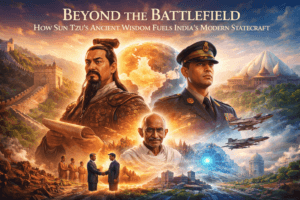
Beyond the Battlefield: How Sun Tzu’s Ancient Wisdom Fuels India’s Modern Statecraft
The most profound victories are often those you never see coming. Over two millennia ago, the Chinese strategist Sun Tzu penned a truth that echoes through the corridors of power to this day: “The supreme art of war is to subdue the enemy without fighting.” At first glance, this seems a paradox—how can one win a war without waging it? Yet, this principle represents the pinnacle of strategic thought, moving beyond brute force to the realms of psychology, diplomacy, and foresight. For a civilization like India, with its deep-seated ethos of ahimsa (non-violence) and intellectual statecraft, this is not a foreign concept but a resonant echo of its own historical genius. In an era of hybrid threats, economic coercion, and information warfare, mastering this art is not just philosophical—it is an imperative for national survival and ascendancy.
The Philosophical Bridge: From Sun Tzu to Satyagraha
Sun Tzu’s axiom is often misinterpreted as passive avoidance. In reality, it advocates for active, superior strategy that renders physical conflict redundant. It is the chess master thinking ten moves ahead, not the boxer refusing to enter the ring. This finds a powerful parallel in India’s own strategic canon.
Centuries before Sun Tzu, Kautilya’s Arthashastra outlined a sophisticated framework for statecraft. His Sama, Dana, Bheda, Danda (conciliation, gifts, division, punishment) are not isolated tools but a graduated continuum. The wise ruler, Kautilya advised, exhausts the first three before resorting to Danda (the rod of punishment). The goal was always to preserve and enhance the state’s power and prosperity, with war seen as a costly, disruptive last resort. Similarly, the Mahabharata presents Lord Krishna’s diligent peace mission to Hastinapura—a masterclass in exhausting all diplomatic avenues to avert catastrophic war.
This intellectual tradition culminated in Mahatma Gandhi’s Satyagraha, or “truth-force.” Gandhi operationalized the principle of subduing without fighting on a moral and mass scale. By confronting the British Empire with relentless non-violent resistance, he weaponized moral authority and global opinion, ultimately making colonial rule untenable. This was Sun Tzu’s ideal realized through the force of conscience—defeating an adversary by dismantling their moral justification and will to fight.
The Modern Arsenal: Where Warfare Wears a Suit
In the 21st century, the “battlefield” has radically expanded. Nations now wield currencies, data packets, vaccines, and cultural narratives as instruments of power. The objective remains Sun Tzu’s: to shape the adversary’s behavior, fracture their alliances, and erode their capacity, all while avoiding a kinetic exchange that drains resources and destabilizes the global order.
India’s recent statecraft offers textbook examples of this philosophy in action:
- The Galwan Calculus: Deterrence and Dialogue The 2020 border clash with China was a moment of extreme peril. India’s response was a calibrated two-step: an immediate, firm military buildup to signal resolve and deter further aggression, paired with persistent diplomatic and military-level talks. This dual-track approach prevented escalation into a full-scale war—a conflict that would have devastated both economies. By standing firm on the ground while keeping channels open, India secured disengagement at key points, achieving a defensive victory through strategic patience and communicated strength.
- The Digital Counterstroke: Economic Statecraft Following the border tensions, India’s ban on hundreds of Chinese apps was a masterstroke of non-kinetic retaliation. It wasn’t a missile launch, but it struck at China’s core interests: economic expansion and technological influence. This move protected national security, bolstered domestic tech aspirations, and sent a clear message of strategic autonomy. It aligned perfectly with the Atmanirbhar Bharat initiative—a long-term strategy to subdue vulnerability by building internal strength and reducing critical dependencies.
- Vaccine Maitri: Soft Power as Strategic Power During the COVID-19 pandemic, India’s Vaccine Maitri initiative was a brilliant application of “winning without fighting.” By supplying vaccines to over 100 countries, India fortified friendships, built immense goodwill across the Global South, and positioned itself as a reliable, benevolent power. This act of strategic compassion effectively countered narratives of other nations’ “vaccine diplomacy,” demonstrating that leadership could be exercised through generosity, creating a web of influence more durable than any military alliance.
- The Surgical Strike Doctrine: Precision and Messaging In response to cross-border terrorism, India’s moves have combined limited, precise kinetic action with overwhelming diplomatic and information campaigns. Surgical strikes and airstrikes like Balakot served as powerful signals of changed rules of engagement. However, their greater impact was amplified by a concerted effort to diplomatically isolate Pakistan on platforms like the FATF and the UN. This approach aimed to subdue the adversary’s strategy of using proxy terror by raising its international cost and delegitimizing it globally.
The Inherent Tension: Wisdom’s Limitations in a Hard World
For all its elegance, Sun Tzu’s doctrine faces stark modern challenges. Non-state actors and terror networks, often ideologically fanatical and unconcerned with economic costs, are less susceptible to psychological deterrence or diplomatic pressure. At times, a clear, kinetic demonstration of capability is necessary to establish credibility—restraint can be misread as weakness, emboldening aggression.
Furthermore, the tools of “peaceful warfare” like economic sanctions or cyber-attacks can cause profound civilian suffering, raising ethical questions. Mastering the art of subduing without fighting today requires not just wisdom but immense capacity: world-class intelligence for foresight, cyber commands for digital deterrence, and agile diplomacy to weave alliances.
Forging India’s Path: The Strategic Triad for the Future
To truly embody this supreme art, India must consciously cultivate a triad of powers:
- Smart Power: The agile fusion of diplomatic, economic, and intelligence tools. This means strengthening multilateral forums (QUAD, I2U2), leveraging diaspora influence, and using trade and investment as strategic levers.
- Soft Power: A consistent, confident projection of India’s cultural appeal, democratic values, and human-centric development model. Initiatives in yoga, Ayurveda, space cooperation, and disaster response are potent tools of attraction and partnership.
- Hard Power: An undeniable, modern military capability that serves as the ultimate guarantor of sovereignty and the foundation upon which smart and soft power can operate confidently. Credible deterrence makes the “without fighting” option viable.
The core of this strategy must be ethical statecraft. As External Affairs Minister S. Jaishankar noted, India is seen as a “Vishwa Mitra” (world friend). This moral credibility—the legacy of Gandhi and the practice of initiatives like Vaccine Maitri—is a unique strategic asset. In a world weary of coercion, a power that leads through consensus, respects sovereignty, and offers a positive agenda carries a persuasive authority that armies cannot buy.
Conclusion: The Ultimate Victory
Sun Tzu’s wisdom endures because it speaks to a higher understanding of power. True victory is not the pyrrhic devastation of an enemy but the preservation and enhancement of one’s own society while achieving strategic objectives. It is the victory that leaves you stronger, not bloodied; respected, not feared.
From Kautilya’s nuanced statecraft to Gandhi’s moral revolution, and from the digital borders of the app ban to the humanitarian frontiers of vaccine diplomacy, India has repeatedly demonstrated an intuitive grasp of this principle. The challenge now is to elevate it from intuitive practice to a deliberate, comprehensive doctrine. In a world of climate crises, pandemics, and invisible cyber frontiers, the ability to subdivide conflicts, build coalitions, and persuade through principle is not just the art of war—it is the art of planetary survival and enlightened leadership. For India, a nation whose civilization has long contemplated the relationship between force and righteousness, mastering this art is the key to securing its future and shaping a more stable world order—proving, once more, that the pen, the mind, and the compassionate heart remain mightier than the sword.
You must be logged in to post a comment.