
Beyond the Battlefield: How 16 Pacts Just Redefined the India-Israel Alliance
Beyond the Battlefield: How 16 Pacts Just Redefined the India-Israel Alliance
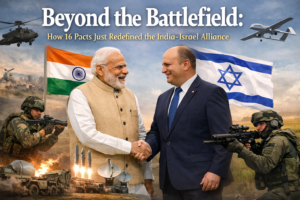
The photograph is iconic: Prime Minister Narendra Modi and his Israeli counterpart, Benjamin Netanyahu, sharing a warm embrace in Jerusalem. It’s an image that, for years, symbolized the deepening warmth between two nations long bound by the invisible threads of strategic necessity and a shared fight against terrorism. But the story emerging from New Delhi and Jerusalem on February 26, 2026, is not about a warm embrace. It is about a tectonic shift.
The announcement of 16 signed agreements and 10 additional initiatives marks a definitive moment: the graduation of the India-Israel relationship from a purely strategic, defence-centric partnership to a multifaceted, future-facing alliance. While the headlines will be grabbed by defence deals and the promise of 50,000 more Indian workers heading to Israel, the real story lies in the quiet, deliberate pivot towards collaboration in artificial intelligence, quantum computing, critical minerals, and co-development. This is no longer just an alliance against common threats; it is an alliance for common prosperity and technological sovereignty.
The Great Uncoupling: From Buyer-Seller to Co-Creators
For decades, the India-Israel relationship was defined by a simple, clear equation: Israel sold, and India bought. From the 1999 Kargil War, where Israeli UAVs and laser-guided munitions proved game-changing, to the steady supply of missiles, radar systems, and border surveillance tech, India was Israel’s largest defence customer. It was a transactional, albeit vital, relationship.
The 2026 pacts signal the death of that old model. In its place rises a framework of co-development, joint production, and technology transfer. This is a monumental leap.
Prime Minister Modi’s assertion that the two nations will “add new dimensions to the defence agreement signed in November last year” hints at a move beyond simple procurement. We are likely looking at a future where Indian defence PSUs and private companies don’t just assemble Israeli designs but sit at the table from the drawing board stage.
This shift is driven by two realities. For Israel, a small nation with world-class R&D, its biggest constraint is market size and manufacturing scale. India offers that scale, a massive domestic market, and a growing appetite for “Make in India” credentials. For India, the goal is no longer just self-sufficiency (Atmanirbharta) in defence, but technological leadership. By integrating Israeli innovation with Indian manufacturing prowess, both nations can create a defence export pipeline that targets third countries, effectively turning a bilateral relationship into a global commercial proposition. This is the true meaning of “special strategic partnership”—moving from dependency to interdependence, and finally, to synergy.
The ‘Tech Bridge’: An Alliance Woven in Silicon and Algorithms
If defence was the old glue, technology is the new bedrock. The establishment of a Critical and Emerging Technologies (iCET) partnership, modelled loosely on the Indo-US framework, is arguably the most significant outcome of the visit.
This partnership, to be led by the National Security Advisors of both countries, signals that technology is now a core component of national security. The focus areas—AI, quantum technology, and critical minerals—are the battlefields of the 21st century.
- Artificial Intelligence: Imagine Israeli algorithms, honed on decades of cybersecurity and autonomous systems experience, being trained on India’s vast, diverse datasets. This collaboration could birth AI solutions for agriculture (predicting crop yields for millions of farmers), urban planning (managing traffic in megacities), and healthcare (diagnosing diseases in remote villages). The proposed “horizon scanning” mechanism, which uses AI and data for strategic foresight, is a perfect example of this. It’s about pooling intellectual capital to predict and prepare for the future, rather than just reacting to it.
- Critical Minerals: This is a geopolitical chess move. As the world races to secure lithium, cobalt, and rare earth elements for the green energy transition, India is diversifying its supply chain beyond its dependence on China. Israel, with its advanced exploration technologies and diplomatic heft in certain regions, becomes a valuable partner. This isn’t just about mining; it’s about securing the raw materials for the batteries and electronics that will power the next generation of the Indian economy.
- Cybersecurity: The plan to establish an India-Israel Centre of Excellence in cybersecurity is a direct response to the exponential rise in digital threats. By fusing Israel’s offensive and defensive cyber capabilities with India’s vast pool of IT talent, the partnership aims to create a secure digital ecosystem for both nations, and potentially, for the world.
A Bridge for People and Produce: The FTA and the Labour Pipeline
While geopolitics and tech dominate the high table, the agreements on mobility and trade have the most tangible, human impact.
The decision to allow 50,000 additional Indian workers into Israel over five years is a masterstroke in managed migration. It addresses a critical labour shortage in Israel’s manufacturing, construction, and hospitality sectors, which have long relied on Palestinian and foreign workers. For India, it’s a win on multiple fronts: it provides employment for a skilled and semi-skilled workforce, generates a steady stream of remittances, and deepens people-to-people ties.
This isn’t a one-off gesture. The detailed list of sectors—from textiles and metal to hospitality and logistics—shows that Israel is viewing Indian workers not as temporary fixers, but as an integral part of its economic fabric. This creates a diaspora that will act as a living bridge between the two cultures for generations.
Complementing this is the renewed push for a Free Trade Agreement (FTA) . The direction from both Prime Ministers to expedite negotiations, with the next round scheduled for May, injects much-needed political will into a process that has often been bogged down by technicalities. An FTA would supercharge the current bilateral trade of $3.62 billion, which took a hit in 2024-25 due to regional instability. By reducing tariffs and regulatory hurdles, it would allow Israeli innovation to flow more freely into the Indian market and Indian goods to find a competitive footing in Israel. The goal is to transform trade from a line item into a powerful engine of the partnership.
The Geopolitical Canvas: From I2U2 to the Middle East Corridor
No modern alliance exists in a vacuum. The India-Israel partnership is now a crucial spoke in a larger, more complex wheel of regional diplomacy.
Modi’s mention of the India-Middle East-Europe Economic Corridor (IMEC) and the I2U2 grouping (India, Israel, UAE, USA) is significant. It signals that India views its ties with Israel as a gateway to the wider West Asian and Mediterranean world. IMEC, in particular, is a direct counter to China’s Belt and Road Initiative. It envisions a rail and shipping link connecting India to Europe via the UAE, Saudi Arabia, Jordan, and Israel.
A stable, prosperous, and technologically advanced Israel is essential for this corridor’s success. The joint statement, with its emphasis on regional connectivity, suggests that India and Israel are now thinking of their partnership not just bilaterally, but as a cornerstone of a new, rules-based, and transparent economic architecture for the region.
A Delicate Balance: The Unspoken Context
Of course, the visit and the agreements are shadowed by the complex realities of West Asia. Modi’s carefully worded remarks on terrorism and his call for “dialogue and the peaceful resolution of issues” are a testament to India’s delicate balancing act. India must maintain its strong strategic ties with Israel while nurturing its historical and energy-linked relationships with Arab nations like Saudi Arabia and the UAE, and its principled support for the Palestinian cause.
By explicitly linking India’s security interests to the “peace and stability in West Asia” and endorsing the “Gaza peace plan,” Modi’s statement attempts to position India not as a partisan player, but as a stakeholder in regional stability. This nuanced approach allows India to deepen its partnership with Israel without alienating its other partners in the region, thereby strengthening its own position as a reliable and independent voice in global affairs.
Conclusion: An Alliance for the Next Quarter-Century
The 16 pacts signed on February 26 are not just a list of diplomatic achievements; they are the blueprint for a relationship that has finally come of age. It has moved beyond the shadow of conflict and into the light of co-creation.
From the dusty fields of Haryana, where Israeli drip irrigation has transformed farming, to the high-tech labs in Bengaluru now collaborating with their Tel Aviv counterparts on quantum computing, this partnership is becoming tangible. It is an alliance built on the pragmatic foundation of mutual benefit—India’s scale and market meets Israel’s ingenuity and agility.
As PM Modi invited Israeli tech firms to invest in India and partner with its youth, he was articulating a vision for the next quarter-century. This is a partnership where a young Indian coder and an Israeli cyber expert will work side-by-side; where an Indian factory will produce defence systems designed on both shores; and where a “Village of Excellence” in India will showcase the best of Israeli agricultural science.
The embrace in Jerusalem was a symbol of friendship. The 16 pacts, however, are a contract for the future. And that future, rooted in technology, innovation, and shared prosperity, looks brighter than ever.
You must be logged in to post a comment.