
Beyond the Battery: How India’s New 30kW ‘Brain’ is Rewiring the EV Revolution
The 30kW Wide Band Gap-based Integrated Drive System (IDS) launched in Chennai by C-DAC, IIT-Madras, and Lucas TVS represents a watershed moment for India’s electric vehicle sector, as this indigenous technology integrates the motor and inverter into a single, compact unit using advanced semiconductors that dramatically improve efficiency, range, and charging speed while reducing weight and system costs. By targeting the critical 30kW power class—ideal for India’s compact passenger cars and fleet vehicles—this “Made in India” innovation directly confronts the nation’s dependence on imported EV components, strengthens domestic supply chains, and creates a collaborative blueprint where academic research (IIT-Madras/C-DAC), industrial scale (Lucas TVS), and policy vision (NAMPET) converge to transform India from a technology importer into a potential exporter of cutting-edge automotive intelligence, ultimately making electric mobility more affordable, practical, and self-reliant for the Indian masses.
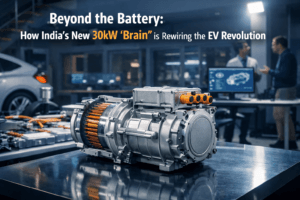
Beyond the Battery: How India’s New 30kW ‘Brain’ is Rewiring the EV Revolution
The hum of an electric vehicle is often described as silent, but beneath the quiet exterior, a symphony of sophisticated technology is at work. On March 3, 2026, in Chennai, a new composition was added to India’s automotive repertoire. The launch of a 30kW Wide Band Gap-based Integrated Drive System (IDS)—a collaboration between C-DAC Thiruvananthapuram, IIT Madras, and Lucas TVS—is more than just a headline in the business press. It is a declaration of technological sovereignty and a glimpse into the future of how India will move.
For the casual observer, “30kW Integrated Drive System” might sound like engineering jargon. But to understand its significance is to understand the very heart of the electric vehicle (EV) revolution and why this “Made in India” component could be as crucial as the battery itself.
The ‘Heart Transplant’ of the Electric Car
To grasp the importance of this launch, one must first understand what this new technology replaces. For decades, the powertrain of an electric vehicle has been a somewhat clunky marriage. You have the electric motor, a robust cylindrical unit that turns electrical energy into motion. Connected to it by a bundle of thick, high-voltage cables is a separate box—the inverter. This inverter acts as the brain’s interpreter, taking the DC (direct current) power stored in the battery and converting it into AC (alternating current) to spin the motor, all while precisely controlling its speed and torque.
This conventional setup, while functional, is like having a stereo system with a receiver, a CD player, and an amplifier all as separate components connected by a rat’s nest of wires. It’s bulky, heavy, prone to energy loss in those cables, and requires more space in the vehicle—space that could be used for legroom or, more critically, more batteries.
The 30kW Wide Band Gap-based Integrated Drive System (IDS) throws this old blueprint out the window. It integrates the motor and the inverter into a single, compact, and exquisitely engineered unit. Think of it as moving from that bulky stereo system to a sleek, modern soundbar. It does everything the old system did, but it does it in a fraction of the space, with less weight, and with breathtaking efficiency.
The Magic of the ‘Wide Band Gap’
The real star of the show, and the source of the system’s “advanced” tag, is the “Wide Band Gap” (WBG) technology. This refers to the type of semiconductors used inside the inverter.
Traditional EVs use silicon-based chips. Silicon is a great workhorse, but it has its limits. When electricity flows through it, it creates resistance, which in turn generates heat. This heat is wasted energy, and managing it requires bulky cooling systems. Silicon simply cannot handle extremely high voltages, frequencies, or temperatures without significant losses.
Enter Wide Band Gap semiconductors, typically made from materials like Silicon Carbide (SiC) or Gallium Nitride (GaN). The “band gap” is the energy required to knock an electron loose and start conducting electricity. In WBG materials, this gap is much wider, allowing them to withstand much higher voltages and temperatures before breaking down.
What does this mean for the Indian EV buyer?
- Increased Range: Because WBG devices are far more efficient (wasting less energy as heat), more of the battery’s precious power makes it to the wheels. For a consumer, this translates directly to more kilometers per charge, chipping away at the ever-present “range anxiety.”
- Faster Charging: WBG systems can handle the higher power levels required for ultra-fast DC charging. This means the 30kW IDS is future-proofed for a time when charging your EV might take no longer than a coffee break.
- Compact and Lightweight Design: The integration, enabled by the smaller cooling needs of WBG components, leads to a lighter powertrain. A lighter car is a more efficient car. It also frees up space for designers to create roomier cabins or larger battery packs without making the vehicle bigger.
- Greater Reliability: These components are inherently more robust and can operate reliably in the harsh conditions of Indian roads—from the scorching heat of Rajasthan to the humidity of Kerala—without performance degradation.
A Strategic Masterstroke: Why Indigenous Development Matters
- Krishnan, Secretary of MeitY, rightly framed this achievement within Prime Minister Modi’s vision of “Make in India, Make for the World.” But the strategic reality on the ground is even more compelling.
Currently, the high-performance semiconductors and the sophisticated control software that form the core of modern EVs are overwhelmingly imported, primarily from Europe, the US, and China. This creates a dependency that is both economically and strategically risky. India was essentially buying the brains of its electric vehicles from abroad, while assembling the body at home.
The development of the 30kW IDS by C-DAC and IIT Madras, in collaboration with an industry giant like Lucas TVS, is a direct assault on this import dependence. It represents the creation of deep-tech intellectual property (IP) on Indian soil.
- For the Economy: It shores up the supply chain. When global chip shortages snarled the auto industry a few years ago, Indian manufacturers were left waiting. An indigenous source of critical technology provides a buffer against such global shocks.
- For the Industry: It lowers costs. By designing and manufacturing the core technology locally, the cost of the entire powertrain system can be reduced. This saving can be passed on to the consumer, making EVs more affordable and accelerating adoption.
- For National Security: In an era where technology is a geopolitical battleground, controlling the IP for critical infrastructure like transportation is a matter of strategic autonomy.
The Sweet Spot: Why 30kW Matters for India
The choice of a 30kW system is not arbitrary. It is a laser-focused strike at the heart of India’s personal mobility market. This power class is the sweet spot for a vast array of vehicles that define Indian roads:
- Compact Electric Cars: Think of the next-generation Alto or Wagon R, but electric. These city cars don’t need the 100kW+ motors of a luxury sedan. A highly efficient 30kW motor is perfectly adequate for zipping through city traffic, providing peppy performance without the cost and weight penalty of a larger system.
- Fleet Mobility Platforms: The booming taxi aggregator market (Ola, Uber) relies on cars that are affordable, durable, and cheap to run. The 30kW IDS promises lower maintenance (fewer parts, greater reliability) and lower energy costs, a game-changer for driver economics.
- Light Commercial Vehicles: The last-mile delivery vans and small trucks that keep e-commerce running are ideal candidates for this technology. It provides the torque needed for stop-start city driving while maximizing the range for a day’s worth of deliveries.
By targeting this segment, the collaboration isn’t just building a technology; it’s building a platform that can democratize electric mobility for the Indian masses.
The IIT-Madras-C-DAC-Lucas TVS Trinity: A Blueprint for the Future
Perhaps the most heartening aspect of this story is the collaboration model. It brings together the three pillars of a successful innovation ecosystem:
- The Research Powerhouse (IIT Madras & C-DAC): The academic and R&D institutions provided the deep scientific knowledge, the cutting-edge research on WBG materials, and the complex control algorithms. They de-risked the fundamental technology.
- The Industry Executioner (Lucas TVS): A storied automotive component manufacturer with decades of experience in taking a design and turning it into a reliable, mass-producible product. They provided the engineering know-how for thermal management, vibration resistance, and manufacturing scalability.
- The Policy Enabler (NAMPET/MeitY): The National Mission on Power Electronics Technology provided the vision, the funding, and the strategic direction, creating a sandbox where such ambitious collaborations could flourish.
This trinity is a powerful blueprint. It proves that India can move beyond being a nation of “job-workers” and “assemblers” to become a creator of high-value intellectual property. It also creates a fertile ground for startups. With the core IP de-risked and validated, a new generation of entrepreneurs can build upon it, creating specialized motor controllers for electric two-wheelers, or bespoke drive systems for agricultural equipment.
The Road Ahead: From Chennai to the World
The inauguration in Chennai is not the end; it is the beginning. The technology is now “ready for commercialization and large-scale deployment.” This is where the real work begins. Lucas TVS will now play a pivotal role in ramping up production, ensuring quality control, and integrating the system into the platforms of various automobile manufacturers.
The success of this project will be measured not in press releases, but on the road. It will be measured in the smile of a cab driver in Mumbai who saves an extra thousand rupees a month on electricity. It will be measured in the confidence of a family in Bangalore who can now take their compact EV on a weekend trip without fear of being stranded. It will be measured in the quiet hum of a million electric cars, powered by a brain that was designed, engineered, and built in India.
This 30kW Integrated Drive System is a testament to the fact that the Indian EV story is no longer just about policy pushes and purchase subsidies. It is about building the intellectual and industrial muscle to power our own future. It is a story of turning a technological import-dependent nation into a potential exporter of cutting-edge automotive intelligence. The revolution, it seems, has found its brain.
You must be logged in to post a comment.