
Beyond the Barrel: How the West Asia Conflict is Starving India’s Core Industries of Vital Minerals
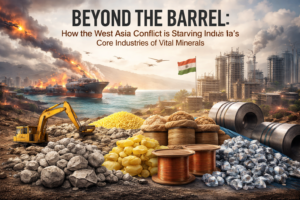
Beyond the Barrel: How the West Asia Conflict is Starving India’s Core Industries of Vital Minerals
The world watches the West Asia conflict through the lens of oil prices. Every missile launch, every tanker skirmish, and every statement from Tehran or Washington sends immediate tremors through the global energy market. For India, a nation that imports over 85% of its crude oil, this volatility is an old, painful acquaintance. We brace for higher petrol prices and a widening import bill.
But to focus solely on oil is to miss the larger, more insidious economic crisis brewing just beyond the Strait of Hormuz. The war in West Asia is not just a fuel crisis; it is a raw material famine threatening the very foundations of India’s industrial economy. From the skyscrapers we build to the food we grow, the wires that power our homes and the steel that frames our cities, the inputs are increasingly coming from a region now engulfed in flames.
While policymakers scramble to secure energy supplies, a quieter, more complex disruption is unfolding. It threatens to stall infrastructure projects, inflate the cost of construction, choke the production of life-saving fertilizers, and grind India’s flagship diamond polishing industry to a halt. This is the story of the hidden供应链 (supply chain) under siege.
The Geography of Dependence: More Than Just Petrodollars
The West Asia region, encompassing the Gulf Cooperation Council (GCC) countries, Iran, Iraq, and others, has long been India’s strategic backyard. Our ties are built on centuries of trade, a vast diaspora, and a seemingly symbiotic energy relationship. In the fiscal year 2025, India imported goods worth a staggering $98.7 billion from the region, according to the Global Trade Research Initiative (GTRI).
We understand this as the cost of oil and gas. However, a deep dive into the trade data reveals a far more granular and critical dependency. The region is not just a fuel station for the Indian economy; it is a quarry and a mine. It is the source of the very dust and rocks that build modern India.
- The Dust That Builds Nations: Limestone and Gypsum Under Threat
Imagine a cement factory in rural Madhya Pradesh. Its massive kilns, running day and night, are essentially giant digesters that cook limestone at high temperatures to produce clinker, the key ingredient of cement. Now, imagine that supply of limestone, seemingly as common as dirt, is suddenly cut off.
It sounds improbable, but India’s construction sector is heavily reliant on high-quality limestone and gypsum from West Asia. In 2025, India sourced 68.5% of its limestone imports—worth $483 million—from the region. This is not just any limestone; it is often preferred for its specific chemical purity, essential for producing high-grade cement for dams, bridges, and high-rises. Similarly, 62.1% of India’s gypsum imports ($129 million), used to control the setting time of cement and in plasterboard, come from the region.
The human impact of a disruption here is not an abstract number on a spreadsheet. It translates to halted construction of a new hospital in Bihar. It means cost overruns for a metro rail project in Bengaluru. It forces a real estate developer in Noida to renegotiate contracts or pass on the increased costs to homebuyers already stretched thin.
While industry insiders argue that alternatives exist—limestone can be sourced from the UAE or Thailand, and gypsum from Oman or even Iran—the switch is not like changing a lightbulb. It requires re-certifying raw materials, recalibrating manufacturing processes, and building new logistics chains. In the short term, any sudden stoppage from West Asia would create a mad scramble, sending spot prices soaring and forcing companies to burn through whatever limited stockpiles they have.
- The Food on Our Plates: Sulphur and the Fertiliser Equation
Perhaps the most alarming dependency is on sulphur. India imported 65.8% of its sulphur—worth $420 million—from West Asia. This bright yellow element is not an end product in itself. It is the foundational chemical for producing sulphuric acid, the lifeblood of the fertilizer industry.
Sulphuric acid is used to manufacture phosphatic fertilizers like DAP (Di-Ammonium Phosphate), which are essential for India’s Green Revolution-style agriculture. Without a steady stream of sulphur, the giant fertilizer plants in Gujarat, Odisha, and Tamil Nadu would be forced to curtail production. This comes at a time when global fertilizer markets are already notoriously volatile.
For now, as Prashant Vashisht of ICRA points out, the industry has a slight buffer. “It is currently an off-season for fertilizer consumption,” he notes. Farmers are not in the fields demanding sacks of urea and DAP. But this is a temporary reprieve. If the conflict and subsequent supply disruptions drag on for a month or more, the timing could become catastrophic.
“The domestic urea production and availability for the upcoming kharif (summer sowing) season will get impacted,” Vashisht warns. A delayed or reduced kharif season doesn’t just mean less food; it means rural distress, farm loan defaults, and ultimately, higher food inflation for every Indian consumer. The government is already exploring alternatives like sourcing sulphur from Southeast Asia, but building a new supply chain for a critical chemical input mid-conflict is a logistical nightmare.
- The Backbone of Industry: Steel’s Double Whammy
The Indian steel industry, the second-largest in the world, is caught in a pincer movement. On one side, it is hit by the direct loss of raw materials. On the other, it is being squeezed by the indirect cost of energy.
India imports 59.1% of its Direct Reduced Iron (DRI)—worth $190 million—from West Asia. DRI, also known as sponge iron, is a high-quality metallic product used in electric arc furnaces, a cleaner and more flexible method of steelmaking. A disruption here would force steel plants to rely more heavily on scrap or blast furnaces, potentially increasing costs and carbon emissions.
But the industry insider quoted in the original report gets to the heart of the matter: “The real challenge is the movement in oil and gas prices.”
Modern steelmaking, particularly as it pivots towards decarbonisation, is increasingly gas-dependent. Many plants use LNG and LPG as a fuel and a reducing agent. When global gas prices spike due to a conflict in a major producing region, the cost of making a tonne of steel in India skyrockets. Pankaj Chadha, Chairman of the EEPC, confirms this stress: “Most plants depend on LPG and LNG, and availability has become an issue.”
This creates a cascading effect. Steel is the mother of all industries. When steel prices rise, the cost of making cars, washing machines, ships, and factory machinery all rise. India’s ambitious infrastructure push—its highways, railways, and ports—becomes more expensive, potentially derailing the very engine of economic growth the government is trying to fuel.
- Powering Progress: The Copper Wire Conundrum
As India races to build its renewable energy capacity and modernise its power grid, copper has become a strategic metal. It is the silent workhorse of the energy transition, conducting electricity from solar farms to cities and from windmills to factories.
Half of India’s copper wire imports—a staggering $869 million worth—come from West Asia. This isn’t just about wiring a new building. It is about winding the coils in transformers that step down voltage for your home. It is about the cables that run along railway tracks for electrification. It is the conductive material in the motors of electric vehicles.
A disruption in copper wire supplies could delay critical power transmission projects, hindering the government’s ‘One Nation, One Grid’ initiative and slowing the rollout of EV charging infrastructure. It would create bottlenecks in the very sectors designed to make India self-reliant in energy, creating a cruel irony where the cure for energy dependence is itself dependent on a conflict zone.
- The Glittering Gamble: Diamonds in the Rough
Finally, there is the human story of Surat. In the diamond polishing units of Gujarat, skilled artisans take rough, uncut stones and turn them into the brilliant gems that adorn jewellery in New York and London. This industry is a massive employer and a top foreign exchange earner for India.
But the rough diamonds arrive in Surat from the world’s trading hubs, many of which are in West Asia. With over 40% of India’s rough diamond imports originating from the region, the conflict has thrown the industry into a state of suspended animation. The report mentions containers stuck at ports. For the diamantaire, a stuck container is not just a logistical delay; it is working capital locked up, orders unfulfilled, and trust eroded with international buyers. For the worker in Surat, it could mean a week without overtime, or worse, a pink slip.
Conclusion: A Storm in the Strait
The Strait of Hormuz, a narrow chokepoint through which a fifth of the world’s oil passes, is also the maritime highway for India’s industrial lifeline. A prolonged closure or persistent attacks on shipping in this region would be a systemic shock to the Indian economy unlike anything seen in recent decades.
The Indian response so far has been a scramble: diversify sources, explore alternatives, tap into strategic reserves. But these are band-aids for a bullet wound. They buy time, but they don’t solve the underlying structural vulnerability. The war in West Asia is a stark reminder that for all its talk of Atmanirbharta (self-reliance), India’s core industries remain deeply, inextricably linked to the peace and stability of a volatile neighbourhood. The cost of this conflict is not just measured in barrels of oil, but in the halted construction, the delayed power projects, and the anxious faces of farmers and factory workers whose livelihoods depend on a steady stream of minerals from a region at war.
You must be logged in to post a comment.