
Beyond the Barrel: How L&T’s Vizag Marvel is Redefining India’s Energy Independence
Larsen & Toubro has achieved a landmark feat in India’s energy sector by successfully commissioning the world’s first LC-Max Residue Upgradation Facility at HPCL’s Visakh Refinery—a project that transforms low-value refinery residue into high-quality, BS-VI compliant fuels, thereby advancing national energy self-reliance. Executed under extraordinarily challenging conditions, including pandemic disruptions and severe space constraints within an operating brownfield site, L&T pioneered innovative construction approaches, modularizing over half the plant into 135 massive prefabricated units and employing precast civil construction to ensure safety, quality, and timely completion.
This complex facility not only incorporates first-of-its-kind technology in India but also stands as a testament to indigenous engineering excellence, setting a new global benchmark for refinery modernization and significantly enhancing the value derived from domestic crude oil.
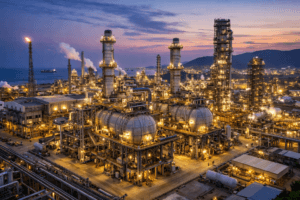
Beyond the Barrel: How L&T’s Vizag Marvel is Redefining India’s Energy Independence
In the heart of Visakhapatnam, within the complex lattice of pipes and towers of HPCL’s refinery, a quiet revolution has been commissioned. It doesn’t roar with the fanfare of a new rocket launch, but its impact on India’s journey to energy self-reliance is just as profound. Larsen & Toubro’s successful feed-in of the world’s first LC-Max Residue Upgradation Facility (RUF) is more than an engineering milestone; it’s a masterclass in transforming the dregs of the oil barrel into high-value fuel, turning a refinery’s waste stream into a wellspring of national value.
For decades, the heavy, tar-like residue left after initial crude oil refining—vacuum residue—posed an economic and environmental challenge. Often used as low-value fuel oil or bitumen, its potential was locked away. HPCL’s Visakh Refinery Modernisation Project, a cornerstone of the National Energy Self-Reliance Programme, sought to crack this code. The task awarded to L&T on an EPC turnkey basis was Herculean: build a first-of-its-kind facility that could force this stubborn residue to yield higher yields of valuable distillates like diesel and petrol, all while meeting India’s stringent BS-VI emission standards.
The Complexity at Scale: Why This Project Was a Different Beast
Calling the RUF just another process unit is like calling a symphony orchestra a noise-making group. As the most complex unit of the modernization project, it integrates several technologies never before seen together in an Indian refinery. Imagine the precision of Ebullating pumps managing catalysts in a high-pressure slurry, the robustness of Grayloc flanges ensuring zero-leak safety in critical junctions, and the controlled power of Pressure Let-down Stations—all working in concert to “upgrade” molecular structures.
But the true genius of this project lies not just in what was built, but how and where it was built. The execution narrative is etched with challenges that would make any project manager pause:
- A Brownfield Puzzle: This wasn’t a blank slate. The facility was constructed within a fully operational refinery in the dense urban landscape of Vizag. Space was a luxury. Every crane movement, every delivery of a 700-tonne module, was a meticulously planned ballet amidst live process units.
- A Pandemic-Period Marathon: Critical construction phases collided with the peak of the COVID-19 pandemic. Mobilizing and safeguarding a workforce, maintaining productivity amidst lockdowns, and managing sudden supply chain seizures tested L&T’s resilience to its core.
- Global Logistics in Disarray: Geopolitical tensions and worldwide supply chain disruptions meant that sourcing specialized equipment became a strategic mission in itself, requiring agile, real-time problem-solving.
The Off-Site Revolution: Modularization as a Lifeline
Confronted with these “severe constructability constraints,” L&T didn’t just push harder; they thought smarter. Their solution was a bold pivot to large-scale modularization, a strategy that may well become the blueprint for future brownfield refinery expansions in India.
Instead of traditional stick-built construction, over half of the structural and piping scope was transformed into 135 plug-and-play modules. These were not small widgets. Some stretched to 35 meters—longer than a blue whale—and weighed up to 700 metric tonnes. They were fabricated with surgical precision at L&T’s advanced manufacturing facilities in Hazira, Vadodara, and other locations, in controlled environments away from the site chaos.
This approach was transformative:
- Mitigated Site Congestion: It drastically reduced the labor, materials, and activity density in the hazardous operating refinery, enhancing safety.
- Assured Quality: Fabrication in a factory setting allowed for superior welding, coating, and quality control compared to a congested site.
- Beat the Timeline: Site preparation and module fabrication happened in parallel, compressing the critical path. These giant Lego blocks were then transported in a jaw-dropping logistical feat involving 230 over-dimensional consignments traversing Vizag’s streets, and installed with millimetre-perfect alignment.
Similarly, L&T applied innovative thinking to civil works, executing over 50% of civil construction, including all three substation buildings, in precast mode—another first for an Indian refinery. This not only accelerated the schedule but also minimized dust, debris, and disruption in the operating plant.
The Human and Strategic Triumph
Behind the statistics of 58 million safe workhours and 750 equipment items lies a story of human endeavor. It’s the story of engineers who designed complex 3D models to ensure every module fit perfectly, of welders who worked on these behemoths in fabrication yards, of logistics experts who planned the nocturnal moves of gigantic loads through a sleeping city, and of site crews who integrated it all under the shadow of a pandemic.
Strategically, this facility is a game-changer for India. By extracting more high-value transportation fuels from the same barrel of domestic crude, it directly reduces the need for imports and improves the refinery’s gross refining margin. It aligns perfectly with the nation’s dual goals of energy self-sufficiency and a cleaner fuel future. The BS-VI compliant fuels produced will contribute to better air quality, making the project a nexus of economic and environmental sense.
As Mr. Subramanian Sarma, L&T’s Deputy Managing Director and President, rightly noted, this project reaffirms a leadership built on executing the seemingly impossible. It wasn’t just about building a plant; it was about delivering a working promise of innovation and precision under fire.
A Legacy Beyond Vizag
The successful feed-in at Vizag is a defining moment, but its resonance will travel far beyond Andhra Pradesh. It demonstrates that with domestic engineering prowess, cutting-edge technology, and transformative construction methodologies, India can not only envision but also execute frontier industrial projects that set global benchmarks.
For L&T, this is a testament to an 80-year legacy of building the nation, now evolving into building the nation’s technological sovereignty. For India’s refining sector, it’s a powerful proof concept: that the path to energy security is paved with innovation, and that even the heaviest residue of the past can be upgraded into a lighter, brighter, more self-reliant future. The world’s first LC-Max RUF is now online, and it’s quietly powering a more confident, capable India.
You must be logged in to post a comment.