
Beyond the Banyan Tree: The Enduring Legacy of Prof. Ramakrishna Ramaswamy, a True Architect of Indian Science
Prof. Ramakrishna Ramaswamy was a visionary leader whose enduring legacy lies in his seamless integration of deep scientific inquiry with transformative institutional building, most notably during his tenure as the 8th Vice Chancellor of the University of Hyderabad. A distinguished scientist whose research journey spanned from the precise world of chemistry at Princeton to the expansive realms of nonlinear dynamics and computational biology, he brought a unique, interdisciplinary worldview to academic governance. At UoH, his leadership transcended mere infrastructure development; he fundamentally reshaped the intellectual culture by creating new schools, fostering collaborative ecosystems, and championing academic programmes that broke down traditional silos. His true and lasting impact, however, is found in the strengthened research ethos he cultivated and the generations of scientists he mentored, cementing his role as a true architect of modern Indian science who understood that building great institutions requires first nurturing a great intellectual culture.
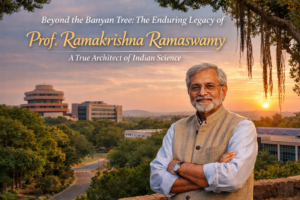
Beyond the Banyan Tree: The Enduring Legacy of Prof. Ramakrishna Ramaswamy, a True Architect of Indian Science
On a university campus, the tenure of a Vice Chancellor is often measured in buildings built and budgets balanced. But the true metric of a great academic leader lies in the intellectual climate they foster—the subtle shift in conversation, the encouragement of a risky collaboration, the quiet confidence instilled in a young faculty member. By that measure, the legacy of Prof. Ramakrishna Ramaswamy, the 8th Vice Chancellor of the University of Hyderabad (UoH), extends far beyond the physical infrastructure completed during his term from 2011 to 2015. It is etched into the very DNA of the institution’s research culture.
A profile of Prof. Ramaswamy is not merely a chronological listing of degrees and designations; it is a masterclass in the evolution of a scientist into a statesman, and a testament to the power of a unified vision for higher education in India. His story is one of traversing disciplines—from the precise world of chemistry to the chaotic beauty of nonlinear dynamics, and finally to the complex realm of institutional governance—all while maintaining an unwavering commitment to intellectual rigour and mentorship.
From Loyola to Princeton: Forging a Scientific Temper
The foundation of Prof. Ramaswamy’s multifaceted career was laid in the 1970s, a decade of significant ferment in the world of science. His journey began with a B.Sc. in Chemistry from the esteemed Loyola College, Madras, in 1972. It was there, amidst a tradition of holistic education, that his analytical curiosity was first ignited. He then moved to the Indian Institute of Technology, Kanpur, a crucible of scientific excellence, to earn his M.Sc. in Chemistry in 1974. IIT Kanpur, with its emphasis on rigorous problem-solving, honed his skills and prepared him for the next great leap: a Ph.D. at Princeton University.
Princeton in the late 70s was a hothouse of intellectual activity. Working under the auspices of a top-tier chemistry department, young Ramaswamy was immersed in a world where the boundaries between physics and chemistry were beginning to blur. His doctoral work, completed in 1978, was his first deep dive into the theoretical underpinnings of molecular behaviour. But perhaps more important than the degree itself was the exposure to a system of inquiry that valued fundamental questions over immediate applications. This ethos—of chasing a problem for its intrinsic scientific beauty—would become a hallmark of his entire career.
A subsequent post-doctoral stint at the California Institute of Technology (Caltech) from 1978 to 1980 further cemented this worldview. Caltech, with its small size and intense focus on discovery, placed him at the very forefront of American scientific research. It was a formative period that equipped him with not just knowledge, but a global perspective on how science is best done: collaboratively, competitively, and with an unyielding dedication to excellence.
The Chaotician and the Complexity of Life
Upon returning to India, Prof. Ramaswamy’s research trajectory took a fascinating turn. While his formal training was in chemistry, his intellectual appetite was far more expansive. He began to focus on nonlinear dynamics and chaos theory—a field that seeks to understand systems so sensitive to initial conditions that their long-term behaviour appears random, famously described as the “butterfly effect.”
This was not a random pivot. It was a natural progression for a mind interested in the fundamental laws governing matter. After all, chemical reactions are dynamic, molecular vibrations are not perfectly harmonic, and the world, at its most granular level, is inherently complex. His work during this period, much of it conducted during his long and distinguished tenure at Jawaharlal Nehru University (JNU) from 1986 onwards, explored classical and quantum chaos, the dynamics of clusters of atoms, and the statistical mechanics of disordered systems.
What set Prof. Ramaswamy apart was his ability to see the connective tissue between seemingly disparate fields. He wasn’t just a theorist working on abstract equations; he was a scientist searching for patterns. This intellectual restlessness naturally led him, in the late 1990s and early 2000s, to one of the most exciting frontiers of science: computational biology and genomics.
Life, after all, is the ultimate complex system. Genomes are sequences of information that evolve through non-linear interactions with their environment. Proteins fold into three-dimensional structures in ways that defy simple prediction. By applying the tools and mindsets of a physicist—looking for emergent properties, scaling laws, and dynamic patterns—he brought a fresh perspective to biological questions. His role as a Professor at the Centre for Computational Biology and Bioinformatics at JNU from 2002 was a testament to this foresight. He was not just adapting to an interdisciplinary trend; he was helping to create it in India, demonstrating that the tools of chaos theory could be as relevant to understanding a pandemic as they were to understanding a molecular vibration.
The Accidental Administrator: A Vision for Interdisciplinarity
A common narrative in academia is that great scientists are often reluctantly pressed into administrative service. For Prof. Ramaswamy, administration seemed less a burden and more a natural extension of his scientific worldview. If his research taught him that complex systems thrive on interaction and connectivity, then why should a university be any different? A university, in his view, was also a complex system, and its health depended on breaking down the silos between its constituent parts.
This philosophy crystallized during his tenure as Vice Chancellor of the University of Hyderabad. He arrived at a pivotal moment, tasked with steering the institution toward a higher trajectory of global relevance. His vision was not to build new departments in isolation, but to create an ecosystem where they could interact.
The structural changes he implemented were a direct manifestation of this. The creation of the School of Economics, the School of Mathematics and Statistics, and the School of Computer and Information Sciences as distinct entities was not merely an administrative reorganization. It was an act of intellectual curation. By giving these fields their own academic homes, he strengthened their core. But by placing them in close proximity—physically and administratively—within the UoH ecosystem, he was fostering an environment ripe for cross-pollination. A statistician could now more easily collaborate with a computer scientist on a genomics problem; an economist could model complex market behaviours with a physicist.
This was the same logic behind the establishment of the College for Integrated Studies. It was a bold move to create a space explicitly designed for interdisciplinary learning, a place where students could transcend traditional boundaries and be equipped to tackle problems that don’t fit neatly into a single textbook.
His focus was always on the research ecosystem. The completion of the Life Sciences building and the BSL-3 facility was more than just a construction project. It was a signal of intent, providing the high-containment infrastructure necessary to attract top talent and conduct world-class research in infectious diseases. Similarly, the strengthening of computational resources across campus was an acknowledgment that modern science, regardless of discipline, is increasingly data-intensive.
Even the seemingly smaller initiatives, like the Annual Chancellors Awards for excellence in teaching and research, spoke to a leader who understood the importance of motivation and recognition in a thriving academic culture. He knew that a university’s greatest asset is its people, and that excellence must be celebrated to be sustained.
A Citizen of the Global Scientific Community
Prof. Ramaswamy’s leadership at UoH was so effective precisely because he was a citizen of the world. His long list of international affiliations—from the Institute for Advanced Study in Princeton to the Isaac Newton Institute in Cambridge and the University of Tokyo—was not just a line on his CV. These experiences gave him a clear-eyed view of where Indian science stood and where it needed to go.
He brought this global sensibility back to Hyderabad. The international collaborations he encouraged were not just about publishing papers together; they were about embedding UoH faculty and students into global networks of knowledge. This exposure was crucial for a university aspiring to be counted among the world’s best.
His subsequent leadership roles in the highest echelons of Indian science—as President of the Indian Academy of Sciences and Vice President of the Indian National Science Academy—were a recognition of his stature not just as a researcher, but as a thoughtful leader capable of shaping national science policy. He was a voice of reason, advocating for a scientific ecosystem that was both rigorous and humane, competitive and collaborative.
The Quiet Mentor and the Living Legacy
Perhaps the most profound, yet hardest to quantify, aspect of Prof. Ramaswamy’s legacy is his role as a mentor. For decades, at JNU, at UoH, and even after his “retirement” as a Visiting Professor at IIT Delhi and an Honorary Professor at IISER Berhampur, he has been a constant presence for generations of students and young faculty. His passing of the baton continues in his editorial roles, shaping the discourse in journals like the Journal of Physics: Complexity and guiding young authors through the TRiPS book series.
The story of Prof. Ramakrishna Ramaswamy is ultimately one of seamlessness. There was no break between the scientist and the administrator, the theorist and the mentor. The same intellectual curiosity that drove him to explore chaos in chemical systems drove him to nurture collaboration within a university. The same clarity of thought that he applied to a problem in quantum mechanics he applied to reorganizing a school.
When we look at the University of Hyderabad today—with its robust research output, its interdisciplinary programmes, and its growing global footprint—we are seeing the maturation of seeds planted during his tenure. The 100KW solar plant on the library is a fitting metaphor: a quiet, efficient, and forward-looking source of power, much like the man himself, providing the energy for an institution to grow, sustainably and brilliantly, into the future.
His legacy is not just the Zakir Husain Complex or the VC Lodge he helped build, but the countless conversations he sparked, the interdisciplinary bridges he built, and the confident, globally-minded scientists and scholars he helped shape. He stands as a true architect of modern Indian science, a visionary who understood that to build a great institution, you must first cultivate a great intellectual culture.
You must be logged in to post a comment.