
Beyond the Ban: What the Palestine Action Ruling Reveals About Britain’s Failing Democracy
A UK high court ruling that declared the government’s proscription of Palestine Action unlawful has exposed the depths of a political establishment willing to misuse terrorism laws against activists while facilitating what genocide scholars and international bodies have concluded are Israeli war crimes in Gaza, with the decision representing not just a legal victory for freedom of expression but a moral indictment of the 624 MPs who voted to place a direct-action group on the same legal footing as al-Qaida, the government’s desperate attempt to silence those who act on the moral conclusions ministers themselves privately hold, and a damning illustration of how the British state would rather imprison elderly protesters than confront its own complicity in arming a campaign that has killed tens of thousands of Palestinians.
Beyond the Ban: What the Palestine Action Ruling Reveals About Britain’s Failing Democracy
The high court’s decision to overturn the proscription of Palestine Action isn’t just a legal victory—it’s a damning indictment of a political establishment that has abandoned its moral compass.
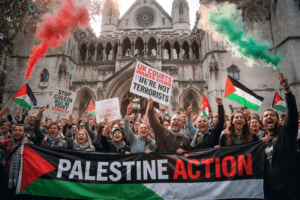
Outside the Royal Courts of Justice on Friday, as news spread that judges had declared the government’s ban on Palestine Action unlawful, there were scenes that told a story no courtroom transcript could capture. Elderly activists who had spent months facing the prospect of 14-year prison sentences simply for holding placards embraced one another. A retired priest who had been arrested while peacefully demonstrating wiped tears from his eyes. Young organisers who had watched their movement branded alongside al-Qaida and Islamic State allowed themselves, for a moment, to feel vindicated.
They had won. But the victory was never really about them.
The Terrorism Label: When Words Lose All Meaning
Let’s sit with what the British government actually did. In a decision that three high court judges have now found to be unlawful, the Home Office placed a direct-action group whose primary tactic involves damaging property belonging to an Israeli arms manufacturer on the same legal footing as organisations that behead journalists and bomb civilian airliners.
The Terrorism Act 2000 was never designed for this. Its architects, drafting it in the aftermath of the Omagh bombing, sought to give authorities the tools to combat organisations engaged in the kind of violence that leaves communities shattered and morgues overflowing. They did not envision it being used against activists armed with bolt cutters and spray paint.
Yet here we are. Between the proscription in October 2024 and Friday’s ruling, more than 2,700 people were arrested for expressing support for Palestine Action. Not for damaging property themselves—for expressing support. The chilling effect on legitimate political expression cannot be overstated. When simply holding the wrong placard at a protest can land you in prison for longer than some rapists serve, democracy itself begins to suffocate.
The judges recognised this. Their ruling explicitly stated that the proscription interfered with fundamental rights to freedom of expression, peaceful assembly, and free association. These are not abstract legal principles—they are the bedrock upon which any functioning democracy rests. And the government, in its eagerness to suppress a movement it found politically inconvenient, was willing to shatter that bedrock.
The Complicity That Dare Not Speak Its Name
Here’s the uncomfortable question that the government has spent months trying to avoid: Why was it so desperate to silence this particular group?
Home Secretary Shabana Mahmood has vowed to fight Friday’s ruling in the Court of Appeal. She insists that Palestine Action’s tactics—the property damage, the occupations, the disruption—justify the terrorism designation. But this argument collapses under even minimal scrutiny.
The suffragettes, now memorialised in statues and school curricula, planted bombs. They burned down private homes. They attacked paintings in the National Gallery. Emily Davison didn’t just refuse to pay her taxes—she threw herself under the King’s horse. By Mahmood’s logic, every suffragette was a terrorist. Yet today, MPs who voted to proscribe Palestine Action pose for photographs beside Emmeline Pankhurst’s statue without a flicker of irony.
The difference, of course, is not in the tactics but in the cause. History has judged the suffragettes not by the damage they caused but by the injustice they fought. They were on the right side of history, and we recognise that now. Their targets were property and symbols of a system that denied half the population the vote—not human life.
Palestine Action’s targets are the premises and equipment of Elbit Systems, Israel’s largest arms manufacturer. The group’s members smash drones and destroy components bound for military aircraft. They do this because those aircraft are being used in Gaza, where an independent UN commission, genocide scholars, Amnesty International, Médecins Sans Frontières, and a growing list of international bodies have concluded that Israel is committing genocide against the Palestinian people.
This is the context the government desperately wants to erase. It is far more comfortable debating whether smashing a window constitutes terrorism than it is confronting the possibility that Britain is facilitating the crime of crimes.
The Arms Trade and the Law: A Study in Selective Enforcement
The International Criminal Court issued arrest warrants for Benjamin Netanyahu and his former defence minister Yoav Gallant in November 2024. The charges include war crimes and crimes against humanity. Britain is a founding member of the ICC and, in theory, bound by its findings.
Yet British-made components continue to power Israeli fighter jets. British intelligence continues to be shared. British citizens continue to serve in the Israeli military. And when the then-foreign secretary briefly acknowledged that Israel’s blockade of Gaza violated international law, he was swiftly walked back by a government that understands the legal implications of stating the obvious.
Because here’s the truth the establishment cannot afford to admit: If the government officially determined that Israel has committed war crimes—let alone genocide—it would be legally obligated to halt arms sales. The arms industry, worth billions to the British economy and employing thousands of workers, would face catastrophic disruption. Diplomatic relationships would be upended. The special relationship with the United States, which views Israel as its primary Middle Eastern ally, would be tested to destruction.
So instead, the government engages in an elaborate performance of willful blindness. It refuses to make the determination that every reasonable observer has already made. It throws activists in prison for damaging the very weapons systems it facilitates. It brands as terrorists those who act on the moral conclusions that ministers themselves have reached in private.
Wes Streeting, now a cabinet colleague of Mahmood’s, wrote last year that “Israel is committing war crimes before our eyes.” Mahmood herself marched against Israeli onslaughts on Gaza more than a decade ago—onslaughts that, whatever their horror, did not approach the scale of the current genocide. Does she believe that Israel has committed war crimes? Does she believe that genocide is occurring? The only alternative to believing these things is a commitment to denialism so profound it approaches the delusional.
Yet she cannot say so. The game requires silence. And when activists refuse to remain silent, the state deploys its heaviest weapons against them.
The Jury Problem: Why the Government Fears Twelve Ordinary People
Perhaps the most telling detail in this entire saga is what it reveals about the government’s confidence in its own case. Time and again, when Palestine Action activists have been hauled before criminal courts, juries have refused to convict them.
This is extraordinary. Jury nullification—the refusal to convict someone who has technically broken the law because jurors believe the prosecution is unjust—is rare in British courts. Jurors are instructed to apply the law as directed by judges. They almost always do. Yet in case after case involving Palestine Action, ordinary people drawn from the community have looked at the evidence, listened to the arguments, and decided that damaging the property of an arms manufacturer supplying a state committing genocide is not a crime deserving punishment.
The government’s response has not been to reflect on whether its prosecutions are just. It has been to seek ways to remove juries from the process entirely. Terrorism proscription is a powerful tool for exactly this purpose—it transforms what would otherwise be straightforward criminal damage cases into terrorism matters, shifting them into a legal framework where jury involvement is limited and sentences are dramatically harsher.
This is not justice. It is the systematic dismantling of one of the oldest protections of English law: the right to be judged by your peers. The government has concluded, correctly, that its peers would not support what it is doing. So it seeks to deny Palestine Action supporters even that basic protection.
The Trump Connection: Following the Money (and the Pressure)
There is another dimension to this story that demands scrutiny. In March 2025, Palestine Action activists vandalised Donald Trump’s Turnberry golf resort in Scotland. The action occurred before the group was proscribed, and it was met with fury from the then-presidential candidate. Trump described the activists as “terrorists” and expressed hope they would be “treated harshly.”
We also know that Trump discussed Palestine Action twice with Prime Minister Keir Starmer. The contents of those conversations have not been disclosed, but the timing is suggestive. The proscription came months later, after Trump’s election victory had fundamentally altered the geopolitical landscape. A Labour government seeking to navigate the treacherous waters of the special relationship with a volatile and vindictive American president would have powerful incentives to demonstrate its toughness on groups that had directly antagonised him.
The public has a right to know whether pressure from Trump influenced the proscription decision. If it did, then the government’s claim that the ban was based purely on an assessment of Palestine Action’s activities is exposed as a fiction. The group was not being proscribed because it posed a genuine terrorist threat—it was being proscribed because it had embarrassed a powerful ally.
Mahmood should release the records of those conversations immediately. Her refusal to do so thus far suggests she has something to hide.
The Numbers That Shame a Parliament
When the legislation proscribing Palestine Action came before Parliament, just 26 MPs voted against it.
Twenty-six.
In a chamber of 650, with multiple parties and a range of views ostensibly represented, fewer than thirty elected representatives were willing to stand against a measure that three high court judges have now found unlawful. The rest—the vast majority—voted to place a political protest movement on the same legal footing as organisations that have murdered thousands of civilians.
This is not cowardice. It is something worse. It is the complete evacuation of moral seriousness from our political class. Those MPs knew, or should have known, that the proscription was legally dubious. They knew, or should have known, that it would be used to arrest elderly protesters and retired priests. They knew, or should have known, that it represented a dangerous expansion of state power against political dissent.
And they voted for it anyway. Because it was easier than explaining to their constituents why they opposed a “tough on terror” measure. Because it was safer than being accused of sympathising with property damage. Because, in the final analysis, they care more about their careers than their principles.
The suffragettes did not have parliamentary majorities. They did not have friendly media outlets or powerful patrons. They had only their determination and their willingness to sacrifice for what they believed. They broke windows and burned buildings and went to prison and force-fed themselves until they vomited blood. And eventually, they won.
The 26 MPs who voted against this proscription will not be remembered. But the activists who faced down the full power of the state, who kept organising even when the terrorism label hung over their heads, who refused to be silenced—they may yet find their place in a different kind of history.
The Reckoning to Come
Friday’s ruling is not the end of this story. The government will appeal. The ban remains in effect while that appeal proceeds. Activists still face prosecution. The apparatus of state repression remains fully operational.
But something has shifted. A court has said, clearly and unequivocally, that the government went too far. That the terrorism label cannot be applied to any group the state finds inconvenient. That fundamental rights still mean something, even in the face of political pressure.
History’s judgment on this period will be devastating. The genocide in Gaza will be remembered alongside Rwanda, alongside Srebrenica, alongside the worst atrocities of the twentieth century. Those who facilitated it—who supplied the weapons, shared the intelligence, provided the diplomatic cover—will be damned alongside the perpetrators. Their names will be taught in schools as examples of complicity, of the banality of evil, of what happens when ordinary people look away from extraordinary crimes.
And those who stood against it? The activists with their placards and their bolt cutters and their willingness to go to prison for what they believed? They will be remembered as the suffragettes are remembered now: as people who understood that some injustices are so profound that breaking the law is not merely excusable but necessary.
The judges who issued Friday’s ruling did not say that Palestine Action’s tactics are lawful. They are not. Criminal damage remains criminal damage, and activists who engage in it remain subject to prosecution. What the court said is that the terrorism label cannot be used to crush political dissent. That the government must distinguish between those who threaten human life and those who threaten property. That even in the fight against terror, we must preserve the freedoms that make the fight worth fighting.
Mahmood will appeal. The government will fight. The activists will keep organising. And eventually, one way or another, the reckoning will come.
When it does, those who facilitated genocide will have nowhere to hide. Those who arrested elderly priests for holding placards will have to explain themselves to their grandchildren. Those who voted to proscribe a political movement alongside al-Qaida will face the judgment of history.
And the activists, the protesters, the hunger strikers, the window-breakers—they will be vindicated. Not because property damage is good, but because genocide is worse. Not because breaking the law is admirable, but because some laws are unjust. Not because they won, but because they were right.
Friday’s ruling is one step in that direction. The next steps will be taken by all of us.
You must be logged in to post a comment.