
Beyond the Ban: How the UK’s Attempt to Crush Palestine Action Backfired Spectacularly
The UK government’s attempt to proscribe Palestine Action under the Terrorism Act backfired spectacularly when senior judges ruled the ban unlawful, marking a historic and humiliating defeat for ministers who stretched the definition of terrorism to target a group whose primary tactics involved graffiti and property damage against Israeli arms manufacturers. The ruling exposed the government’s reliance on flimsy intelligence and cynical political manoeuvres, including bundling the group with neo-Nazi organisations and insinuating unsubstantiated foreign funding, while the ban itself triggered a Streisand Effect that transformed a little-known protest movement into a national symbol of resistance. Most damagingly, the heavy-handed crackdown led to scenes of pensioners, clergy, and war veterans being arrested for holding placards, turning public opinion against the government and affirming that the Terrorism Act cannot be used to silence political dissent, however disruptive, without undermining the very foundations of British democracy.
Beyond the Ban: How the UK’s Attempt to Crush Palestine Action Backfired Spectacularly
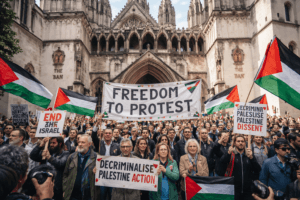
On a grey February morning in London, a crowd of protesters gathered outside the Royal Courts of Justice, their banners a defiant splash of colour against the stone columns. Among them were retired teachers, clergy members, war veterans, and students—a cross-section of British society that looked nothing like the stereotypical image of a terrorist sympathizer. They were waiting for a verdict that would send shockwaves through Whitehall and deliver a stinging rebuke to a government already under fire for its handling of protest and foreign policy.
When the judgment came, it was historic. Three of the country’s most senior judges ruled that the government’s proscription of Palestine Action—a direct action group targeting Israeli arms manufacturers—was unlawful, “disproportionate,” and an infringement on the fundamental rights to freedom of speech and assembly.
For the government, it was described by the Guardian’s legal affairs correspondent as an “embarrassing defeat.” But to view this merely as a legal hiccup is to miss the forest for the trees. This was a political earthquake that exposed the fault lines in Britain’s democracy, revealing a government willing to stretch the definition of terrorism to silence dissent, and a public that refused to let it happen without a fight.
This is the story of how a little-known protest group became a national cause célèbre, and how the government’s heavy-handed approach transformed a fringe movement into a symbol of resistance, turning a legal loss into a public relations disaster of epic proportions.
The Unprecedented Stretch: When Vandalism Became Terrorism
To understand the magnitude of the court’s decision, one must first understand the legal tool the government tried to wield. The Terrorism Act 2000 was forged in the crucible of the Northern Ireland peace process and the global threat from Al-Qaeda. It was designed to dismantle organisations like Islamic State and Boko Haram—groups whose modus operandi involves beheadings, suicide bombings, and the mass murder of civilians.
Palestine Action, by contrast, operates in hi-vis vests and balaclavas. Their arsenal consists of paint, bolt cutters, and crowbars. Their tactics, as described in a secret government report by the Joint Terrorism Analysis Centre (JTAC) that was disclosed during the judicial review, involved “graffiti, petty vandalism, occupation and lock-ons.” They target factories and offices, not people. Their goal is to disrupt the supply chain of companies like Elbit Systems, an Israeli arms manufacturer whose drones and military hardware, activists argue, are complicit in the devastation in Gaza.
When Yvette Cooper, the then Home Secretary, announced the ban last June, it wasn’t the damage itself that was unprecedented, but the application of the law. The government leaned on a provision within the Act concerning “serious damage to property.” Yet, as the JTAC report conceded, the group’s actions typically resulted in minor damage.
The court latched onto this contradiction. The judges found that only a “very small number” of the group’s activities could even be legally classified as terrorism. To ban the entire organisation based on these isolated incidents was, in their view, like using a sledgehammer to crack a nut. It was a classic case of the state overreach, where the letter of the law was contorted to fit a political agenda. The judges effectively ruled that the existing criminal law—covering criminal damage, conspiracy, and trespass—was perfectly adequate to deal with the group. The Terrorism Act was not just the wrong tool; it was a dangerous one to deploy in this context.
The ‘Nudge-Nudge, Wink-Wink’ Insinuation and the Company They Kept
The government’s case was not just legally shaky; it was built on a foundation of political cynicism that further alienated the public. In the days leading up to the parliamentary vote on the ban, a convenient story was briefed to the Times newspaper: the Home Office was investigating whether Palestine Action was funded by Iran.
For those paying attention, the timing was impeccable. It framed anyone who opposed the ban as potentially being a dupe of a hostile foreign power. It was a classic smear tactic, designed to poison the well of public debate. However, the insinuation was so flimsy that the Home Office itself was forced to distance itself from it shortly after.
Jonathan Hall KC, the independent reviewer of terrorism legislation—who, it must be noted, supported the ban—publicly eviscerated the claim on Channel 4’s Dispatches. He described it as a “nudge-nudge, wink-wink” insinuation, a piece of political theatre with no foundation in evidence. For a government to be caught using such a tactic, only to have its own security adviser dismiss it as innuendo, was deeply damaging to its credibility.
Furthermore, the government’s choice of company for Palestine Action on the banning order was revealing. The group was lumped in with two neo-Nazi organisations: the Maniacs Murder Cult and the Russian Imperial Movement. By bundling them together, the government presented MPs with a binary, and morally repugnant, choice: ban them all, or be seen as soft on neo-Nazis. It was a legislative trap that bypassed nuanced debate, forcing through a ban on a pro-Palestinian group by tethering it to far-right extremists. This procedural dirty trick did not go unnoticed by the public or the press, fueling the perception that the government was more interested in suppressing a political viewpoint than in a genuine counter-terrorism strategy.
The Human Cost of a Political Ban
If the legal and political manoeuvrings stayed within the Westminster bubble, the consequences of the ban did not. The proscription turned ordinary, law-abiding citizens into instant criminals. The act of wearing a badge, sharing a social media post, or holding a placard expressing support for the group became a terrorist offence, carrying a potential prison sentence of up to 14 years.
The stories that emerged from this crackdown read less like counter-terrorism operations and more like scenes from a dystopian novel.
There was Laura Murton, who was threatened with arrest by armed police simply for holding a sign that read “free Gaza” alongside a Palestinian flag. The police, operating under the vague and sweeping new powers, interpreted her expression of solidarity as “supporting a proscribed organisation.” The absurdity of armed officers confronting a woman with a placard highlighted the chilling, disproportionate nature of the law in action.
Then there was Marianne Sorrell, a retired teacher. Her crime? Holding a placard stating: “I oppose genocide. I support Palestine Action.” For this, she was arrested and held by police for nearly 27 hours. In a move that shocked civil liberties campaigners, officers forced their way into her home, conducting a thorough search as if she were a suspected bomb-maker. The state’s power, unleashed by the proscription, was used to terrify a pensioner in her own home for expressing a political opinion.
Jon Farley was arrested for carrying a placard that reproduced a graphic from Private Eye magazine. The graphic juxtaposed two images: one of activists spraying a military plane with paint, captioned “Unacceptable Palestine Action”; the other of Palestinians queueing for food being shot, captioned “Acceptable Palestine Action: shooting Palestinians queueing for food.” It was a piece of satirical commentary on the government’s perceived double standards. For this act of satire, he was arrested.
The Metropolitan Police Federation openly admitted the situation was “unsustainable.” The sheer volume of arrests—of pensioners, clergy, and war veterans being carried away from peaceful demonstrations—placed an enormous strain on police resources and, more importantly, on public consent for policing. Scenes of elderly, non-violent protesters being manhandled by officers played out on news broadcasts and social media, turning the police into the visual antagonists of a drama where the public increasingly sided with the protesters.
The Streisand Effect: How the Ban Made Palestine Action Famous
Perhaps the most profound irony of this entire saga is the outcome the government least expected. Before the ban, Palestine Action was a relatively niche direct-action group, known primarily to those who followed the arms trade or radical politics. Their actions, while disruptive, rarely broke through into the mainstream news cycle.
The government’s attempt to silence them has had the opposite effect. By branding them terrorists, by arresting pensioners, and by losing a humiliating court battle, the government has handed Palestine Action a platform and a level of public sympathy they could never have achieved on their own. This is the “Streisand Effect” in full force—the phenomenon where an attempt to suppress information only makes it spread further and wider.
Now, Palestine Action is on the front page of newspapers. Their name is discussed in Parliament, in legal journals, and on prime-time news. The court case forced the release of embarrassing government documents that exposed the weakness of the case against them. The image of the group has been transformed from one of masked vandals to one of David standing up to a clumsy and authoritarian Goliath.
The movement has also evolved. The ban galvanised a coalition of support that stretched from Amnesty International and UN experts to a former Director of Public Prosecutions and, remarkably, a Trump administration official. This diverse coalition, united by a concern for civil liberties and the rule of law, has normalised the group in a way its own propaganda never could. The civil disobedience campaign, with its images of respectable citizens being arrested, has further cemented the group’s image as a focal point for principled resistance.
A Watershed Moment for Protest in Britain
The quashing of the ban is more than just a win for Palestine Action; it is a pivotal moment for the health of British democracy. The court has drawn a line in the sand, reminding the executive that the powerful machinery of the Terrorism Act cannot be used to silence lawful, if disruptive, protest.
The ruling affirms a principle that seemed to be under threat: that the right to protest, even in ways that cause annoyance and economic damage, is a cornerstone of a free society. It distinguishes between groups that seek to harm people and those that target property as a means of political communication. While few may agree with the tactics of painting a factory or occupying a rooftop, the court has affirmed that such actions are not the moral or legal equivalent of mass-casualty terrorism.
This judgment will inevitably make future governments think twice before reaching for the proscription powers to silence domestic dissent. It has exposed the intellectual and moral bankruptcy of conflating vandalism with jihadism. It has forced a national conversation about who gets to be called a terrorist, and why that label is so readily applied to those protesting Israeli policy while being withheld from the far-right groups that have stalked our streets in recent years.
For the thousands who marched, for the pensioners who were arrested, and for the legal team that fought the case, the ruling is a vindication. For the government, it is a moment of reckoning. It stands exposed not only for its legal overreach but for its political cowardice in prioritizing the silencing of critics over the substance of the criticism itself. In trying to ban Palestine Action, the government has not only lost a court case; it has lost a battle for the soul of British protest, and in doing so, has guaranteed that the movement it sought to erase will be remembered and discussed for years to come.
You must be logged in to post a comment.