
Beyond the Ballot: How a Voter Purge and Women’s Votes Cemented a Political Sweep in Bihar
Prime Minister Narendra Modi’s coalition secured a sweeping victory in Bihar’s state election, a win attributed by the alliance to its effective governance, expanded political unity, and particularly strong support from women voters, who turned out in record numbers and were rewarded with popular policies like an alcohol ban and direct cash handouts.
However, the decisive mandate is shadowed by a significant controversy: a rushed voter roll purge that saw over four million names removed from the electoral lists, a move the opposition decries as a systematic “vote theft” that disenfranchised legitimate voters and tilted the playing field, raising profound concerns about electoral integrity as similar voter list revisions are planned for other key Indian states.
Beyond the Ballot: How a Voter Purge and Women’s Votes Cemented a Political Sweep in Bihar
The dust has settled in Bihar, and the political landscape of one of India’s most consequential states has been decisively redrawn. Prime Minister Narendra Modi’s National Democratic Alliance (NDA) hasn’t just won; it has achieved a staggering sweep, poised to secure a super-majority in the 243-seat state assembly. This victory, however, is shrouded in a controversy that strikes at the very heart of democratic integrity: a massive, chaotic purge of the voter rolls that saw over four million names vanish ahead of the election.
While the ruling coalition credits its win to a popular mandate and successful welfare policies, the opposition cries foul, alleging a systemic “vote theft” enabled by the very institutions meant to safeguard the electoral process. The true story of Bihar’s election is a complex tapestry woven from threads of genuine political appeal, strategic social engineering, and profound questions about the sanctity of the voter list.
A Victory Forged in Coalition and “Modi’s Guarantee”
On the surface, the NDA’s victory is a masterclass in political strategy. The coalition, led by Modi’s Bharatiya Janata Party (BJP) and incumbent Chief Minister Nitish Kumar’s Janata Dal (United), entered the race more unified than ever. This alliance neutralized the anti-incumbency that often plagues long-serving governments and presented a united front to the electorate.
The campaign rhetoric was a potent mix of local governance and national pride. Spokesmen for the coalition pointed to Kumar’s success in improving Bihar’s once-notorious law and order situation, a significant concern for a state previously marred by gang violence. But the centerpiece of their narrative was the “double-engine sarkar” (double-engine government)—the idea that having the same party in power at the state and central levels accelerates development.
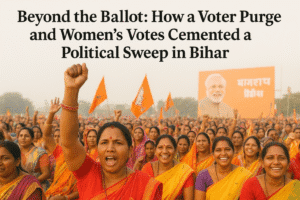
Prime Minister Modi’s personal popularity, often referred to as “Modi’s Guarantee,” was leveraged to its fullest. His image, clad in an orange vest, adorned countless posters across the state, a constant reminder of the central government’s largesse and his perceived leadership during national crises.
The “Lakhpati Didi” Factor: How Women Reshaped the Electorate
Perhaps the most significant, and least controversial, story of this election is the unequivocal voice of Bihar’s women. The female voter turnout of over 71%—nearly 10 percentage points higher than male turnout—is not just a statistic; it is a political revolution.
This surge was not accidental. The NDA government, particularly Nitish Kumar, has consciously and consistently courted the female vote. His ban on alcohol in 2016, while criticized by some, was wildly popular among women, who often bore the brunt of alcohol-fueled domestic violence and drained household finances. This policy created a deep reservoir of goodwill.
Furthermore, state programs offering scholarships and entrepreneurship funds for women aimed to foster financial independence. The most impactful move, however, came just weeks before the election: a direct cash handout of approximately $110 to millions of women in the state. In a state with an average per capita monthly income of around $70, this was not a trivial sum. Critics labeled it a blatant pre-election bribe, but for many struggling families, it was a tangible benefit that overshadowed abstract accusations.
This “pink vote” appears to have been a decisive force, transforming the social fabric of Bihar’s politics and rewarding the coalition that directly addressed their security and economic concerns.
The Elephant in the Booth: The Great Voter Roll Purge
Beneath the celebratory conch shells and circular posters lies the election’s most contentious issue: the Special Intensive Revision (S.I.R.) of the voter lists. Conducted by the Election Commission of India, this exercise led to the stunning deletion of over four million names from Bihar’s electoral rolls.
The official justification was bureaucratic hygiene: removing the dead, duplicates, and fake voters to create a cleaner, more accurate list. In practice, the process was marred by chaos and confusion. Reports emerged of eligible, living voters finding their names missing, having to navigate a last-minute bureaucratic maze to reclaim their fundamental democratic right.
The opposition, led by Rahul Gandhi’s Indian National Congress, mounted a vehement protest and even sued the election commission. They presented evidence that numerous individuals declared “dead” by the authorities were very much alive. This forced a partial reversal, with hundreds of thousands of names being reinstated. But the damage, they argue, was already done.
The timing and scale of the purge raised alarming questions. Why was such a drastic revision necessary just a year after a national parliamentary election, in which Bihar delivered crucial seats to Modi’s coalition? The opposition posits a damning dilemma: either the 2024 national win was based on a flawed roll, or the current state election was being manipulated through mass disenfranchisement.
Rahul Gandhi, in a detailed public presentation, went so far as to highlight a specific case of a “Brazilian model” whose photograph was used on 22 different voter IDs across 10 polling booths, each with a different name. This single anecdote became a powerful symbol of the opposition’s broader accusation: that the system is not just flawed, but being weaponized for “vote theft.”
A National Precedent? The Fears of a Widening Purge
The implications of the Bihar S.I.R. extend far beyond the state’s borders. The same “cleaning” exercise is now underway in nine other Indian states, including southern strongholds where the BJP has historically struggled—Kerala, Tamil Nadu, and West Bengal.
This has sparked fears that the controversy in Bihar is not an isolated incident, but a national strategy. For parties in these states, the Bihar election serves as a cautionary tale. If a purge of this magnitude can occur in a state of 130 million people amid such opposition outcry and still be validated by a sweeping victory, what checks exist to prevent similar exercises elsewhere from tilting the electoral playing field?
The Election Commission, a body meant to be an impartial arbiter, finds its credibility under unprecedented scrutiny. Its assurances of transparency clash with on-the-ground realities of procedural chaos and the opposition’s claims of institutional capture.
The Road Ahead: Mandate or Manipulation?
The resounding victory of Modi’s coalition in Bihar is a political fact. It points to a powerful, well-oiled political machine that successfully consolidated its base, expanded its coalition, and, most importantly, resonated with a key demographic—women—through a combination of populist welfare and resonant social policy.
Yet, the shadow of the voter purge looms large, ensuring that this victory will be analyzed and debated for years to come. It raises uncomfortable questions about the integrity of the electoral process itself. Can a mandate be considered unassailable when the very list of mandators was so controversially altered immediately before the election?
The story of Bihar is a tale of two parallel realities. In one, a government earned its massive majority through performance and smart politics. In the other, it engineered that majority by systematically reshaping the electorate. The truth, as is often the case in the complex theater of Indian democracy, likely lies somewhere in the nuanced, and contested, space between. For India’s political future, how this dichotomy is resolved will be far more important than the seat count in any single state assembly.
You must be logged in to post a comment.