
Beyond the Ballot Box: Israel’s Mandatory Death Penalty Law and the Redefinition of Justice
The Israeli Knesset’s National Security Committee has advanced a bill imposing a mandatory death penalty for Palestinians convicted of “terrorist acts” resulting in death—a radical break from Israel’s six‑decade moratorium on capital punishment. The legislation strips courts of discretion, makes execution by hanging the default punishment, and explicitly forbids presidential pardons, while creating a two‑tiered legal system: inside Israel death is an option, but in the occupied West Bank it becomes the mandatory primary sentence. Driven by far‑right coalition members, the bill is designed to bypass judicial oversight and enshrine vengeance as policy, risking a constitutional crisis with the Supreme Court and drawing sharp international condemnation for codifying unequal justice under occupation.
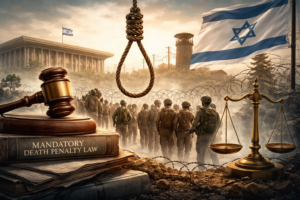
Beyond the Ballot Box: Israel’s Mandatory Death Penalty Law and the Redefinition of Justice
On March 24, 2026, a seemingly procedural vote in the Israeli Knesset’s National Security Committee set in motion a seismic shift in the legal landscape of the Israeli-Palestinian conflict. By approving a draft law that imposes a mandatory death penalty for Palestinians convicted of “terrorist acts” resulting in death, the committee—controlled by the far-right wing of the governing coalition—has moved Israel closer to a precipice it has deliberately avoided for the better part of six decades.
While the headlines focus on the legislative mechanics of the second and third readings scheduled for next week, the true significance of this bill lies not just in the punishment it prescribes, but in what it reveals about the changing nature of Israeli governance, the weaponization of legal systems in conflict zones, and the dismantling of the judicial safeguards that have historically defined Israel’s identity as a liberal democracy, at least within its contested borders.
To understand the gravity of the moment, one must look beyond the dry language of the bill and examine the tectonic forces driving it. This is not merely a law about capital punishment; it is a law about sovereignty, vengeance, and the establishment of a two-tiered system of justice that formalizes a reality where the value of a life is dictated by the identity of the victim and the nationality of the accused.
The Mechanics of Mandatory Execution
The draft law, presented by Knesset Member Limor Son Har-Melech of the Otzma Yehudit party (led by National Security Minister Itamar Ben-Gvir), strips the judiciary of its most fundamental power: discretion. Historically, even in jurisdictions that retain the death penalty, the decision to impose it rests with a judge or jury who weighs mitigating circumstances—the age of the defendant, the presence of coercion, or the possibility of remorse.
This bill obliterates that process.
According to the text approved by the committee, the punishment for a Palestinian convicted of a killing defined as a “terrorist act” is mandatory. The court is left with no authority to consider mercy. Furthermore, the bill explicitly abolishes the possibility of pardon. By stating that “no pardon may be granted,” the legislation bypasses the traditional executive branch authority of the President of Israel to commute sentences. The only narrow escape hatch is granted to the Prime Minister, who can petition the court to delay the execution for a maximum of 180 days—a temporary reprieve, not a true check on judicial finality.
The execution itself is to be carried out by the Israeli Prison Service via hanging, to be implemented within 90 days of the sentence’s confirmation. In the context of the West Bank, where the military court system operates, the bill establishes the death penalty as the primary punishment, relegating life imprisonment to an “exceptional” status that must be justified.
This inversion of justice—where death is the default and life is the anomaly—represents a radical departure from the norms of military jurisprudence that have governed the occupation since 1967.
A Nation That Paused the Gallows
Perhaps the most jarring aspect of this legislative push is its stark contrast with Israel’s own historical relationship with capital punishment. Since its establishment in 1948, Israel has executed exactly two people: Nazi war criminal Adolf Eichmann in 1962 and the convicted murderer Meir Tobianski (posthumously acquitted) in 1948. Outside of these extreme cases, Israel has maintained a de facto moratorium on the death penalty for over sixty years.
Israeli military courts in the West Bank have handed down death sentences in the past, but these were invariably commuted or reduced upon appeal. The Israeli Supreme Court, acting as the High Court of Justice, has historically served as a bulwark against such finality, often citing the moral weight of taking a life and the potential for judicial error.
This new law is designed explicitly to bypass that bulwark. By making the sentence mandatory and stripping the president of pardon powers, the coalition is signaling a desire to move capital punishment from the realm of theoretical deterrence to a practical, bureaucratic reality.
The Spatial Segregation of Justice
One of the most legally pernicious elements of the draft is its geographical distinction between Israel proper and the West Bank. Within the internationally recognized borders of Israel (the Green Line), the law offers a binary choice between death and life imprisonment. However, in the West Bank—territory occupied since 1967 and considered by the international community to be outside Israeli sovereignty—the law imposes the death penalty as the “primary” punishment.
This distinction is legally incoherent and politically damning. It exposes the crux of the matter: the law is not designed to administer justice equally for all citizens. Israeli citizens accused of killing Palestinians—even in acts of settler violence—are tried in civilian courts under a different legal framework where the death penalty does not apply. Palestinians, however, regardless of their legal status, fall under the jurisdiction of military courts in the West Bank where this draconian standard will be applied.
By explicitly creating a higher threshold of punishment for the occupied territories, the law codifies a system of apartheid legality. It acknowledges that the West Bank is neither fully annexed nor a sovereign state, but rather a legal vacuum where the occupying power can impose the harshest possible penalties without the checks and balances required of its own civilian judicial system.
The Political Calculus of Vengeance
To view this legislation purely through a legal lens is to miss the political theater driving it. For Itamar Ben-Gvir and the Otzma Yehudit faction, the death penalty is not a deterrent; it is a promise.
Since entering the government, Ben-Gvir has leveraged his position as National Security Minister to push a nationalist agenda that prioritizes punitive measures over policing and diplomacy. This bill serves multiple political purposes. First, it is a fulfillment of a core campaign promise to the party’s base—a base that has grown increasingly disillusioned with what they perceive as the government’s soft-handed approach following the events of October 7.
Second, it is a deliberate test of the limits of the judicial system. By insisting on a mandatory sentence with no option for pardon, the coalition is provoking a constitutional confrontation with the judiciary. They are daring the Supreme Court to strike down the law, knowing that such a strike would be framed as the “elite” judicial establishment protecting “terrorists” over the victims of terror.
Third, the law serves as a distraction from the government’s internal divisions. As protests continue over judicial reform and the handling of the war in Gaza, pushing a piece of legislation that garners popular support among the right-wing base allows the coalition to project an image of unity and strength.
The Human Cost of Abstraction
While the debate in the Knesset focuses on legal abstractions—jurisdiction, mandatory minimums, and separation of powers—the reality of this law is starkly human.
If passed, this law will apply overwhelmingly to young Palestinian men, often tried in military courts where conviction rates hover near 99%. Under the current system, families of detainees often describe the military court process as a revolving door where guilt is presumed. Under the new law, a conviction would carry the automatic weight of a death sentence.
Moreover, the 90-day timeline from confirmation to execution creates a logistical and psychological nightmare. It leaves virtually no time for thorough appeals or for international bodies like the International Court of Justice (ICJ) or the International Criminal Court (ICC) to intervene. For the families of detainees, the period between sentencing and execution would be a countdown of despair.
For the families of victims, the law offers the illusion of closure. However, experts in conflict resolution and victim advocacy have long argued that state-sanctioned vengeance—particularly in asymmetrical conflicts—rarely brings peace. Instead, it escalates cycles of violence. A mandatory death penalty in the West Bank is likely to transform every security incident into a potential death row case, increasing the stakes of resistance and making negotiations or prisoner exchanges exponentially more difficult.
International Implications
The timing of this vote is not coincidental. As the international community continues to scrutinize Israel’s conduct in Gaza and the West Bank, with cases pending at the ICJ regarding occupation policy and the ICC regarding war crimes, the passage of this law would be seen as a direct act of defiance.
The law’s provision to treat the West Bank differently from sovereign Israel provides fresh ammunition for legal bodies arguing that Israel is administering the territories in a manner that violates international humanitarian law. It reinforces the argument that the legal systems operating in the West Bank are designed to discriminate based on nationality, potentially bolstering ongoing proceedings at international courts.
Furthermore, while the United States has historically shielded Israel from severe diplomatic consequences at the UN, the imposition of a mandatory death penalty for Palestinians—excluding Jewish Israelis from the same standard—may strain even those longstanding ties, particularly with a U.S. administration that, depending on the political climate of 2026, may be less tolerant of policies that codify inequality.
The Road Ahead
As the bill heads toward its final readings, the question is no longer whether it will pass the Knesset, but rather what happens after.
The Israeli Supreme Court will almost certainly be petitioned to strike it down. The court’s previous rulings have consistently held that Israel’s military occupation is governed by international law, which has strict prohibitions on the imposition of the death penalty by occupying powers except in the most limited of circumstances.
However, with the government currently embroiled in a contentious battle to curb the power of the Supreme Court, the fate of this law will likely hinge on whether the court feels emboldened to stand in the way of a clearly defined legislative mandate, or whether it chooses to allow the political branches to bear the weight of this historic decision.
For the people living under the shadow of this law—the Palestinian detainees in Israeli prisons, their families waiting in the West Bank, and the Israeli citizens who fear terrorism—the outcome is existential. This is not a policy shift; it is a moral declaration.
By making death mandatory and mercy impossible, the Israeli Knesset is not just changing a penal code. It is redefining the very nature of the conflict: moving it from a political-military struggle with legal parameters to a zero-sum game where the only finality is absolute. In doing so, the State of Israel is walking a path that distances it from the judicial traditions of its founders and enters a legal wilderness where the separation of powers yields to the power of political vengeance.
The vote next week will not end the debate. It will mark the beginning of a constitutional crisis that will define Israeli democracy and its occupation for the next generation. The only certainty is that the gallows, dormant for over sixty years, are being dusted off—and the fabric of justice in the land between the river and the sea will be permanently torn.
You must be logged in to post a comment.