
Beyond the Bad News Cycle: How The Better India Built an “Algorithm of Optimism” and Redefined Impact
In 2008, corporate professionals Anuradha Kedia and Dhimant Parekh, frustrated by the news media’s relentless focus on problems, founded The Better India to answer a simple but radical question: who was reporting the solutions? Rejecting the standard playbook, they built a solutions-oriented journalism platform dedicated to spotlighting grassroots changemakers and actionable innovations across India. Over 17 years, their commitment to “return on impact” over traditional metrics has grown into a movement reaching over 250 million people, proving that stories of constructive change can achieve massive virality by fulfilling a deep public hunger for agency and hope, thereby rewriting the algorithm of news itself from one of cynicism to one of empowered optimism.
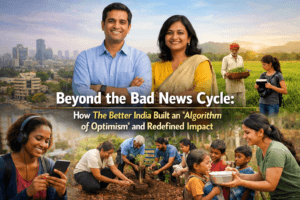
Beyond the Bad News Cycle: How The Better India Built an “Algorithm of Optimism” and Redefined Impact
We open our news apps and brace ourselves. The headlines are a familiar barrage: conflict, crisis, scandal, and despair. This diet of disruption isn’t just depressing; it’s paralyzing. It informs us of the world’s fractures but offers no blueprint for repair. We’re left with a profound, nagging question: Is this all there is?
For Anuradha Kedia and Dhimant Parekh, sitting with their morning newspaper in 2008, this question became an urgent itch they had to scratch. Both were corporate professionals, not journalists. But they possessed a simple, revolutionary insight that would eventually seed one of India’s most unique media platforms: If the news is so adept at diagnosing the disease, who is writing the prescription?
Their answer was The Better India (TBI). But this isn’t just a story about a “positive news” site. It’s a case study in human psychology, resilient entrepreneurship, and a masterclass in building a business where the core metric isn’t just revenue, but “Return on Impact.”
The Founding Insight: A Rebellion Against Learned Helplessness
The initial spark for Kedia and Parekh wasn’t a grand business plan. It was a visceral reaction to a media environment that, in its quest for clicks and eyeballs, was inadvertently teaching its audience learned helplessness. By showcasing problem after problem with scant coverage of solutions, the narrative implicitly suggested that positive change was either impossible or the sole domain of distant institutions.
“We almost felt like it was our duty to start disseminating this information,” Anuradha recalls. They saw “pockets of goodness” everywhere—in grassroots innovators, community leaders, and simple citizens solving complex local problems. Yet these stories were absent from the mainstream discourse. This gap represented more than an editorial blind spot; it was a failure of imagination that TBI was founded to correct.
Their first iteration, a humble blogspot site, was less a publication and more a digital archive for the hope they encountered while volunteering in Bengaluru. It was an act of preservation, ensuring that the wisdom of local solutions wouldn’t be lost. This foundational principle—journalism as a knowledge legacy—remains TBI’s bedrock. Dhimant frames it powerfully: “Otherwise, what legacy were we leaving behind for the next generation?”
The Engine of Trust: Stories That Don’t Preach, But Prove
What separates TBI from mere “good news” or inspirational fluff is its rigorous focus on solutions-oriented journalism. Every story is anchored in a tangible, replicable solution. It’s not about ignoring problems, but about spotlighting the people who are rolling up their sleeves to fix them.
Take the story of Partho Bhowmick’s “Blind With Camera.” TBI didn’t just write a feel-good piece about disabled photographers. They detailed the how: the assistive technology, the training methods, the reimagining of sight through touch and sound. The impact was immediate and profound. A visually impaired girl, ridiculed for her passion, read the article, found the program, and wrote to TBI: “Reading the story helped me realise I could.”
This is TBI’s magic trick. They bypass cynicism by providing irrefutable evidence. The skeptic’s question—“Are there really so many changemakers in India?”—is answered not with rhetoric, but with a relentless, scrolling parade of proof. From farmers using WhatsApp groups like ‘Baliraja’ to combat isolation and share sustainable practices, to urban professionals building food forests in concrete jungles, each story is a data point in a new, more hopeful map of the country.
As a reader, you don’t just feel uplifted; you feel equipped. The narrative shifts from “Look at this terrible thing” to “Look at how this person tackled a terrible thing. Here’s how they did it.” This transforms the audience from passive consumers of doom into potential participants in a solution.
Building the “Algorithm of Optimism” in a Viral World
In the age of algorithmic feeds that thrive on outrage, building a scalable business on optimism seemed counterintuitive. Media veterans warned them it wouldn’t work. The playbook didn’t exist. Yet, this lack of a template became their strength. They had to write their own.
Dhimant, with his computer science background, and Anuradha, with her sharp editorial vision, understood something crucial. As she articulates, “Good virality is simply human connection at scale.” Their content works because it taps into fundamental human desires: for agency, for hope, for connection to something larger than ourselves. An inspiring story of a village overcoming water scarcity isn’t just “positive”; it’s deeply relevant and sharable because it speaks to a universal struggle and a universal longing for triumph.
They’ve grown to over 250 million engagements across languages, not by gaming algorithms with negativity, but by feeding a latent, underserved hunger. They proved that depth and virality aren’t opposites. A story about a life changed is profoundly deep, and if told authentically, it will find its audience and spread because people crave meaning, not just sensation.
The Business of Impact: Where ROI Means “Return on Impact”
Perhaps the most radical aspect of TBI’s journey is their redefinition of success. In the startup world, obsessed with burn rates and exit strategies, Kedia and Parekh built a sustainable company around a different core metric.
“For me, it’s ‘return on impact’,” Anuradha states. The financial numbers matter—they enable the work—but the true north star is the tangible change their stories catalyze. A farmer adopts a new technique. A volunteer joins a cause. A young person sees a path where they saw none. This impact is often slow, rippling out in unpredictable ways, like the story written in English for metro readers that ended up mobilizing thousands of farmers in rural Maharashtra via WhatsApp.
This philosophy demanded immense patience. “It takes time to build something substantial, something meaningful,” Dhimant notes. They resisted shortcuts, staying true to their “moral compass.” They’ve embraced technology and AI, but “wisely,” using it to amplify human stories, not replace the human insight behind them.
The Lesson for Us All: Curation is a Form of Creation
The enduring lesson from The Better India’s 17-year journey is that what we choose to amplify defines our world.
We live in an information ecosystem. By exclusively consuming and sharing stories of breakdown, we reinforce a narrative of decay. TBI offers an alternative: consciously curate a feed of construction. This isn’t about putting on rose-colored glasses; it’s about putting on builder’s goggles. It’s about balancing our awareness of the world’s flaws with an equal awareness of its fixes.
Their success is a beacon for creators, entrepreneurs, and everyday readers. It proves that there is a vast, engaged audience for content that empowers rather than frightens, that connects rather than divides. It shows that a business can be both profitable and purposeful, measuring its weight in the world by the actions it inspires.
So, the next time you feel the weight of the bad news cycle, remember the lesson of The Better India. The changemakers are already there, working quietly in countless corners. The question is no longer “Are they out there?” but “Whose story will I read next, and what might it inspire me to do?” The algorithm of optimism doesn’t run on code; it runs on our collective choice to seek, share, and become part of the solution.
You must be logged in to post a comment.