
Beyond the Ambulance: How India’s Tech-Infused Medical Transport is Revolutionizing Chronic Care Access
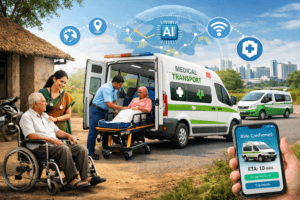
India is transforming its healthcare accessibility by integrating advanced technology into non-emergency medical transportation (NEMT), specifically to address the critical challenge of reliable travel for chronic care patients. By deploying GPS tracking, AI-driven route optimization, telemedicine support, and digital booking platforms, the new system replaces a fragmented and unreliable informal network with a structured, patient-centric service. This shift ensures safer, timely, and dignified travel—with features like wheelchair-accessible vehicles and real-time updates—which directly improves appointment adherence, reduces patient anxiety, and enhances care continuity, particularly in remote areas. The resulting ecosystem fosters better coordination among hospitals, insurers, and transport providers, turning medical logistics into a dependable pillar of India’s evolving healthcare infrastructure.
Beyond the Ambulance: How India’s Tech-Infused Medical Transport is Revolutionizing Chronic Care Access
Introduction: The Silent Crisis of Getting There
For millions of Indians managing chronic illnesses—diabetes, kidney disease, cancer, or cardiovascular conditions—the greatest challenge often isn’t the treatment itself, but the arduous journey to receive it. The saga typically involves pre-dawn starts, reliance on reluctant relatives, haggling with unreliable private vehicles, and the exhausting navigation of urban traffic or remote rural roads, all while unwell. The result? Missed appointments, deteriorating health, and a systemic inefficiency that costs hospitals, insurers, and, most critically, patients their well-being and dignity.
India is now engineering a quiet revolution to address this foundational gap in its healthcare ecosystem. Moving beyond the flash of emergency ambulances, a new paradigm of Non-Emergency Medical Transportation (NEMT), supercharged by technology, is emerging. This isn’t just about moving people from point A to B; it’s about weaving reliability, predictability, and humanity into the very fabric of patient care logistics. It’s a recognition that in a nation with a burgeoning chronic disease burden, consistent access is the first step to effective treatment.
The Old Reality: A Fragmented Journey Fraught with Anxiety
To appreciate the shift, one must understand the traditional landscape. For decades, non-emergency medical travel existed in a state of distressing informality. As Nitin Lahoti of Mobisoft Infotech points out, the system was plagued by long distances, traffic snarls, unsuitable vehicles, and immense physical strain. Elderly patients or those with mobility issues faced particular humiliation and risk.
The ripple effects were profound. From a patient’s perspective, the ordeal bred dependency and anxiety. The uncertainty of “how will I get there?” compounded the stress of “what will the doctor say?”. This directly impacted treatment adherence; studies have consistently shown that transportation barriers are a leading cause of missed clinical appointments, leading to poorer health outcomes and higher long-term costs.
For healthcare providers, patient no-shows created scheduling black holes, underutilized specialist time, and disrupted clinic workflows. For insurers and TPAs (Third-Party Administrators), the lack of formal, documented transport made verification and reimbursement a tedious process. The entire ecosystem operated on ad-hoc arrangements, where the patient’s comfort and safety were often secondary to mere availability.
The Tech-Driven Transformation: Building Blocks of a Reliable System
The new generation of NEMT platforms is attacking these pain points with a suite of integrated technological solutions, transforming chaos into coordination.
- Seamless Access & Dignified Booking: The journey now begins with dignity. User-friendly mobile apps or dedicated call centers allow patients or caregivers to book a trip with specific needs—be it a wheelchair-accessible vehicle, stretcher support, or a trained attendant. This simple act replaces begging and negotiation with a structured, respectful request.
- Intelligent Matching & Real-Time Assurance: Technology enables intelligent vehicle-to-patient matching. A routine check-up might require a comfortable sedan, while a dialysis patient post-treatment might need a vehicle with stretcher support. Once en route, GPS tracking and live ETA updates provide peace of mind for both the patient and the waiting family or hospital. The debilitating “waiting and wondering” is eliminated.
- AI, Automation & Smarter Routing: At the operational heart lies artificial intelligence. Route optimization algorithms process real-time traffic data, ensuring the fastest possible path, reducing journey time and fuel consumption. More innovatively, automated scheduling systems can dynamically adjust pickup times if a hospital appointment runs late, creating a buffer that reduces stress for all parties.
- Predictive Analytics for Proactive Care: Hospitals are beginning to leverage predictive models integrated with NEMT data. By analyzing historical appointment trends, they can forecast peak outpatient days and ensure adequate transport resources are pre-emptively allocated. This shifts the model from reactive scrambling to proactive management.
- The Digital Paper Trail: The entire process generates a digital trip log—a verifiable record of pick-up, drop-off, route, and time. This transparency is a game-changer. Families can track a loved one’s journey. Hospitals have proof of patient arrival/departure. Insurers have clean, auditable data for swift reimbursements, reducing fraud and administrative friction.
Bridging the Urban-Rural Healthcare Divide
Perhaps the most significant impact of tech-enabled NEMT is its potential to democratize access. In tier-2, tier-3 cities, and rural areas, where specialist care is often concentrated in district hospitals, the access challenge is magnified. Tech platforms are creating vital connective tissue.
These services are systematically linking patients in remote villages to tertiary care centers for routine dialysis, chemotherapy, physiotherapy, and follow-up consultations. By providing verified, safe, and dedicated vehicles for these journeys, they are making continuous care plans feasible. Families are spared the exorbitant cost and extreme inconvenience of arranging last-minute long-distance travel. For a patient requiring thrice-weekly dialysis, this isn’t a convenience; it’s a lifeline that makes treatment sustainable.
The Human and Systemic Impact: More Than Just a Ride
The value transcends logistics. For an elderly diabetic patient, a comfortable, on-time ride with assisted boarding reduces physical trauma. For a cancer patient feeling frail, the mental relief of a guaranteed, gentle journey is a form of care in itself. Dignity, safety, and predictability are becoming standardized features, not luxuries.
For the healthcare system, the benefits are tangible:
- Improved Clinical Outcomes: Better adherence leads to better disease management.
- Operational Efficiency: Hospitals face fewer no-shows, smoother outpatient department (OPD) flow, and better-utilized staff and equipment.
- Financial Clarity: Integrated billing, cashless payments, and clean documentation streamline the financial ecosystem for providers, insurers, and patients.
- Trust and Partnership: Formal partnerships between hospitals, insurers, and NEMT providers, governed by Service Level Agreements (SLAs), foster accountability and a shared commitment to patient-centric service.
The Road Ahead: An Integrated, Sustainable Future
The trajectory points towards even deeper integration and innovation. The future of NEMT in India is likely to be:
- Greener: The emergence of electric medical fleets promises eco-friendly, quieter transport, crucial for patient comfort and urban pollution reduction.
- More Connected: IoT-enabled vehicles with in-cabin monitoring can transmit vital stats to hospitals in real-time for high-risk patients, turning the vehicle into a mobile care extension.
- More Accessible: Subscription-based models for conditions like dialysis or weekly therapy can offer cost-effective, worry-free planning for patients on fixed budgets.
- Policy-Supported: Increased alignment with government health schemes and Ayushman Bharat could scale access, making reliable transport a recognized component of healthcare delivery.
Conclusion: Redefining the Pathway to Care
India’s bolstering of medical transportation through technology is a profound step towards holistic healthcare. It acknowledges that the journey is an integral part of the cure. By injecting reliability into patient travel, the country is not just moving bodies; it is safeguarding treatment continuity, restoring patient agency, and building a more resilient and humane healthcare infrastructure.
The shift from informal, fragmented arrangements to organized, tech-powered NEMT signifies a maturation of the health ecosystem. It’s a move that places the patient’s lived experience at the center, ensuring that the path to healing is no longer a barrier in itself, but a seamless, supported component of the care continuum. In the fight against chronic disease, ensuring patients can reliably reach their care may be one of the most impactful prescriptions of all.
You must be logged in to post a comment.