
Beyond the AI Hype: Why India’s Education Revolution Must Start Today, Not Tomorrow
The AI4India report issues an urgent warning that India’s demographic dividend is at severe risk unless the nation fundamentally overhauls its education, skilling, and hiring systems for the AI era. It argues that continuing with fragmented, outdated approaches will leave millions of graduates unemployable as AI automates routine cognitive tasks. To prevent this, the report calls for a national declaration of AI literacy across all disciplines, a shift in academia from policing AI tools to actively teaching critical reasoning and evaluation within AI-augmented workflows, and a transformation in industry hiring towards portfolio-based assessments and real-world problem-solving. Critically, it emphasizes that success depends on cultivating uniquely human skills—like ethical judgment, creative synthesis, and tool orchestration—while ensuring inclusive access through public compute infrastructure and support for Indic-language AI ecosystems to build a sovereign, equitable, and human-centric future of work.
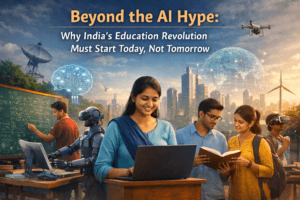
Beyond the AI Hype: Why India’s Education Revolution Must Start Today, Not Tomorrow
The whispers of an AI-powered future have crescendoed into a deafening roar. For India, a nation where the median age is under 30 and over 1.5 million engineers graduate annually, this technological shift isn’t just about innovation—it’s an existential question of employability. The recent AI4India report, “Future of Employability in the Age of AI,” serves not as a gentle forecast but as a stark siren, warning of a potential “fundamental decoupling” of Indian talent from the global economy if systemic change is delayed. The message is clear: tinkering at the edges will not suffice. India requires a foundational realignment of its education, skilling, and hiring paradigms, moving with an urgency that matches the speed of the technology itself.
The Stakes: A Ticking Demographic Clock
India’s demographic dividend, long touted as its superpower, now faces its greatest test. The intersection of three crises—rapid AI evolution, an outdated educational core, and a traditional hiring mindset—threatens to render this dividend a liability. The report identifies a dangerous gap: while AI is automating routine cognitive tasks at an unprecedented rate, our institutions are still mass-producing graduates skilled primarily in those very tasks. The result isn’t mere unemployment, but “unemployability”—a generation armed with degrees that the economy no longer values.
This isn’t about robots replacing humans wholesale. It’s about the bifurcation of work. AI excels at pattern recognition, data synthesis, and execution. The roles of the future will belong to those who can orchestrate these tools: asking the right questions, evaluating outputs with critical reasoning, applying ethical judgment, and synthesizing insights across domains. Is our system building these capabilities, or is it still training students to excel in closed-book exams that AI can now ace in seconds?
The Policy Imperative: From Silos to National Literacy
The report’s call for policymakers to declare AI literacy a “national baseline” is revolutionary. It proposes a shift from viewing AI as a niche IT subject to treating it like a fundamental skill—as essential as reading or basic mathematics. This means a humanities student in Kolkata must understand how large language models influence media and sociology, just as an agriculture student in Punjab must grasp how AI-driven analytics can optimize crop yields.
Key to this is inclusive access. The digital divide is not just about connectivity; it’s a compute divide. The recommendation for publicly-funded shared compute infrastructure and device-support schemes for Tier 2/3 institutions is critical. An AI-literate nation cannot be built if hands-on experience is a privilege of metropolitan elite institutions. Furthermore, the push for supporting Indic-language AI ecosystems and Indian datasets is a strategic necessity. It ensures the AI revolution is not a Western import but is rooted in India’s linguistic diversity and unique societal challenges, from healthcare in rural areas to governance at scale.
Academia’s Pivot: From Policemen to Pioneers
The most profound shift must occur within universities and colleges. The instinct to “police” AI use in assignments—fearing plagiarism and cheating—is a losing battle and a misdirected effort. The AI4India report wisely urges a shift to “teaching with AI.” This is a pedagogical earthquake.
Imagine a law assignment where students use AI to draft a contract, but their grade depends on their ability to critically identify its loopholes and biases. Envision a literature class where AI generates an analysis of a poem, and students must evaluate its depth and propose a more nuanced reading. This redesign moves assessment from “product” to “process”—valuing the human skills of critique, refinement, and ethical application.
This requires massive faculty empowerment. Investing in “communities of practice” and recognized certification programs for AI pedagogy is non-negotiable. The teacher’s role evolves from a knowledge-deliverer to a coach, guiding students in the art of leveraging powerful tools wisely and responsibly.
Industry’s Call to Action: Rewriting the Rules of Engagement
The corporate world cannot remain a passive consumer of talent. The report challenges CHROs and hiring managers to lead from the front. Continuing to hire based on generic degrees and resume keywords is a recipe for obsolescence. The imperative is to:
- Rewrite Job Descriptions: Move from listing static qualifications to defining problems that need solving. Instead of “Proficient in Excel,” a JD might state, “Ability to derive actionable insights from complex datasets using AI-augmented analytics tools.”
- Embrace New Hiring Models: Portfolio-based assessments, task-based simulations, and structured AI apprenticeships will reveal capability far better than a degree certificate. Can a candidate use AI tools to build a viable marketing plan for a new product in a day? That test is more telling than any GPA.
- Become Co-Creators: Industry must step into the classroom—not just for guest lectures, but to co-design micro-curricula and share anonymized real-world use cases. This bridges the notorious gap between theory and practice, ensuring students grapple with actual business challenges.
EdTech’s Evolution: Beyond Tool-Centric Tutorials
The EdTech boom demonstrated India’s appetite for accessible learning. Now, these platforms must evolve. The era of “Learn ChatGPT in 10 Hours!” tutorials is already ending. As the report states, the future lies in “capability-building programmes that emphasise reasoning, evaluation, and multi-tool orchestration.”
The next generation of skilling must be context-rich and problem-first. It’s not about knowing which button to click in an AI tool; it’s about knowing which tool to use, how to sequence them, and how to validate the output for a specific challenge—be it optimizing a supply chain for a Gujarati MSME or creating a public health campaign in Tamil. Designing these experiences to be mobile-first, multilingual, and low-bandwidth sensitive is key to achieving scale and equity.
The Human Insight: Sovereignty, Ethics, and the Unautomatable Self
Beneath these systemic recommendations lies a deeper, more human imperative. The push for sovereign foundational models under the IndiaAI Mission isn’t just about technological independence; it’s about shaping AI that reflects Indian values, constitutional principles, and cultural context.
Ultimately, this realignment is a quest to redefine what makes us uniquely human in an age of intelligent machines. Our education system must now fiercely cultivate the traits AI lacks: ethical reasoning, empathy, creative breakthrough, strategic ambiguity, and the wisdom to ask “why?” and “what for?”.
The AI4India report is not a prediction of doom, but a playbook for renewal. The year 2026 is not too early to act; it is, perhaps, the last clear chance. By realigning education to build evaluators over executors, skilling to foster orchestrators over operators, and hiring to seek problem-solvers over pedigree, India can do more than survive the AI era. It can lead a new model of inclusive, human-centric technological advancement for the world. The alternative—a fragmented, delayed response—risks not just economic stagnation, but the squandering of its greatest promise: the energy and potential of its youth. The realignment must begin today.
You must be logged in to post a comment.