
Beyond the 9.1% Hike: Decoding India’s New Salary Script for 2026
The EY Future of Pay 2026 Report reveals that while India Inc. projects a 9.1% average salary hike, the true story lies in a fundamental shift toward precision-based compensation, where skills, particularly in AI, ML, and cybersecurity, now command premiums of up to 40%, effectively making them the new currency of pay. The report highlights a widening performance gap, with top earners taking home 1.6 times more than average performers through differentiated variable pay, while also noting the strategic expansion of long-term incentives like ESOPs beyond the C-suite to retain critical talent. This new landscape, led by sectors like GCCs and Financial Services, signals that compensation is no longer just about annual increments but about a sophisticated blend of skill premiums, performance intensity, and wealth-building tools that demand both employees and employers rethink their approach to value and rewards.
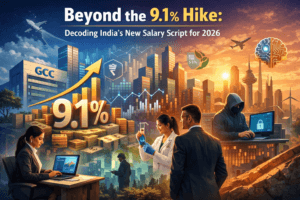
Beyond the 9.1% Hike: Decoding India’s New Salary Script for 2026
The annual salary increment letter has long been a sacred text in the Indian professional’s life—a simple, powerful number that defined a year of hard work. But according to the latest EY Future of Pay 2026 Report, the narrative is undergoing a profound rewrite. The headline figure is a healthy 9.1% projected salary increase for India Inc. in 2026. However, for the savvy professional and the forward-thinking leader, that number is merely the cover of a much more complex and revealing story.
This isn’t just about getting a raise anymore; it’s about understanding a new compensation philosophy where precision, skills, and performance are creating a multi-tiered system of rewards. We are moving from an era of blanket increments to an age of surgical precision in pay.
The Sectoral Shuffle: Where the Money Moves
While the average is 9.1%, the real action is in the outliers. The report highlights a clear hierarchy of sectors that are set to outpace the market, driven by global tailwinds and domestic demand.
Global Capability Centers (GCCs) are the new rockstars of the Indian talent market, projected to lead with a 10.4% hike. These are no longer just back-office outposts; they are innovation hubs running core tech and R&D for the world’s largest corporations. For a professional, a move to a GCC is increasingly looking like a masterstroke for career growth, offering a blend of global exposure, complex problem-solving, and now, industry-leading pay.
Close on their heels are the traditional powerhouses. Financial Services (10%) and E-Commerce (9.9%) continue their war for talent, while the Lifesciences and Pharmaceuticals sector (9.7%) demonstrates the enduring value of deep scientific expertise in a health-conscious world.
What does this mean for you? If you’re in a sector like IT or Hi-Tech (projected at 9.1%, exactly at the average), the headline number might seem stagnant. But the real opportunity lies in specializing in the domains that are pulling the overall sector forward—like fintech within financial services or health-tech within pharma.
The Death of the Generalist: Skills Are the New Currency
The most seismic shift outlined in the report is the steady dismantling of the traditional, role-based pay structure. For decades, you were paid for the chair you sat in. Now, you are increasingly paid for what you can do. The report notes that nearly half (45-50%) of surveyed organizations are shifting to skill-based pay frameworks.
This is where the “human insight” becomes critical. It signals the end of the “safe” generalist. The professional who relies on doing a decent job year after year will find their pay growth stagnating. In their place, the “specialist with range” is being crowned.
Nowhere is this more evident than in the red-hot market for AI, machine learning, and cybersecurity talent. The report states that these roles can command a skill premium of 30-40%. In a world where the average hike is 9.1%, a 40% premium isn’t just a bonus; it’s a different economic stratosphere. This is the market screaming its priorities. Companies aren’t just adopting AI; they are being rebuilt around it, and they are willing to pay a king’s ransom for the architects of this new world.
For the individual, this is a clarion call. Your value is no longer defined by your years of experience or your job title alone. It’s defined by your stack of capabilities. Are you a marketer who can wield generative AI? A finance professional who can build a machine-learning model for fraud detection? A HR leader who can leverage people analytics? If the answer is yes, you are not just negotiating a salary; you are commanding a premium.
The Performance Gauntlet: Why “Just Doing Your Job” Isn’t Enough
The data on variable pay and performance differentiation is perhaps the most sobering for the average performer. The gap between the stars and the steady-eddies is becoming a chasm.
The report reveals a stark reality: top performers are taking home 1.6x more than their less-esteemed colleagues. This isn’t just about a slightly bigger bonus. The mechanics are brutal and beautiful in their clarity. High performers are earning 120-150% of their target payouts, while average performers are scraping by with 60-80%. If your target variable is, say, ₹10 lakhs, this is the difference between taking home ₹15 lakhs or just ₹6 lakhs. Over a few years, this compounding effect can create a lifetime of wealth disparity between two people who started at the same desk.
This sharpens the focus on a crucial question for every employee: “What is my tangible impact?” The era of “presenteeism” is over. Companies are using data analytics (with 50-60% of large firms now doing so) to dissect performance with surgical precision. They know who is driving revenue, who is solving the toughest problems, and who is just filling a seat.
For managers, this creates a new responsibility. It’s no longer enough to give everyone a pat on the back. They must have honest, data-backed conversations about performance and coach their teams to move up the value chain. The “average” rating is no longer a safe harbor; it’s a warning light.
Beyond Cash: The New Architecture of Wealth and Security
Compensation is no longer just about the monthly paycheck and an annual bonus. The report highlights a sophisticated layering of rewards designed for retention and alignment with long-term goals.
Long-Term Incentives (LTIPs), particularly ESOPs, are becoming democratized. Once the preserve of the C-suite, they are now being used to lock in critical individual contributors, especially in GCCs and tech firms. If you’re a coder with a rare skill, your compensation package might now include a piece of the company’s future, making you a true stakeholder. This is a powerful psychological shift—it transforms an employee from a hired hand into a co-owner.
Furthermore, the definition of “good pay” is expanding to include stability and fairness. As Abhishek Sen, Partner at EY India, notes, employees are increasingly seeking “clarity, fairness, and consistency” in pay decisions. This is a profound insight. In a volatile world, a transparent and well-communicated pay philosophy can be as much of a retention tool as a large bonus. People want to understand why they are paid what they are paid and see a clear, achievable path to earning more.
The tightening of clawback provisions, especially in BFSI, and the linking of up to 15% of leadership variable pay to ESG metrics also signal a maturation of the market. Pay isn’t just about profit; it’s about sustainable and ethical value creation. For the next generation of leaders, this means their ability to build a diverse team or reduce the company’s carbon footprint will directly impact their earnings.
Navigating the New Terrain
The EY report draws a map of a new world of work. The 9.1% increment is the climate, but the weather—where you stand—is highly localized.
For the employee, the message is to invest relentlessly in your skills portfolio. Your biggest asset isn’t your current job; it’s your adaptability. Seek out roles and projects that build future-proof capabilities, particularly in the AI and data space. Understand your company’s pay philosophy and have an open dialogue about how your unique skills translate to your compensation.
For the employer, the challenge is to build a system that is both competitive and sustainable. This means moving away from gut-feel performance reviews to data-driven ones. It means designing skill-based pay frameworks that are fair and transparent. And it means communicating the “why” behind pay decisions to build trust in an era where skepticism is high.
The Future of Pay isn’t a distant concept; it’s arriving in 2026. It’s a future where pay is sharper, more personalized, and a truer reflection of an individual’s unique value. The professionals and companies that understand this new script won’t just survive; they will thrive.
You must be logged in to post a comment.