
Beyond the 4% Uptick: Why Indian Railways’ Freight Growth Hides a Looming Capacity and Diversification Challenge
Indian Railways’ February 2026 freight performance showed a modest 4% year-on-year increase to 137.72 million tonnes, with healthy growth in segments like iron ore, steel, and fertilisers, but experts warn this incremental progress falls far short of the double-digit expansion required to meet long-term national logistics goals. Beneath the surface-level numbers lies a precarious structural reality: the national transporter remains dangerously dependent on coal and other bulk commodities while struggling to capture high-value non-bulk freight from roads, a challenge compounded by severe capacity constraints on its mixed-use network. The success of the Dedicated Freight Corridors proves that dedicated infrastructure can drive efficiency, but the slow progress on new corridors and the urgent need for private capital highlight the gap between ambition and execution. Ultimately, the 4% growth serves as a diagnostic warning that Indian Railways must aggressively diversify its cargo base, embrace private investment, and overhaul its operational model to truly become the competitive, efficient backbone of India’s logistics future.
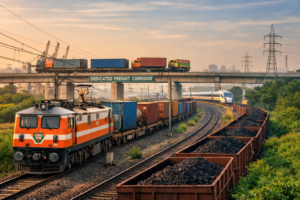
Beyond the 4% Uptick: Why Indian Railways’ Freight Growth Hides a Looming Capacity and Diversification Challenge
On March 6, 2026, the Indian Railways announced its freight figures for February 2026, reporting a steady 4% year-on-year increase to 137.72 million tonnes (mt) . At first glance, the numbers appear healthy. Freight revenue climbed to ₹14,571.99 crore, Net Tonne Kilometres (NTKM)—a crucial measure of freight output—improved by 4.18%, and core sectors like iron ore, steel, and fertilisers showed encouraging growth . For the average observer, this looks like the national transporter chugging along nicely, supporting India’s economic engine.
However, beneath the veneer of these incremental gains lies a more complex and precarious reality. Sandwiched within the Ministry’s press release was a subtle but significant acknowledgment from experts: double-digit expansion is needed to meet long-term goals. This 4% figure, while positive, is not a cause for celebration but rather a diagnostic prompt. It raises fundamental questions about whether Indian Railways can break free from its historical constraints to capture a larger slice of India’s rapidly growing logistics pie.
This article delves deep into the February 2026 freight data, moving beyond the headline numbers to explore the structural challenges, strategic shifts, and high-stakes reforms that will determine whether Indian Railways can transform from a lumbering bulk carrier into a competitive, diversified logistics powerhouse.
The February Numbers: A Snapshot of Steady but Unspectacular Growth
The data released by the Rail Ministry on March 6, 2026, offers a detailed look at where the growth is coming from and, more importantly, where it is not .
Table: Indian Railways Freight Performance – February 2026 vs. February 2025
| Metric | February 2025 | February 2026 | Change (%) |
| Total Freight Loading (Million Tonnes) | 132.48 | 137.72 | +3.96% |
| Freight Revenue (₹ Crore) | 14,151.96 | 14,571.99 | +2.97% |
| Net Tonne Kilometres (Million NTKM) | 72,955 | 76,007 | +4.18% |
The marginal difference between tonnage growth (3.96%) and NTKM growth (4.18%) suggests that, on average, goods travelled slightly longer distances than they did in the previous year. This is a positive indicator of network utilisation and deeper market penetration.
Commodity-Level Insights: The Winners The railways’ daily freight loading position revealed some stellar performers in specific niches :
- Raw Materials for Steel Plants (excluding iron ore): An extraordinary 46.9% jump in daily loading, indicating robust activity in the primary metals sector.
- Iron Ore: A solid 27.6% increase, reflecting sustained demand from both domestic steelmakers and export markets.
- Pig Iron and Finished Steel: Up by 20.8%, aligning with the government’s push for manufacturing and infrastructure development.
- Fertilisers: A significant 10.2% daily increase and a massive 27.7% jump on a cumulative monthly basis, underscoring the importance of rail in moving agricultural inputs ahead of the cropping season .
- Mineral Oil and Container EXIM: Both grew by an impressive 17.8%, signalling a gradual shift towards moving high-value and non-bulk goods .
These figures tell a story of an economy in motion. The surge in steel and raw material inputs points to infrastructure-led capital formation, while the rise in fertiliser movement highlights the railways’ enduring role in the agricultural supply chain. However, these bright spots coexist with a structural dependency that continues to define—and limit—the organisation’s potential.
The “Coal Conundrum” and the Diversification Dilemma
For decades, Indian Railways has been synonymous with bulk movement. Coal, iron ore, cement, and food grains form the bedrock of its freight business. While this has provided a stable revenue base, it has also created a dangerous dependency. According to a PwC-FICCI report published in mid-2025, coal alone accounts for nearly 50% of the railways’ freight volumes .
This dependency is the elephant in the room when analysing the February 2026 numbers. While the overall freight basket grew by 4%, the growth is still disproportionately driven by the same old suspects: iron ore and steel. The “high-value” non-bulk segments—FMCG, e-commerce, pharmaceuticals, automobiles, and consumer durables—remain largely on the roads.
Why does this matter?
- Vulnerability to Policy Shifts: As a government panel warned in January 2026, the Railways must prepare for a “post-coal future.” With India committed to achieving net-zero emissions by 2070 and aggressively expanding renewable energy, thermal coal demand is expected to plateau and eventually decline . Betting the house on coal is a long-term strategic risk.
- Lower Revenue Yield: Bulk commodities, while voluminous, often move on lower freight rates compared to high-value manufactured goods. A truck carrying electronics or packaged consumer goods generates significantly higher revenue per kilometre than a train hauling coal. The February revenue growth of 2.97% lagging behind volume growth of 3.96% is a subtle reminder of this yield pressure .
- Missed Opportunity: The non-bulk freight market in India is overwhelmingly dominated by roads. The PwC-FICCI study noted that while more than 90% of non-bulk freight moves by truck, in developed countries like the US, rail and intermodal systems capture around 30% of this segment . This represents a vast, untapped market that the railways are currently ill-equipped to serve.
A Parliamentary Standing Committee on Railways, in its report in December 2025, explicitly recommended that the ministry “intensify outreach to sectors such as FMCG, e-commerce, [and] fly ash,” stressing that “diversification is imperative for long-term sustainability” .
The Infrastructure Bottleneck: When Passengers and Freight Collide
The fundamental challenge facing Indian Railways is not just a lack of demand, but a lack of dedicated capacity. Most of the network is a “mixed-use” system, where slow, heavy freight trains share the same tracks with high-speed passenger trains, including the prestigious Vande Bharat expresses. This creates a logistical logjam.
On high-density corridors, the network runs at over 100% capacity, leading to chronic delays, unpredictable transit times, and systematic slowdowns. A freight train on the conventional network might crawl at an average speed of 25 km/h, making it uncompetitive for time-sensitive cargo . This is precisely why the Dedicated Freight Corridors (DFCs) are so critical.
The DFC Game-Changer The Eastern and Western DFCs, which span about 2,750 km, are already demonstrating what a dedicated freight network can achieve. By segregating freight from passenger traffic, the DFCs allow trains to run faster (40-60 km/h), longer, and heavier. In FY 2024-25, DFCs handled over 90 billion NTKM of freight, and train operations surged by an astonishing 48% .
The DFCCIL (Dedicated Freight Corridor Corporation of India) even operated “Rudrashtra,” the country’s longest freight train, stretching 4.5 kilometres with 354 wagons—a feat impossible on the congested mixed network . The success of the DFCs is a powerful proof of concept: if you build dedicated capacity, freight will shift to rail.
However, the DFCs currently cover only about 4% of the network length but already move over 14% of the freight . To replicate this success, India needs more. Three additional freight corridors are on the drawing board, with detailed project reports finalised, but they come with an estimated price tag of around ₹2 lakh crore and are yet to enter the formal budget pipeline . The window between now and the completion of these corridors will determine whether the railways can capture the upcoming logistics boom or lose it permanently to highways.
The Private Capital Imperative: Rethinking the Funding Model
One of the most significant shifts in the railway’s strategic discourse is the growing acceptance that the public exchequer alone cannot fund the capex required for this transformation. Historically, the Railways has been wary of Public-Private Partnerships (PPP), citing safety and operational complexities. That mindset is now being challenged at the highest levels.
In January 2026, the Public Investment Board (PIB)—the inter-ministerial body that vets major public projects—explicitly told the Railways to rethink its growth plan and actively bring in private capital . The recommendations were sweeping:
- Private Participation in Construction: Involving private companies in multi-tracking projects and port connectivity.
- Innovative Procurement: Adopting models like the Hybrid Annuity Model (HAM) and “wet leasing,” where private firms supply not just trains but also the crew to operate them .
- Rolling Stock Investment: Encouraging private entities like port operators, cement producers, and logistics providers to invest in their own wagons, with potential rebates on freight charges to incentivise participation .
This push for privatisation is not just about money; it is about efficiency and service quality. Private operators are likely to be more responsive to customer needs, offering the kind of time-tabled, reliable services that FMCG and e-commerce companies demand. The Parliamentary Committee has also urged the Railways to offer “commercially viable and attractive terms” to lure private investment into future DFCs .
Yet, execution remains the Achilles’ heel. Large-scale rail projects in India are notorious for delays and cost overruns. A March 2024 report noted that 26 railway projects were among the 51 most delayed central sector schemes . The Udhampur-Srinagar-Baramulla rail link took nearly three decades to complete. For private investors wary of regulatory uncertainty and land acquisition hurdles, these timelines are a significant deterrent.
Divisional Excellence: The Waltair Model
Amidst the macro-level challenges, some micro-level successes offer a blueprint for the future. The Waltair Division of Indian Railways, which handles critical routes in Odisha and Andhra Pradesh, posted record freight growth in the first half of FY2025-26 .
The division achieved a 10.9% growth in loading, with iron ore movement surging by 21.69%. Crucially, its freight earnings jumped by 12.18%, and NTKM grew by 9.64% . This performance was not accidental. It was driven by:
- Strategic focus on key industrial clusters.
- Improved turnaround efficiency and operational reliability.
- Aggressive formation of long-haul trains.
The Waltair example demonstrates that when local management is empowered and infrastructure bottlenecks are addressed, double-digit growth is achievable even within the current system. It proves that the “experts’ demand” for double-digit expansion is not a pipe dream but a tangible target, provided the right operational levers are pulled.
Road to Rail: The Logistics Cost Imperative
Ultimately, the debate over railway freight is a debate over India’s economic competitiveness. India’s logistics costs are estimated to be around 14% of GDP, significantly higher than in developed economies (8-10%). High logistics costs inflate the price of every product, from a sack of cement to a smartphone, and erode export competitiveness .
A modal shift from road to rail is one of the most effective ways to slash these costs. Rail transport is inherently 3 to 4 times more energy-efficient than road and produces a fraction of the carbon emissions. The World Bank estimates that raising rail’s modal share from the current ~25% to 40% by 2047 could cut annual CO₂ emissions by over 200 million tonnes and save billions in fuel imports .
Initiatives like the “Truck-on-Train” service, pioneered by the DFCCIL, aim to capture this shift by allowing trucks to be loaded onto specially designed rail wagons for the long-haul portion of their journey, combining the flexibility of road with the efficiency of rail .
The February 2026 numbers show that Indian Railways is moving in the right direction, but at a walking pace when the economy needs it to sprint. The 4% growth is a maintenance beat, not a game-changer.
For the Railways to truly become the backbone of a $10-trillion economy, it must confront its structural rigidities head-on. This means aggressively building new dedicated freight corridors, embracing private capital not as a last resort but as a strategic partner, and fundamentally re-engineering its service offerings to attract automobiles, electronics, and packaged goods.
The policymakers and experts are clear: the days of relying on coal to pull the freight train are numbered. The future belongs to a diversified, efficient, and customer-centric railway. The February 2026 report card serves as a gentle reminder that while the locomotive is still running, it desperately needs more power, new tracks, and a more diverse cargo hold to reach its destination. The double-digit dream is achievable, but it will require a radical departure from business as usual.
You must be logged in to post a comment.