
Beyond the $300 Billion Illusion: India’s Climate Justice Stand at COP30 and the Unseen Battles Back Home
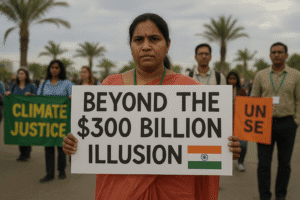
Beyond the $300 Billion Illusion: India’s Climate Justice Stand at COP30 and the Unseen Battles Back Home
The air in Belém, Brazil, is thick with the scent of the Amazon and the weight of unmet promises. As world leaders convene for COP30, the familiar script of climate diplomacy is playing out, but with a new, urgent intensity. At the heart of this drama stands India, delivering one of its most forceful critiques to date, arguing that the entire financial architecture of global climate action is built on an “illusion.”
This isn’t just a story of diplomatic spats; it’s a narrative about survival, equity, and the stark contrast between global pledges and grassroots reality. While the world debates abstract billions in conference halls, the real work—and the real crisis—is unfolding in India’s forests and contaminated water pipelines, painting a complete picture of a nation navigating its climate destiny.
The Belém Showdown: India Demands Legal Teeth for Climate Finance
The cornerstone of the COP30 negotiations is the New Collective Quantified Goal (NCQG)—a new annual financial target of at least $300 billion by 2035, agreed upon at COP29. To developed nations, this represents progress. To India, speaking for the Like-Minded Developing Countries (LMDCs), it is a dangerously hollow victory.
Indian negotiator Suman Chandra’s message was unequivocal: a target without legal obligation is meaningless. The core of India’s argument rests on Article 9.1 of the Paris Agreement, which places a clear, binding responsibility on developed countries to provide financial resources to developing nations. The NCQG, India asserts, conveniently sidesteps this legal mandate, treating climate finance as a voluntary donation rather than a foundational obligation for historical emissions.
“Without adequate, scaled-up, and long-term funding, our NDCs are just paper promises,” is the unspoken cry from the Global South. India’ critique is threefold:
- The Mirage of Voluntary Finance: The $300 billion goal lacks a formal, predictable mechanism. It risks becoming a repeat of the failed $100-billion-a-year pledge, which was never fully met. India insists that developed nations must provide multi-year projections of grants and concessional loans, moving beyond one-off pledges.
- The Mask of “Creative Accounting”: India raised serious concerns over the integrity of reporting, pointing out that some developed nations have submitted outdated data or even reduced their contributions in official reports. When loans at market rates or re-packaged development aid are counted as “climate finance,” the spirit of the agreement is violated.
- The Principle of Equity: For India, this is non-negotiable. Finance and technology are not acts of charity but essential rights for climate-vulnerable nations to achieve a just transition. By ignoring Article 9.1, richer nations are effectively dismissing the principle of Common But Differentiated Responsibilities and Respective Capabilities (CBDR-RC).
India’s demand is simple yet revolutionary: formally negotiate Article 9.1 at COP30 and embed the NCQG within a framework of legal accountability. Without this, the $300 billion target is not just an illusion; it is a guarantee that the green transition will be stalled for lack of fuel.
The Counter-Narrative: Brazil’s Tropical Forests Forever Facility
In stark contrast to the finance stalemate, the COP30 host, Brazil, launched a bold and tangible initiative: the Tropical Forests Forever Facility (TFFF), or the Global Forest Fund. This mechanism represents a paradigm shift from talking about deforestation to creating a direct financial incentive to stop it.
The concept is elegantly simple: create a global endowment fund that pays tropical forest nations a regular fee—a proposed $4 per hectare—for keeping their forests standing. Payments would be deducted for any forest loss, and crucially, 20% of the payout is earmarked for Indigenous and local communities, acknowledging their role as the forests’ most effective guardians.
With Brazil and Indonesia committing $1 billion each and Norway pledging $3 billion, the TFFF has significant initial backing. Its goal is to mobilize $125 billion, with the World Bank acting as the trustee. However, its success hinges on overcoming immense challenges: securing massive private sector investment, ensuring transparent and corruption-free payment systems, and establishing foolproof satellite monitoring to verify “no deforestation” claims.
The TFFF is a test of global political will. It shows that when there is a clear, measurable outcome—standing forests—the international community can rally around an innovative financial model. This only highlights the irony of the broader climate finance debate, where the equally clear outcome of a just energy transition struggles to find a similarly robust mechanism.
The Domestic Front: Aligning Global Demands with Local Action
India’s powerful stance on the global stage is backed by significant, though often underreported, domestic action. The country is not merely a petitioner for funds; it is a laboratory for large-scale environmental management.
Boosting the Carbon Sink: A Silent Achievement
While the world focuses on emissions, India has been quietly building its natural carbon sink. Between 2005 and 2021, the country increased its forest and tree cover to 25.17% of its geographical area, creating an additional 2.29 billion tonnes of CO2 equivalent carbon sink. This achievement, highlighted by experts like former IMD director LS Rathore, is a cornerstone of India’s climate strategy, directly aligning with its international commitments under the Paris Agreement.
This isn’t accidental. It’s the result of sustained policy efforts under the National Action Plan on Climate Change (NAPCC), which integrates mitigation with crucial adaptation strategies, especially for the agriculture sector. This domestic progress strengthens India’s moral authority to demand that others meet their obligations.
Rationalizing Forest Violations: The Devil in the Details
Back in the policy corridors of Delhi, the Forest Advisory Committee (FAC) is fine-tuning the machinery of environmental governance. In a significant move, the FAC has recommended standardizing penalties for violations of the forest law.
The new mandate requires Penal Compensatory Afforestation (CA) on an area equal to the violated forest land, in addition to a financial penalty known as the Penal Net Present Value (NPV). The NPV quantifies the economic value of the ecosystem services lost—from clean air to water filtration—and can be levied at up to five times the standard rate.
This rationalization seeks to end arbitrary enforcement and ensure that violators consistently bear both the cost of restoration (through penal CA) and the cost of ecological damage (through penal NPV). Furthermore, the FAC has demanded that state governments identify and act against officials who permit such offenses, adding a layer of accountability often missing in environmental enforcement.
NGT’s Directive in Tambaram: When Climate Vulnerability Becomes Local
The abstract threat of climate change becomes terrifyingly real in places like Tambaram, Tamil Nadu. Here, the National Green Tribunal (NGT) is overseeing a public health crisis rooted in infrastructural collapse. Following water contamination that led to hospitalizations and deaths, the NGT has issued a blueprint for urban climate resilience.
The tribunal identified the core problem: only 38 of Tambaram’s 70 wards are covered by an Underground Sewerage System (UGSS). In the rest, septic tanks and open drains leak into canals, posing a perpetual risk of cross-contamination with aging water pipelines.
The NGT’s orders are a masterclass in systemic problem-solving:
- Quarterly water audits and pipeline integrity checks by the pollution control board.
- Immediate preparation of Detailed Project Reports (DPRs) to extend the UGSS to all wards.
- Mandatory quarterly progress reports and timely release of state funds.
- Continued community health surveillance and awareness programs.
This situation in Tambaram is a microcosm of the adaptation challenges thousands of fast-urbanizing cities in the Global South face. It underscores why India fights so hard for climate finance: without it, building the resilient infrastructure needed to protect millions from such crises is an impossible task.
The Unbreakable Link
The threads from Belém, Delhi, and Tambaram are woven into a single tapestry. India’s demand for binding finance at COP30 is directly linked to its need to fund massive afforestation projects, implement stringent forest conservation laws, and build climate-resilient water and sewage systems in cities across the country.
The $300 billion is not an arbitrary number. It is the estimated cost of survival and equitable development. When India calls it an “illusion” without legal backing, it is speaking from the front lines of the climate crisis, where promises won’t filter contaminated water or protect standing forests. The world can choose to see this as a diplomatic confrontation, or it can recognize it as a plea for a realistic partnership to secure a livable planet for all. The outcome of this choice will define not just the success of COP30, but the trajectory of global climate action for decades to come.
You must be logged in to post a comment.