
Beyond the 2.75% Figure: Why India’s New CPI is Really a Mirror of a Changed Nation
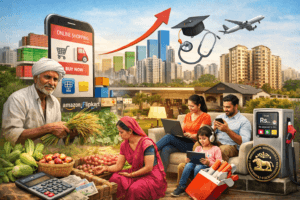
Beyond the 2.75% Figure: Why India’s New CPI is Really a Mirror of a Changed Nation
At first glance, Thursday’s announcement from the Ministry of Statistics and Programme Implementation (MoSPI) appeared to be a routine technical update. The base year for the Consumer Price Index (CPI) moved from 2012 to 2024. Retail inflation clocked in at a benign 2.75%. The headline was safe, and the markets barely flinched.
But to view the new CPI series merely as a statistical recalibration is to miss the forest for the trees.
This isn’t just a new index; it is a confession that the Indian consumer of 2026 shares almost no resemblance to the Indian consumer of 2012. The basket of goods we use to measure the health of the rupee is no longer filled with just wheat, rice, and cloth. It is now loaded with data plans, health insurance premiums, dining out, and smart devices.
We are not just measuring inflation differently. We are measuring a different India.
The Vanilla of the Middle Class
The most striking—and politically delicate—shift in the new series is the drastic reduction in the weight of the Food and Beverages category. It has dropped to 36.75% from 45.86%.
In a country where “price rise” has historically been synonymous with “onion prices,” this is a tectonic shift. Chief Economic Advisor V. Anantha Nageswaran framed this as a technical victory, noting that lowering the weight of the volatile food category will make the headline number less jumpy.
But outside the boardroom, this revision tells a deeper story about aspiration and inequality.
For the urban upper-middle class, food is indeed a shrinking part of the monthly budget. A family in South Delhi or Bengaluru may spend more on Zomato orders than on raw vegetables, but their anxiety around inflation is tied to housing maintenance costs, school fees, and fuel. The new index reflects them.
However, for the vast informal workforce and rural poor, food still consumes the lion’s share of incremental income. By reducing the food weight, the government’s inflation barometer becomes less sensitive to the very price shocks that hurt the most vulnerable.
This creates a curious paradox: The CPI is now more accurate for the “average” Indian, but that average is being pulled upward by the consuming classes. The headline figure of 2.75% may be a soothing balm for the RBI, but it may not translate to relief in the local mandis.
The Digitalization of the Shopping Basket
Perhaps the most symbolic change in the new series is the inclusion of 12 online marketplaces as direct data collection points.
In 2012, e-commerce was a novelty; today, it is infrastructure. The fact that statisticians are now scraping prices from Amazon, Flipkart, and BigBasket is an admission that the physical market is no longer the sole price setter. For millions of Indians, the “prevailing price” of a pair of jeans or a mixer-grinder is determined by a flash sale, not a local retailer.
This shift also introduces a new dynamic in inflation measurement: algorithmic pricing. When a central bank adjusts interest rates to cool demand, does the effect trickle down the same way when prices are set by AI-driven supply chain algorithms? This is a question the previous series was never equipped to answer.
The 50 New Services: We are Spending on Life, Not Just Living
The old CPI tracked 40 services. The new one tracks 50. That increase of ten seems minor, but it represents a fundamental shift in how Indians allocate surplus cash.
The creation of standalone groups for “Information and Communication” (3.61% weight) and “Recreation, Sports and Culture” (1.52%) is significant. A decade ago, a mobile phone recharge was a luxury; today, it is a utility on par with electricity. By giving it its own category, the CPI acknowledges that connectivity is no longer discretionary—it is essential for employment, education, and banking.
Similarly, the separation of “Health” (6.1%) and “Education” (3.33%) as distinct heavyweight categories highlights the changing nature of household financial stress. In the 2012 series, these were buried within miscellaneous groups. Today, they are front and centre.
This is not just statistical tidiness. It is a reflection of the precarity of the middle class. The single biggest driver of distress in urban India is not the price of vegetables; it is the cost of a bypass surgery or a private school admission. By elevating these weights, the new CPI validates what families have known for years: health and education have become the primary drivers of household inflation, even if they are not the primary drivers of the headline rate.
The Housing-Fuel Merger: A Double-Edged Sword
The clubbing of Housing with Electricity, Gas, and Fuels into a single 17.67% super-category is a pragmatic move. In urban India, rent and utilities are paid as a single lump sum. They are perceived by the consumer as a singular “shelter cost.”
However, this aggregation carries risks for policymakers. Electricity tariffs are often subject to political subsidy cycles, while rent is market-driven. By merging them, the index may obscure whether inflation is coming from actual housing scarcity or from administered fuel price hikes. The RBI will need to look beneath the hood of this combined weight to gauge the true source of demand pressure.
The Cigarette Paradox: Why did Tobacco Weight Increase?
One figure that stands out in the new weighting matrix is the increase in weight for Paan, Tobacco, and Intoxicants—up to 2.99% from 2.38%.
At a time when health awareness is supposedly rising, a higher weight implies that households are spending a larger share of their total expenditure on these items than they were in 2011-12. This is not a policy failure; it is a behavioural insight.
Despite high taxation and stringent packaging laws, the consumption of tobacco products has not shrunk as a proportion of expenditure for the lowest income deciles. This “stickiness” of vice spending during economic transformation is observed globally, but seeing it quantified in the official weights is a stark reminder of the challenges of public health in a price-sensitive economy.
What does this mean for your EMI?
For the average borrower, this revision is the most relevant change in a decade.
The RBI’s Monetary Policy Committee (MPC) sets interest rates based on inflation projections. If the new CPI is less volatile and structurally lower due to reduced food weight, the MPC may feel more confident in holding rates steady or even cutting them, even if specific food items see temporary spikes.
Mr. Nageswaran explicitly stated that the new series will result in “more calibrated monetary and fiscal policy.” Translation: The government and the central bank will have fewer panic moments. The “2.75%” January reading, if sustained, opens up significant fiscal space. It reduces the real interest rate burden on the government’s own borrowing and eases the pressure on the RBI to remain hawkish.
However, there is a flip side. If the new index under-represents the inflation experienced by the poor (due to lower food weights), but monetary policy is tightened based on this index, it could result in a situation where interest rates are set against the “average” consumer, leaving the marginal consumer behind.
The “Linking Factor” and the Erased Decade
MoSPI Secretary Saurabh Garg confirmed that a “linking factor” will be provided to allow statisticians and economists to splice the old series with the new, allowing comparisons back to 2013.
But for the common person, the history is effectively reset.
We cannot directly compare the inflation rate of January 2026 (2.75%) with January 2025 under the old series. This “data break” is statistically sound, but politically convenient. It allows the narrative to shift forward, unburdened by the high inflation spikes of the late 2010s. The new series presents a clean slate.
Yet, the ghosts of the past remain. The reason the base year was moved from 2012 to 2024 is because the 2012 basket had become archaic. It was still living in the world of the pre-demonetization, pre-GST, pre-pandemic economy. The 2024 HCES data finally catches up to the reality of a formalized, digitized, and service-oriented consumption economy.
Conclusion: A Mirror, Not a Painting
A good inflation index is not a painting that flatters the subject; it is a mirror that reflects warts and all.
The new CPI series is a high-definition mirror. It shows us that India eats less grain and more processed food. It shows us that India pays more for data than for diesel. It shows us that health and education have moved from being occasional expenses to structural financial commitments.
For policymakers, this mirror offers better clarity. For investors, it offers predictability. But for the citizen, it offers a moment of self-recognition.
The inflation of the future will not be about the price of a kilo of potatoes. It will be about the cost of remaining connected, remaining healthy, and remaining educated in a rapidly modernizing economy.
The January number of 2.75% is just the first pixel of a very large, very detailed new picture. It will take months of data points to understand the full contours of this changed landscape. But one thing is certain: The old ways of understanding “expensive” and “cheap” no longer apply.
We are not just measuring prices differently. We are living differently.
You must be logged in to post a comment.