
Beyond the $1.8 Billion Sale: How a Handshake in Miaoli Is Redrawing the Global Memory Chip Map
PSMC has finalized the $1.8 billion sale of its Miaoli, Taiwan facility to Micron Technology, but the transaction is far more than a simple asset transfer, representing a strategic pivot for both companies in the AI-driven semiconductor landscape. Under the deal, PSMC will provide high-bandwidth memory (HBM) foundry services to Micron, giving the Taiwanese company a direct entry into the lucrative AI supply chain, while Micron will offer technical assistance to help PSMC develop advanced DRAM processes, effectively trading a physical plant for future-proofed expertise. For Micron, the acquisition provides immediate, scalable production capacity to meet surging AI demand, with plans for a second facility by 2026, solidifying its long-term commitment to Taiwan and positioning the Miaoli site as a critical node in the global AI infrastructure by the time meaningful shipments begin in 2028.
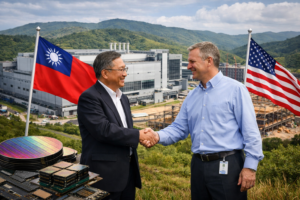
Beyond the $1.8 Billion Sale: How a Handshake in Miaoli Is Redrawing the Global Memory Chip Map
Dateline: TAIPEI – In the rolling hills of Miaoli County, Taiwan, a transaction closed on Monday that is far more significant than a simple real estate deal. When Powerchip Semiconductor Manufacturing Corp. (PSMC) handed over the keys to its Tongluo Township facility to American giant Micron Technology, they weren’t just transferring ownership of a building; they were igniting a complex technological partnership that will ripple through the AI supply chain for years to come.
The official press releases speak of a $1.8 billion acquisition, technology collaboration, and fiscal year 2028 shipping targets. But to understand the real weight of this moment, you have to look at the strategic dilemmas facing both companies, the relentless hunger of the AI boom, and the delicate dance of intellectual property in one of the world’s most critical industries.
The Sale That Wasn’t Just a Sale
For the casual observer, the news reads as a straightforward consolidation: Micron, the Boise-based memory behemoth, is buying a factory to expand its DRAM (Dynamic Random Access Memory) production. But the structure of the deal reveals a more intricate narrative. PSMC isn’t just cashing out and walking away. By securing a technology collaboration agreement in return, the Taiwanese company is effectively trading a physical asset for a future-proofed skillset.
“This is the semiconductor equivalent of a master chess move,” says Dr. An Wei, a Taipei-based industry analyst who has followed both companies for decades. “PSMC realized that going head-to-head with the likes of Micron, Samsung, and SK Hynix in the volume DRAM market is a losing battle. The capital expenditure is astronomical. So, they are pivoting. They are selling the factory to fund a new direction, and using the deal to get Micron to teach them the advanced moves they need for that new game.”
That “new game” is the world of 3D AI foundry services. PSMC Chairman Frank Huang hinted at this when he mentioned the company’s foray into wafer-on-wafer (WoW) technology, interposers, and silicon capacitors. These aren’t your standard computer chips. These are the intricate, layered architectures required to stack memory directly on top of logic chips—the secret sauce behind the high-bandwidth memory (HBM) systems that power the NVIDIA and AMD AI accelerators driving the current artificial intelligence revolution.
The Micron Mandate: Securing the Future, One Cleanroom at a Time
From Micron’s perspective, the acquisition is a decisive stroke in a high-stakes global game. The demand for HBM has skyrocketed, turning memory chip makers into unexpected but critical players in the AI gold rush. For years, DRAM was a commodity product, its price fluctuating wildly with the cycles of the PC and smartphone markets. Today, it is a strategic asset.
The Tongluo facility offers Micron something almost as valuable as the silicon wafers themselves: speed and scale. Building a brand-new leading-edge fab from scratch is a multi-year, multi-billion-dollar endeavor fraught with regulatory hurdles and construction delays. Acquiring an existing, modern facility from PSMC allows Micron to compress that timeline dramatically.
Manish Bhatia, Micron’s executive vice president for global operations, framed the acquisition as complementary to its existing Taiwan operations. Taiwan is already a cornerstone of Micron’s empire, housing its massive Taiwan Memory Corporation (TMTC) joint venture and its R&D hub. The Tongluo site slots perfectly into this ecosystem, allowing for seamless integration of talent and technology.
But the vision is even grander. The announcement that Micron plans to begin construction on a second facility of comparable scale at the same site by the end of fiscal year 2026 is a powerful signal. It speaks to a long-term commitment to the region and a belief that the demand for advanced memory will not be a fleeting bubble. The addition of 270,000 square feet of cleanroom space—enough to fill several football fields—represents a bet on a future where AI is ubiquitous.
A Symbiotic Partnership: HBM for Process Technology
The core of the deal’s genius lies in the quid pro quo. PSMC will begin providing HBM and post-wafer-finish (PWF) foundry services to Micron. This is a fascinating role reversal. PSMC, traditionally a logic and foundry player, will now perform specialized back-end work on Micron’s memory wafers.
This arrangement allows Micron to outsource a complex, high-value part of the manufacturing process to a trusted local partner, freeing up its own internal capacity. For PSMC, it provides an immediate, revenue-generating entry into the lucrative HBM supply chain. It’s like a skilled carpenter who usually builds furniture being hired by a lumber mill to apply the highest-quality varnish to their finest wood before it’s sold.
In return, Micron will provide the technical assistance PSMC needs to develop niche DRAM processes at its Hsinchu facility. This is about helping PSMC graduate to more advanced memory technologies, specifically targeting the 8-gigabit (8G) DDR4 product line. While DDR4 is not the absolute bleeding edge (that crown belongs to DDR5 and HBM), the 8G DDR4 space is a massive and stable market. It’s the memory found in countless servers, laptops, and consumer devices. Mastering this process with Micron’s guidance will allow PSMC to capture significant value and provide a stable foundation for its more experimental 3D AI foundry business.
The Human Element: Engineers, Trust, and the Taiwan Factor
Behind the corporate strategizing and the billion-dollar price tags are the people who will make this partnership work. When a company like Micron takes over a facility like the one in Tongluo, the first and most critical question is always: “What happens to the employees?”
While not explicitly detailed in the release, such acquisitions typically involve the transfer of thousands of engineers and technicians. For these workers, the transition can be a mix of anxiety and opportunity. They are moving from a local Taiwanese pure-play foundry to a global Fortune 500 company with vastly different corporate culture, reporting structures, and career paths. Micron’s success in Tongluo will hinge on its ability to retain this talent, integrate them smoothly, and inspire them with the vision of working on the world’s most advanced memory technologies.
Furthermore, the collaboration hinges on a deep level of trust. PSMC will be handling Micron’s proprietary HBM wafers in its foundry services. Micron, in turn, will be sharing its advanced DRAM process know-how with PSMC’s engineers in Hsinchu. This exchange of intellectual property—the lifeblood of the semiconductor industry—requires a partnership built on more than just a contract. It requires a shared understanding of the market and a mutual respect for each other’s capabilities.
“This kind of ‘co-opetition’ is rare and difficult,” notes Dr. An Wei. “It only works because both sides have a clear and non-conflicting view of their future. Micron is focused on volume leadership in DRAM. PSMC is pivoting to a specialty foundry model. They are no longer competitors. They are now pieces of a larger puzzle.”
Looking Ahead: 2028 and Beyond
The timeline laid out by Micron points to fiscal year 2028 for “meaningful product shipments” from the existing Tongluo fab. That gives the company roughly two years to integrate the facility, install its own advanced production equipment, and ramp up yields to its exacting standards. It’s a tight window, but in the semiconductor world, it’s practically lightning speed.
When those shipments begin, they will feed directly into the insatiable demand of the AI data center market. Every new large language model, every autonomous driving system, every AI-powered medical diagnostic tool relies on the high-bandwidth memory that Micron will be producing in Miaoli.
The story of the PSMC-Micron deal is, therefore, a story of transformation. It’s about a local champion, PSMC, boldly reinventing itself for a new era. It’s about a global powerhouse, Micron, aggressively securing its supply chain to dominate that era. And ultimately, it’s about the rolling hills of Miaoli County becoming a critical node in the global nervous system of artificial intelligence. The sale is complete, but for the engineers, the executives, and the industry watchers, the real work—and the real story—has just begun.
You must be logged in to post a comment.