
Beyond Tariffs: How the India-EU FTA Demands a New Industrial Mindset to Win the Tech Future
The recently concluded India-EU Free Trade Agreement represents far more than a simple tariff-elimination pact; it is a strategic catalyst with the potential to fundamentally rewire India’s electronics and tech manufacturing sector by addressing its core structural weaknesses. The deal offers a dual engine for growth: slashing prohibitively high import duties on critical European components and precision machinery to revolutionize input costs and quality, while simultaneously granting Indian products duty-free access to the massive EU market. However, its true promise lies in forcing a necessary evolution from low-value assembly to high-value innovation and design, leveraging collaboration on R&D and alignment with stringent EU sustainability standards to build long-term global competitiveness. Ultimately, whether this “mother of all deals” achieves its projected $50 billion export dream hinges entirely on India’s domestic execution—bridging the skills gap, integrating MSMEs, ensuring policy stability, and, most crucially, shifting the industrial mindset from seeking cost arbitrage to building indispensable technological capability and intellectual property.
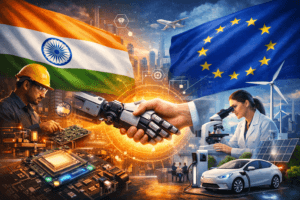
Beyond Tariffs: How the India-EU FTA Demands a New Industrial Mindset to Win the Tech Future
The recent conclusion of the India-European Union Free Trade Agreement has been met with headline-grabbing superlatives—”the mother of all deals,” a “turning point.” For India’s electronics and technology manufacturing sector, these phrases are more than just diplomatic cheerleading; they are a stark recognition of a seismic opportunity. This isn’t merely a trade pact; it’s a potential blueprint for rewiring India’s industrial DNA from the circuit board up. The promise is a leap from a $18 billion to a $50 billion export corridor by 2031. But the real story isn’t in the numbers—it’s in the painful, necessary evolution the deal demands from Indian industry.
The Hidden Engine: An Input-Side Revolution
Much of the public discourse focuses on the glittering export opportunity: duty-free access for over 93% of Indian goods into a $750 billion European market. Yet, the most transformative impact may be inward-bound. For years, Indian electronics manufacturing has been hamstrung by a critical cost paradox. To build goods for the world, India relies heavily on importing high-precision components, advanced machinery, and testing equipment—often from Europe itself. These vital inputs have faced import duties of 40% or higher, embedding a structural cost disadvantage before production even begins.
The FTA strategically dismantles this wall. Imagine a manufacturer of medical devices or professional AV systems. The specialized German sensors or Dutch lithography tools they need now become significantly cheaper. This isn’t just about marginal cost savings; it’s about enabling fundamental quality upgrades and innovation-led product design that was previously financially unviable. As Pankaj Rana of Hisense India notes, this “underappreciated input-side shift” allows for “unprecedented cost reductions while elevating quality.” It directly attacks the hidden bottlenecks that have kept Indian manufacturing in a lower-value tier.
The Great Value Chain Migration: From “Screwdriver” to “Synapse”
India’s success in electronics has been real, but narrowly defined. We have become a world-class assembly hub—masterful at “screwdriver” tech, where components from elsewhere are efficiently put together into smartphones, TVs, and appliances. The high-value domains of design, core R&D, and intellectual property creation have remained largely offshore. The FTA creates the conditions to change this, but it does not guarantee it.
The agreement facilitates more than just tariff reduction; it opens pathways for technical collaboration, joint R&D, and mutual recognition of standards. This is the crucial bridge from assembly to innovation. European prowess in precision engineering, automotive electronics, and sustainable tech can now be partnered with, not just purchased from.
The move is towards becoming the “synapse”—the central nervous system where ideas are conceived and transformed into blueprints. As Rajeev Singh of BenQ India highlights, easier collaboration can help “Indian operations move up the value chain.” This means Indian engineers working on next-generation semiconductor designs, creating IoT platforms for smart cities, or developing energy-efficient motor controllers, not just casing them.
The Sustainability Imperative: A Built-In Competitive Edge
Timing is everything. This deal arrives as European markets are hardening their environmental, social, and governance (ESG) standards. The EU’s Carbon Border Adjustment Mechanism (CBAM) and Ecodesign regulations are not trade barriers but market realities. Here, India has a potential, underdeveloped advantage.
The FTA incentivizes the production of goods that meet these stringent green standards. For Indian companies already investing in renewable energy solutions, electric vehicle components, or smart water management systems (like Energy Bots’ IoT devices), this alignment is a powerful market-entry tool. Their products aren’t just cheaper; they are future-compliant. This transforms sustainability from a compliance cost into a core competitive differentiator, allowing “Made in India” to resonate with the values of the conscious European consumer.
The Execution Abyss: Where Grand Deals Go to Die
This is where optimism must meet cold, hard realism. India’s history with FTAs is a cautionary tale of underutilization. Complex rules of origin, bureaucratic documentation, and a lack of awareness among small and medium enterprises (MSMEs) have often rendered such agreements theoretical for many.
The implementation challenges for this FTA are profound:
- The Skills Chasm: Moving up the value chain requires a different workforce. We need more semiconductor design engineers, compliance specialists for EU medical device directives (MDR), and advanced robotics technicians—not just assembly line operators. Our education system requires a urgent, industry-linked overhaul to build this talent pipeline.
- The MSME Onboarding Crisis: The backbone of Indian manufacturing, MSMEs, often lack the resources to navigate complex EU certifications like CE marking. Without targeted handholding—through industry clusters, government-funded consultancy, and simplified processes—they risk being excluded from the new supply chains this FTA will create.
- Infrastructure & Policy Consistency: Reliable power, efficient ports, and robust logistics are the unglamorous foundations of competitiveness. Similarly, technology investors dread sudden policy shifts. Long-term capital commitment in semiconductor fab or advanced chemistry cell battery plants requires a decade-long horizon of regulatory predictability.
- Beyond Cost Arbitrage: The greatest risk is that Indian industry views this deal only as a cost advantage. If the goal remains to be the cheapest, we will eventually lose to other geographies. The goal must be to become indispensable—through intellectual property, innovative design, and quality so rigorous it becomes a brand in itself.
A Strategic Pivot in a Fragmenting World
Ultimately, the India-EU FTA transcends economics. In an era of technological decoupling and supply chain nationalism, it represents a conscious, strategic alignment between two democratic blocs seeking “trusted” partnerships. It offers Europe diversified, values-aligned sourcing. It offers India a ladder to technological maturity and global integration.
As Aditya Khemka of CP PLUS states, it’s a step toward “a more balanced and resilient technology ecosystem.” This deal is a statement that India aims to be a participant in shaping the rules of the next technological wave, not just a participant in its assembly.
Conclusion: The Sputnik Moment for Indian Tech Manufacturing
The India-EU FTA is less a finished deal and more a starting gun. It provides the platform—the duty-free access, the tariff cuts on inputs, the framework for collaboration. What happens next is entirely up to India’s industrial ecosystem, policymakers, and educational institutions.
Will we use cheaper European components to simply assemble cheaper goods? Or will we use them as building blocks for our own proprietary, globally competitive innovations? Will we see this as a final destination or the first step in a long, arduous climb to technological sovereignty?
The “mother of all deals” is, in truth, a mirror. It reflects back the ambition, capability, and executional rigor of Indian industry. The $50 billion export target is a possibility, but the real prize is the structural reset of India’s tech manufacturing identity. The blueprint is signed. Now, we must build.
You must be logged in to post a comment.