
Beyond Tariffs: How the 2026 India-EU FTA is Redefining Sustainable Globalisation
The 2026 India-EU Free Trade Agreement represents a historic shift in trade diplomacy by placing sustainability, climate action, and responsible business practices at its core, moving beyond traditional tariff reductions to include a comprehensive “Trade for Sustainable Development” chapter that creates enforceable commitments on environmental protection, labour rights, and supply chain resilience. This landmark partnership, solidified during the January 2026 summit where European leaders attended India’s Republic Day celebrations, unlocks a market of 2 billion people while establishing institutional frameworks for collaboration on clean energy, sustainable finance, and digital innovation. However, the agreement’s success hinges on addressing implementation challenges, including regulatory uncertainty in the EU, capacity constraints among Indian SMEs, and the need for both sides to transform political commitments into tangible results that benefit businesses, workers, and the environment across both regions.
Beyond Tariffs: How the 2026 India-EU FTA is Redefining Sustainable Globalisation
The landmark trade deal between New Delhi and Brussels isn’t just about market access—it’s a blueprint for how democracies can collaborate on climate action, supply chain resilience, and sustainable development in an increasingly fractured world.
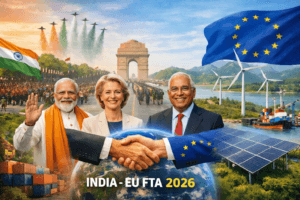
When European Commission President Ursula von der Leyen and European Council President António Costa took their seats as chief guests at India’s 77th Republic Day parade on January 26, 2026, the symbolism was impossible to miss. Here were the leaders of the world’s largest single market witnessing India’s military pageantry and cultural diversity from the centre stage of Kartavya Path—a honour traditionally reserved for India’s closest strategic partners.
The message was clear: the European Union and India are no longer just trading partners engaged in on-again, off-again negotiations. They are becoming genuine strategic allies with a shared vision for how 21st-century economies should function.
Twenty-four hours later, when Prime Minister Narendra Modi stood alongside both European leaders to announce the conclusion of the EU-India Free Trade Agreement after nearly two decades of stop-start negotiations, the deal was immediately dubbed “the mother of all agreements.” It unlocks a combined market of 2 billion people, representing 25 percent of global GDP and one-third of world trade.
But buried beneath the headline-grabbing statistics about tariff reductions and market access lies a more profound story—one that reveals how sustainability, climate action, and responsible business practices have moved from the periphery to the centre of modern trade diplomacy.
The Sustainability Pivot: Why This FTA is Different
Previous generations of trade agreements were largely concerned with eliminating barriers. They focused on tariffs, quotas, and customs procedures. Environmental and social considerations, if they appeared at all, were relegated to non-binding side letters or aspirational preambles.
The 2026 India-EU FTA shatters that template.
At its heart lies a comprehensive “Trade for Sustainable Development” (TSD) chapter that creates enforceable commitments on everything from labour rights and gender equality to biodiversity protection and climate action. This isn’t greenwashing or diplomatic window-dressing—it’s a legally binding framework that ties trade preferences to sustainability performance.
For Indian industry, this represents both a challenge and an opportunity. The challenge is immediate and practical: European buyers, already operating under the EU’s increasingly stringent sustainability regulations, will now expect their Indian suppliers to meet comparable standards. The Carbon Border Adjustment Mechanism (CBAM), the Corporate Sustainability Due Diligence Directive (CSDDD), and the EU Deforestation Regulation aren’t going away—and the FTA doesn’t exempt Indian exporters from compliance.
But the opportunity is potentially transformational. By embedding sustainability requirements within the trade agreement rather than imposing them unilaterally, the EU has given India a seat at the table in shaping how these standards evolve. More importantly, it has created incentives for Indian businesses to leapfrog their competitors in other markets by building world-class sustainability capabilities.
The Joint Agenda: More Than a Trade Deal
The FTA itself is only one piece of a larger puzzle. The “Towards 2030—Joint India-EU Comprehensive Strategic Agenda,” adopted during the summit, outlines a partnership that extends far beyond traditional trade concerns.
The document identifies several interconnected priorities: resilient supply chains, clean energy transition, sustainable finance, and climate action. These aren’t separate streams running in parallel—they’re increasingly understood as different dimensions of the same challenge.
Consider supply chain resilience, which has become a fixation for policymakers since the COVID-19 pandemic exposed the fragility of global production networks. The conventional wisdom holds that resilience requires diversification away from single-source dependencies. But the India-EU approach adds a sustainability layer: resilient supply chains must also be responsible supply chains, with transparent environmental and social performance.
This thinking reflects a fundamental shift in how advanced economies view their trading relationships. The old model prioritised efficiency above all else, leading to concentrated production networks that delivered low costs but created systemic vulnerabilities. The emerging model accepts that some efficiency may need to be sacrificed in exchange for resilience and sustainability—but seeks to minimise that trade-off through innovation and collaboration.
India is uniquely positioned to benefit from this transition. Unlike many other manufacturing destinations, India combines relatively low labour costs with a robust democratic system, a common law legal framework, and a growing reputation for policy stability. For European companies under pressure to clean up their supply chains, India offers something increasingly rare: scale with predictability.
What the Data Tells Us About Business Readiness
The authors of this article, through their work at the Centre for Responsible Business, have spent several years tracking how European and Indian companies actually collaborate on sustainability issues. Their findings offer grounds for cautious optimism.
First, there’s no shortage of good practices to build upon. European companies operating in India—currently numbering over 6,000—have already developed sophisticated approaches to working with Indian partners on environmental and social issues. These range from joint research on circular economy models in the textiles sector to collaborative pilot projects on renewable energy integration in industrial supply chains.
Second, interest in deeper collaboration remains robust despite regulatory uncertainty. The EU’s sustainability agenda has been anything but stable, with debates over the implementation of CSDDD and the future of CBAM creating confusion for businesses on both sides. Yet Indian suppliers continue to seek information about European requirements, recognising that sustainability capability will increasingly determine their access to premium markets.
Third, the scope for collaboration is expanding beyond traditional sectors. While apparel, textiles, and agri-food have long been the focus of EU-India sustainability discussions, new areas are emerging: sustainable mobility, green hydrogen, artificial intelligence applications for environmental monitoring, and digital tools for supply chain transparency.
Fourth, Indian small and medium enterprises (SMEs) are awakening to the importance of sustainability requirements. Many Indian SMEs that serve as second or third-tier suppliers to European buyers have historically been insulated from direct pressure to improve their environmental performance. That’s changing. As larger Indian companies face due diligence requirements from their European customers, they’re increasingly passing those expectations down the supply chain.
Finally, technology is emerging as a critical enabler. Artificial intelligence and digital platforms are making it possible to track products through complex supply chains, verify sustainability claims, and identify risks before they become crises. Indian technology companies, already globally competitive in software services, have an opportunity to develop solutions that serve both domestic and international markets.
The Institutional Architecture: Making Commitments Real
Good intentions, however well-documented in joint agendas and strategic frameworks, don’t implement themselves. The India-EU FTA includes specific institutional mechanisms designed to ensure that sustainability commitments translate into action.
The TSD chapter establishes a formal dialogue process between the parties, with provisions for civil society consultation. This matters because it creates transparency and accountability. When Indian environmental groups or European trade unions have concerns about how the agreement is affecting their interests, they’ll have formal channels to raise those concerns.
The Federation of European Businesses in India (FEBI) has moved to complement these government-to-government mechanisms with its own initiatives. Its newly announced cross-sectoral Working Group on Sustainability reflects recognition that businesses can’t simply wait for regulators to sort everything out. Proactive collaboration on standards, best practices, and capacity building will be essential if the FTA’s potential is to be realised.
Challenges That Can’t Be Ignored
No honest assessment of the India-EU sustainability partnership can ignore the obstacles ahead.
The regulatory environment in Europe remains unsettled. Implementation of CSDDD has been delayed amid pushback from industry groups and some member state governments. CBAM’s phased introduction is creating anxiety among exporters who aren’t sure how they’ll comply. The EU’s political landscape, with elections approaching in several key countries, could produce shifts in climate policy.
Indian businesses, particularly smaller ones, face capacity constraints. Understanding complex EU regulations, investing in cleaner technologies, and documenting sustainability performance all require resources that many SMEs lack. Without targeted support programmes, there’s a risk that the FTA’s sustainability provisions could become barriers rather than bridges.
There are also philosophical differences about the relationship between trade and sustainability. India has historically emphasised common but differentiated responsibilities—the principle that developing countries shouldn’t be held to the same environmental standards as wealthy nations. While India’s climate ambitions have grown significantly under Prime Minister Modi’s leadership, this underlying tension hasn’t entirely disappeared.
The Geopolitical Dimension: Why This Matters Beyond Economics
The timing of the India-EU FTA is no accident. It comes at a moment of profound uncertainty in global affairs.
The war in Ukraine has entered its fourth year with no end in sight. Tensions in the Indo-Pacific continue to escalate. The multilateral trading system, already weakened by the paralysis of the WTO’s Appellate Body, faces new challenges from protectionist tendencies in both developed and developing economies.
In this environment, the alignment between India and the EU sends a powerful signal. Two of the world’s largest democracies are choosing cooperation over fragmentation, openness over protectionism, and shared standards over regulatory divergence. They’re betting that rules-based trade can still deliver prosperity while advancing climate goals and social objectives.
This isn’t just about economics—it’s about demonstrating that democratic societies can govern globalisation effectively. If the India-EU partnership succeeds, it will offer a model for how like-minded countries can work together to shape the rules of the global economy. If it fails, the vacuum will be filled by less transparent, less accountable actors.
What Comes Next: From Agreement to Implementation
The ink is barely dry on the FTA and the Joint Agenda. The hard work of implementation lies ahead.
For Indian businesses, the priority must be building awareness and capability. Understanding what European buyers will require, investing in systems to track and report sustainability performance, and engaging with European partners on shared challenges—these aren’t optional extras for companies that want to succeed in the EU market.
For the Indian government, the challenge is to create an enabling environment. This means aligning domestic policies with international commitments, providing support for SMEs to upgrade their capabilities, and ensuring that the benefits of the partnership reach beyond a small group of large exporters.
For European companies and policymakers, the task is to be patient and pragmatic. Indian industry is transforming rapidly, but transformation takes time. Imposing unrealistic deadlines or inflexible requirements will only breed resentment and resistance. The goal should be continuous improvement, not instant perfection.
And for civil society on both sides, the opportunity is to hold governments and businesses accountable. The FTA’s sustainability provisions create new leverage points for advocacy. Environmental groups, labour unions, and consumer organisations can use the agreement’s monitoring mechanisms to push for faster progress and better enforcement.
A Carpe Diem Moment
The phrase appears in the original article, and it bears repeating: this is genuinely a carpe diem moment for India-EU relations.
The stars have aligned in ways they rarely do in international affairs. Political leadership on both sides is committed to the partnership. Business communities are eager to deepen their engagement. The geopolitical environment demands closer cooperation between democratic powers. And the sustainability agenda, far from being a constraint on trade, has become a driver of innovation and value creation.
Two billion people across India and the European Union are watching to see whether their leaders can seize this moment. The agreements have been signed. The declarations have been made. Now comes the real work of turning paper commitments into tangible results—for people, for prosperity, and for the planet.
You must be logged in to post a comment.