
Beyond Tariffs: Decoding the India-New Zealand FTA – A Strategic Milestone with Human Heartbeats
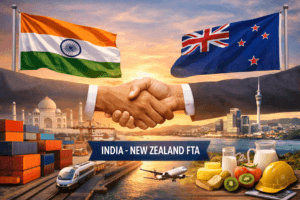
Beyond Tariffs: Decoding the India-New Zealand FTA – A Strategic Milestone with Human Heartbeats
The announcement that India and New Zealand have concluded negotiations for a Free Trade Agreement (FTA) is more than just another economic headline. It is a meticulously crafted pact that tells a story of strategic pragmatism, political sensitivity, and a forward-looking vision for people-led growth. Concluded in a swift nine months—a blink of an eye in the often-glacial world of trade diplomacy—this agreement marks a significant realignment of economic pathways for both nations in the Indo-Pacific.
A Pact Forged in Complementary Needs
At its core, this FTA is a tale of two economies with distinct profiles finding synergy. India, a massive and rapidly growing market with a powerhouse services sector and competitive manufacturing, seeks diversification and deeper integration into global value chains. New Zealand, a high-income economy with world-class agricultural and dairy exports, looks for stable, long-term markets for its premium products.
The numerical targets are ambitious: a goal to double bilateral trade to $5 billion within five years, and a commitment from New Zealand to catalyze $20 billion in investments into India over 15 years. These are not arbitrary figures but signals of intent. For India, still navigating the economic uncertainties posed by shifting trade policies in the West, this agreement with a trusted partner like New Zealand provides a cushion and a new avenue for growth in the Oceania region, complementing its existing pact with Australia.
The Art of the Deal: Protection and Access in Delicate Balance
Perhaps the most telling aspect of this FTA is what it explicitly protects. Union Minister Piyush Goyal’s statement that the government has been “sensitive in protecting interests” of farmers is a direct reflection of the political and social weight of agriculture in India. By securing a complete carve-out for sensitive sectors like dairy, wheat, rice, onions, and edible oils, India has drawn a firm line. This safeguards millions of livelihoods from immediate competition with New Zealand’s highly efficient, export-oriented dairy farms. It demonstrates a model of trade negotiation where economic liberalization is not a blanket policy but a calibrated tool, ensuring domestic stability is not sacrificed at the altar of market access.
Conversely, New Zealand gains significantly reduced or eliminated tariffs on 95% of its exports to India, including timber, fruits, and other agricultural goods. This opens a premium channel for Kiwi exporters into one of the world’s largest consumer markets. The deal, therefore, is not a zero-sum game but a structured exchange: New Zealand gets wide-ranging access for its non-sensitive goods, while India secures vital protections and gains elsewhere.
The Human Capital Corridor: 5,000 Visas and Beyond
While goods trade often dominates headlines, the most innovative and human-centric element of this agreement is the annual quota of 5,000 temporary employment visas for Indian professionals. This is not merely a concession but a strategic recognition of India’s strengths and New Zealand’s needs.
The visa coverage is notably broad and culturally insightful:
- Traditional Skills: It includes AYUSH practitioners, yoga instructors, Indian chefs, and music teachers, formally creating a pathway for India’s soft power and cultural capital.
- Professional Expertise: It caters to high-demand sectors like IT, engineering, healthcare, education, and construction.
This creates a structured, mutually beneficial mobility corridor. For New Zealand, it addresses critical skill shortages with a stream of qualified professionals. For India, it reduces the uncertainty for skilled workers, offers valuable international experience, and promises significant remittance flows. The three-year stay provision adds stability, making it more substantial than short-term work programs.
Economic Diversification: A Strategic Imperative
The FTA arrives at a critical juncture for Indian exporters. With the backdrop of heightened tariffs and protectionist sentiments in some traditional markets, diversification is no longer just advantageous—it is imperative. The agreement explicitly aims to provide a fillip to labor-intensive sectors such as apparel, leather, textiles, and footwear. By securing better market access for these sectors, the deal supports job creation at home, aligning economic diplomacy with domestic employment goals.
Furthermore, sectors like automobiles, pharmaceuticals, machinery, and electronics—where India has growing manufacturing prowess—stand to gain a foothold in a high-standard market like New Zealand. This dovetails with India’s production-linked incentive (PLI) schemes, creating an export outlet for scaled-up domestic manufacturing.
The Bigger Picture: Strategic Trust in the Indo-Pacific
Prime Minister Narendra Modi’s description of the pact as a “historic milestone” and the personal phone call with his counterpart Christopher Luxon underscore the political weight behind this economic agreement. In the complex geopolitics of the Indo-Pacific, such deepening ties between a leading Asian democracy and a key Pacific nation carry strategic resonance. It builds on shared democratic values and a common interest in a stable, rules-based regional order.
The agreement also reinforces India’s distinct approach to trade blocs. Instead of joining massive multilateral frameworks like the RCEP, India is pursuing a “network of agreements” strategy—stitching together tailored, balanced deals with like-minded partners (e.g., Australia, UAE, now New Zealand). This allows for greater control, the ability to protect core interests, and the building of a trusted economic network.
The Road Ahead: Implementation and Integration
With the signing expected in the first half of 2026, the focus will now shift to implementation. The real test will be how smoothly tariff reductions are phased, how the visa quota system is administered, and how effectively businesses in both countries leverage the new opportunities. For Indian MSMEs, in particular, awareness campaigns and logistical support will be key to converting treaty text into tangible exports.
In conclusion, the India-New Zealand FTA is a landmark achievement not for its sheer size, but for its nuanced design. It is a blueprint for 21st-century trade that goes beyond mere goods exchange. It balances market access with social protection, hard economics with human mobility, and immediate gains with long-term strategic partnership. It proves that in a polarized world, equitable and sensible deals are still possible—deals that acknowledge national sensitivities while building bridges for shared prosperity. The true success will be measured not just in rising trade figures, but in the stories of an Indian yoga instructor in Auckland, a Kiwi forestry expert in Chennai, and the countless businesses that will now see each other’s countries not as distant shores, but as connected markets.
You must be logged in to post a comment.