
Beyond Survival: Why India’s Muslims Must Reclaim Reform as an Act of Self-Respect
The article argues that for Indian Muslims, engaging in sincere internal social reform is not a diversion from the struggle against external prejudice and political marginalization, but a vital component of it. While acknowledging the real dangers of majoritarian exploitation of any internal critique, it contends that a defensive, monolithic silence only cedes agency and allows community narratives to be defined by hostile forces. True reform must be reclaimed as an act of self-respect and constitutional confidence, focusing on practical, community-led advancements in education (like modernizing madrasas and transforming mosques into civic hubs), redefining public visibility through civic service, and courageously addressing entrenched issues of gender justice. Ultimately, the path to dignity and equal citizenship requires both resisting injustice and undertaking internal renewal, framing reform not as submission to pressure but as an assertion of the right to self-determination and full participation in national life.
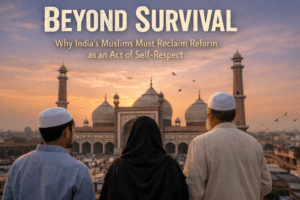
Beyond Survival: Why India’s Muslims Must Reclaim Reform as an Act of Self-Respect
To be a Muslim in India today is to navigate a profound and exhausting duality. On one hand, there is the relentless external pressure: the need to constantly prove one’s patriotism, to preemptively condemn global events, to live under the shadow of suspicion that transforms constitutional citizenship into a conditional privilege. On the other, there is an internal pressure to present a united front, to silence difficult conversations for fear that any admission of social frailty will be weaponized by a hostile political discourse. It is within this suffocating silence that a vital truth is being smothered: for India’s Muslims, internal reform is not a distraction from the struggle for justice and dignity—it is its very foundation.
The argument for postponing introspection is understandable. When triple talaq is criminalized not purely out of concern for women but as a performative act of majoritarian disciplining, when discussions on madrasa education or waqf boards are framed as evidence of civilizational backwardness, the instinct to circle the wagons is strong. Muslim leadership often responds by treating the community as a monolith under siege, where any internal critique is deemed a betrayal. But this defensiveness, while a natural reaction to prejudice, is a strategic cul-de-sac. It cedes the moral and practical initiative to others, allowing regressive elements within and punitive agendas without to define the narrative.
The path forward requires a courageous reclamation of agency. This means disentangling the genuine, necessary project of community reform from the majoritarian project of “correcting” Muslims. It is the difference between reform as self-respect and reform as submission.
The Three Pillars of Self-Directed Reform
Any meaningful reform agenda must move beyond 19th-century theological debates and address the concrete, lived realities of a plural community. It must focus on building resilience and claiming space from within, centered on three urgent pillars.
- Education: From Access to EmpowermentTheSachar Committee report laid bare the systemic educational deficit, a reality that persists. While primary enrollment has improved, the dropout rate in higher education is a silent crisis fueled by economic precarity. The state’s obligation to ensure equitable access is absolute and non-negotiable. However, community-led innovation can build a crucial bridge.
Imagine if the neighborhood mosque, beyond its spiritual role, evolved into a vibrant community education hub. Evening schools for remedial tutoring, digital literacy centers, vocational skill workshops—open to all children irrespective of faith—could transform these institutions from symbols of separation into engines of integration and empowerment. Similarly, the modernization of madrasa education is not a concession to critics but a moral imperative for the community’s future. Providing diini taalim (religious education) is vital, but denying students English, mathematics, and sciences is a disservice that limits horizons and perpetuates socio-economic marginalization. Reform here is not about erasing identity but about expanding capability.
- Visibility: Dismantling Caricatures with Civic ActionThe mainstream visual vocabulary of Indian Muslims has been ruthlessly simplified: the minaret, the beard, the hijab. These are often presented as symbols of insularity. This caricature can only be dismantled through proactive, civic visibility.
When Muslim institutions lead in areas of universal concern—disaster relief, environmental drives, public health awareness, inter-faith dialogue—they redefine their public presence. A mosque organizing a blood donation camp or a free medical check-up for an entire neighborhood does more for community integration than a dozen defensive press releases. It reaffirms a core Islamic ethic: that service to humanity (khidmat-e-khalq) is a form of devotion. This shifts the narrative from what Muslims are against to what they are for, building social capital and challenging stereotypes through tangible action.
- Gender Justice: The Unfinished RevolutionThe political firestorm around triple talaq, while addressing a real injustice, ironically obscured the deeper, more pervasive gender inequities within Muslim society. The uncomfortable truth is that practices like dowry, which have no Islamic sanction, have become entrenched. Rights to inheritance, explicitly granted in Islamic law, are often denied. Women’s representation in religious bodies and community decision-making remains tokenistic.
Waiting for external forces to impose justice in these areas is a recipe for resentment and loss of agency. The momentum must come from within, led by Muslim women scholars, lawyers, and activists who are already reclaiming the egalitarian threads within Islamic tradition. Religious leadership must have the courage to endorse this internal movement, framing gender justice not as an imported Western idea but as a fulfillment of Islamic principles. A community cannot demand dignity from the outside while denying it to half its members on the inside.
Reform as Constitutional Confidence
At the heart of this entire endeavor is a shift in posture—from a defensive performance of nationalism to a confident assertion of constitutional citizenship. The Indian Constitution does not require performative patriotism; it guarantees equality, freedom of conscience, and protection from discrimination. Internal reform, therefore, should be framed not as an apology to majoritarianism, but as an exercise of the community’s constitutional right to self-improvement and equal participation in national life.
This is the stark crossroads: one path leads to a permanent state of defensive victimhood, where every critique is treason and stagnation is mistaken for unity. The other path is harder but more dignified. It requires the courage to critique and reform one’s own community without fear or favour, while simultaneously and uncompromisingly demanding the state uphold its constitutional obligations for every citizen.
In an era of relentless polarization, to look inward is not an act of surrender. It is an act of profound strength. It is to say, “Our quest for justice is two-fold: to hold power accountable for its discrimination, and to hold ourselves accountable to our highest ideals.” By reclaiming the agenda of reform, India’s Muslims can move beyond the exhausting dialectic of persecution and resistance. They can build, from the ground up, a future defined not by what they are fighting against, but by what they are building for themselves and their nation. That is the ultimate form of resilience. That is how dignity is secured.
You must be logged in to post a comment.