
Beyond Subsidies: How India’s 20% Local Content Rule Reshapes the Battery Storage Race
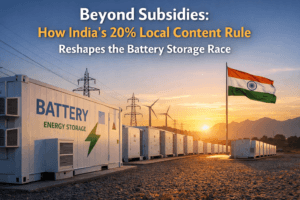
Beyond Subsidies: How India’s 20% Local Content Rule Reshapes the Battery Storage Race
India’s ambitious renewable energy transition, targeting 500 GW of non-fossil capacity by 2030, has long hinged on a critical, often understated component: battery energy storage systems (BESS). Storage is the linchpin that can transform intermittent solar and wind into reliable, dispatchable power. Recognizing this, the government has moved beyond mere deployment targets to strategically shape the industry’s very foundations. A recent directive from the Ministry of Power mandating a minimum of 20% local content for all BESS projects receiving Viability Gap Funding (VGF) is more than a procurement tweak—it’s a calculated move to ensure that India’s clean energy future is built, in part, by Indian hands.
Decoding the Directive: More Than a Percentage
At its core, the order, addressed to 15 states and the utility giant NTPC, establishes a uniform baseline. For any BESS project seeking financial support through the Power System Development Fund (PSDF), at least one-fifth of the total project cost must qualify as “local content.” Crucially, this includes indigenously developed Energy Management System (EMS) software, a stipulation already emphasized in recent VGF guideline amendments.
The policy’s context is telling. It came in response to states seeking exemptions from the broader “Make in India” procurement rules, arguing for unfettered access to global technology to meet urgent capacity needs. The Ministry’s response is a nuanced compromise: rather than a full exemption or a restrictive reservation, it sets a balanced threshold. BESS is not on the list of items reserved exclusively for Class-I local suppliers (those with over 50% local content). Instead, it allows both Class-I and Class-II suppliers to compete, provided they integrate the mandated local value. For tenders already issued, states can secure post-facto undertakings from bidders, ensuring continuity without derailing ongoing processes.
The Strategic Intent: Building Capability, Not Just Capacity
The 20% figure is a starting line, not a finish line. Its primary objective is explicit: to accompany the sector’s growth with “strong domestic value creation.” This approach reveals a maturing industrial strategy that understands technology absorption is key to long-term energy security.
- Cultivating Homegrown Innovation (The Software Play): By mandating indigenous EMS—the “brain” of any storage system—India is directly fostering high-value intellectual property. EMS software dictates how a battery charges, discharges, and interacts with the grid, optimizing for cost, longevity, and stability. Developing this expertise domestically creates a cadre of engineers and companies capable of innovating for India’s unique grid challenges, from frequent ramping needs to erratic frequency profiles.
- Creating a Domestic Supply Chain Beachhead: A complete BESS encompasses more than just battery cells. It includes battery modules, thermal management systems, power conversion systems (PCS/inverters), and balance-of-system components. The 20% rule provides a guaranteed market slice for Indian players in these adjacent areas. It encourages global OEMs to partner with or source from local component suppliers and system integrators, gradually seeding a broader industrial ecosystem.
- Reducing Strategic Dependence: Heavy reliance on imports, particularly from a handful of dominant economies, poses supply chain and geopolitical risks. By kickstarting domestic participation, India aims to build resilience against external shocks and price volatility in the global battery market.
The Ripple Effects: Winners, Partnerships, and Challenges
This policy will reshape the competitive landscape:
- For Global OEMs (Tesla, LG, Fluence, etc.): The mandate is an invitation to localize, not a barrier to entry. The most successful will be those who move beyond a pure import-and-install model to forge strategic joint ventures or technology licensing agreements with Indian partners. The focus will be on transferring non-core assembly, integration, and software development to India. It’s a shift from being mere suppliers to becoming ecosystem enablers.
- For Emerging Indian Tech Firms: This is a clarion call. Startups and established firms specializing in EMS, system integration, and component manufacturing now have a guaranteed offtake channel. Companies like Tata Power, Amara Raja, or new-age BESS integrators can leverage this to scale up, attract investment, and move up the value chain. The policy could be the catalyst for India’s first homegrown BESS unicorn.
- For Project Developers and States: Initially, there might be concerns about cost or technology maturity. However, the directive aims to standardize procurement and enhance transparency, potentially reducing tender disputes. In the long run, a vibrant local market could lead to more competitive pricing, faster servicing, and systems better tailored to regional grid needs.
- The Implementation Hurdles: The success hinges on effective monitoring. Defining and verifying “local content” requires robust, transparent methodologies to prevent greenwashing. There’s also a tightrope walk between promoting domestic industry and maintaining the pace and quality of deployment. The government must ensure the 20% requirement acts as a stepping stone, not a bottleneck.
The Bigger Picture: Aligning Schemes with Sovereignty
This directive does not exist in a vacuum. It’s tightly interwoven with India’s massive financial commitments to storage:
- VGF Scheme 1: ₹3,760 crore for 13,220 MWh of BESS.
- VGF Scheme 2 (June 2025): A monumental ₹5,400 crore for 30 GWh, with 25 GWh allocated to states and 5 GWh to NTPC.
By attaching local content conditions to this ~$1 billion+ pool of public funding, India is using its market-shaping power deliberately. It’s a model reminiscent of its successful push in solar PV, where phased manufacturing programs gradually increased domestic sourcing requirements.
Conclusion: A Defining Moment for Atmanirbhar Energy
India’s 20% local content mandate for BESS is a signature policy at the intersection of energy transition and industrial strategy. It acknowledges that true energy sovereignty requires mastering the technologies that will power the grid of tomorrow. While the immediate focus is on integrating renewables and stabilizing the grid, the long-term play is to position India as a formidable player in the global advanced energy storage landscape.
The journey from 20% to higher thresholds will depend on how swiftly the domestic industry matures. If managed adeptly, this policy could be remembered as the foundational step that allowed India to not just host battery storage projects, but to truly own the technology, innovation, and economic benefits they bring. The race is no longer just about gigawatts on the grid; it’s about capturing the value behind every gigawatt-hour stored.
You must be logged in to post a comment.