
Beyond Stealth: Russia’s Su-57 Pitch to India and the High-Stakes Geopolitical Chessboard
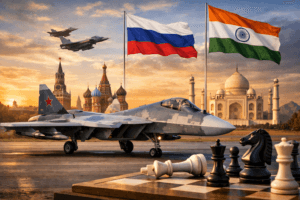
Beyond Stealth: Russia’s Su-57 Pitch to India and the High-Stakes Geopolitical Chessboard
In the high-altitude world of global defense procurement, few offers are as bold as the one currently on the table from Moscow to New Delhi. At the recent Dubai Airshow, Russian officials extended what is being described as their most expansive military-technology proposal to India: full-scale technology transfer and local production of the upgraded Sukhoi Su-57 fifth-generation stealth fighter. This move comes at a critical juncture, as Russia rolls out enhanced Su-57s for its own forces and India faces an urgent, multi-decade scramble to rebuild its air combat power. The proposal is more than a simple arms deal; it is a strategic gambit with profound implications for defense independence, geopolitical alignment, and the future of aerial warfare in Asia.
The Evolving “Felon”: Decoding the Su-57 Upgrade
The aircraft at the heart of this offer is not the early prototype often debated in defense circles, but a matured platform undergoing continuous evolution. Rostec’s announcement of the “new technical configuration” for the Su-57 is significant. While precise details remain classified, the enhancements likely focus on two critical areas foundational to a 5th-gen fighter: sensor fusion and weapons integration.
- Enhanced Onboard Systems: This points to upgrades in the jet’s avionics suite, potentially including a more powerful and software-defined N036 Byelka AESA radar, improved infrared search-and-track (IRST) systems, and advanced electronic warfare capabilities. The real magic, however, lies in the integration. A true fifth-generation advantage comes from a “combat cloud” where data from these sensors, off-board platforms (like AWACS or other aircraft), and satellite feeds are fused into a single, intuitive tactical picture for the pilot. The upgrade likely represents a step forward in this cognitive workload reduction, granting the pilot superior situational awareness.
- New Weapons Configuration: The Su-57’s internal weapon bays are designed for stealth. An expanded configuration suggests the integration of newer, smarter munitions that can be carried internally to preserve its low observable (stealth) profile. This could include next-generation air-to-air missiles with longer range and better resistance to countermeasures, and precision-guided stand-off weapons for ground attack. Notably, the offer includes “licensed production of air weapons,” which would allow India to domestically manufacture the most advanced Russian missiles, a significant leap in self-sufficiency.
Russia’s Unprecedented Offer: Why Now?
Russia’s pitch goes far beyond selling ready-made aircraft. The package includes:
- Phased Local Production: Starting with Russian-built jets, then moving to complete manufacturing lines in India, mirroring the Su-30MKI model but with even deeper involvement.
- Full Technology Transfer: Explicitly mentioned are engines (likely the izdeliye 30), AESA radar, low-observable technologies, AI elements, and optics. This is the core intellectual property of a 5th-generation fighter.
- Customization: Openness to developing a two-seat variant tailored for India, which could be used for training, complex strike missions, or even as a loyal wingman controller for unmanned systems.
This generosity is born of stark necessity and strategic calculation. The war in Ukraine has strained Russia’s military-industrial complex and underscored the risks of international isolation. Locking in India, a traditional partner and the world’s largest arms importer, provides a crucial financial and strategic buffer. It ensures long-term production runs, sustains the Russian aerospace ecosystem, and solidifies a key geopolitical partnership at a time when Western sanctions are biting. For Russia, this deal is about maintaining relevance in the Indo-Pacific and securing the future of its flagship fighter program.
India’s Dilemma: The Gap Between Urgency and Ambition
The Indian Air Force (IAF) faces a stark numerical reality. With depleting squadrons and the impending retirement of legacy MiG series, its own analysis calls for inducting 35-40 new fighter jets annually for the next two decades to meet the goals of “Roadmap 2047.” This urgency creates a multi-layered dilemma:
- The Indigenous Pathway – AMCA: India’s own 5th-gen AMCA (Advanced Medium Combat Aircraft) is a point of national pride and strategic imperative. However, its timeline for operational deployment is at least a decade away. Relying solely on the AMCA would mean accepting a critical capability gap during a period of heightened regional tensions.
- The Western Option – F-35: While technologically advanced, the F-35 comes with severe political strings attached, likely limited technology sharing, and the perpetual risk of sanctions under legislation like CAATSA. It could also jeopardize India’s relationship with Russia and its extensive inventory of Russian-origin systems.
- The Russian Bridge – Su-57: This offer appears to solve the immediate timeline problem while offering unparalleled technological access. The promise of mastering engine and radar technology could theoretically accelerate the AMCA program. However, it raises tough questions: Will the transferred technology be the cutting-edge version or a previous iteration? Can Russia fulfill its promises while under extensive sanctions? Does doubling down on Russian kit make India more vulnerable to future geopolitical pressure?
The Geopolitical and Industrial Tightrope
For India, the decision transcends technical specifications. It is a classic exercise in its “multi-alignment” foreign policy.
- The Sanctions Shadow: Integrating a high-tech Russian platform like the Su-57 risks triggering secondary sanctions from the West, potentially disrupting access to critical components from Europe and Israel for other defense projects, including the AMCA itself. Russia’s offer to include “local manufacturing of critical components” is a direct attempt to assuage this fear.
- Strategic Autonomy vs. Strategic Dependency: While tech transfer promotes autonomy, becoming the primary production hub for a major Russian system creates a new form of dependency—on spares, updates, and further development. It also complicates interoperability with Western systems India is increasingly acquiring.
- The China Calculus: Both India and Russia view China with complex lenses. For India, the Su-57 would be a direct counter to China’s J-20. For Russia, selling to India balances its relationship with Beijing. However, deepening defense ties with Moscow could limit India’s options in building a broader coalition to counter Chinese influence in the region.
Conclusion: More Than a Fighter Jet
The upgraded Su-57 rolling off Russian production lines is a tangible asset. Russia’s offer to India is a strategic lifeline wrapped in a golden promise. For New Delhi, the choice is not merely between aircraft, but between divergent pathways for its defense-industrial future and its geopolitical posture.
Accepting the offer could provide a rapid, potent boost to the IAF’s capabilities and seed its industry with coveted technologies, but at the cost of immense geopolitical risk and potential long-term entanglement. Declining it would reinforce the commitment to Western partnerships and the indigenous AMCA, but would demand navigating a perilous capability gap for years to come.
As the Modi-Putin summit approaches, this deal will loom large in discussions. The outcome will reveal much about India’s assessment of global alignments, its faith in its own technological timeline, and the price it is willing to pay for immediate airpower. In the end, the Su-57 story is not just about a stealth fighter; it is a defining test of India’s journey toward becoming a defense powerhouse, balancing on a tightrope strung between urgent need, future ambition, and the unforgiving realities of great power politics.
You must be logged in to post a comment.