
Beyond Slogans: What Andhra Pradesh’s Push for a “Tech-Driven Decision-Making Year” Reveals About India’s Governance Future
Beyond Slogans: What Andhra Pradesh’s Push for a “Tech-Driven Decision-Making Year” Reveals About India’s Governance Future
The announcement by Andhra Pradesh Chief Minister N. Chandrababu Naidu that 2026 should be heralded as a “technology-driven decision-making year” might, at first glance, sound like another political soundbite in an era saturated with digital promises. Yet, a closer examination of the context, the existing infrastructure, and the unspoken challenges reveals a pivotal moment not just for a state, but for the very blueprint of Indian governance. This is not merely about adopting new tools; it’s a fundamental re-imagining of the relationship between citizen and state, promising efficiency but also demanding rigorous scrutiny.
The Foundation: More Than Just a WhatsApp Service
At the heart of Naidu’s review was the Real Time Governance System (RTGS) and the ManaMitra WhatsApp-based service. The statistic is staggering: 868 services accessible to 1.4 crore citizens via a messaging platform. This figure alone dismantles the archaic image of citizens waiting in serpentine queues for basic certificates. ManaMitra represents a quiet revolution in accessibility, turning the most ubiquitous app in India into a town hall.
But the true insight lies in what this enables: the shift from reactive to predictive governance. When thousands of service requests—for birth certificates, income proofs, or ration card updates—flow into a centralized, AI-processable system, patterns emerge. Authorities can identify bottlenecks in real-time, forecast demand for specific services in different regions, and allocate resources proactively. The decision-making shifts from being based on monthly reports and gut feelings to being driven by live dashboards and data trends.
The 2026 Vision: AI as the Civil Servant’s Co-Pilot
Naidu’s call for using Artificial Intelligence in delivering government services is the natural next step. Imagine an AI layer integrated into the RTGS:
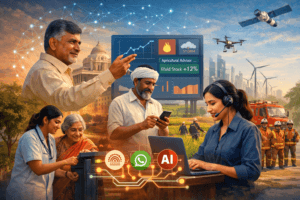
- In Agriculture: Instead of farmers struggling with market prices, AI could analyze local yield data, weather patterns, and national demand to provide hyper-local advisory: “Hold your groundnut stock for 15 days; prices are projected to rise 12% in your cluster.”
- In Revenue & Land Records: AI could cross-reference transaction data, satellite imagery, and historical records to flag discrepancies or potential fraud in real-time, protecting the most vulnerable from land grabs.
- In Disaster Management (Fire Services reviewed): AI models could process weather data, urban layout maps, and historical incident reports to predict high-risk zones for fires, especially during festivals like Sankranti, enabling pre-emptive deployment of resources.
The goal here is not to replace human bureaucrats but to augment their capacity. The “tech-driven decision” means providing the civil servant with a powerful, data-rich recommendation, allowing them to focus on nuance, empathy, and complex problem-solving where machines fall short.
The Global Context & The Andhra Blueprint
Andhra’s push did not occur in a vacuum. It sits at the confluence of several powerful trends:
- India’s Digital Public Infrastructure (DPI) Success: The proven model of Aadhaar, UPI, and OCEN has created a national architecture for innovation. States like Andhra are now building their unique applications on top of this “societal operating system.”
- The Global Race for GovTech: From Estonia’s X-Road to Singapore’s Virtual Singapore, nations are competing on governance efficiency. For India, a successful state-level model becomes a exportable template, a “soft power” asset.
- The Post-Pandemic Acceleration: COVID-19 forced a digital leap in service delivery. The public’s acceptance of digital interfaces is now at an all-time high, creating a fertile ground for deeper integration.
Andhra, under Naidu’s earlier tenure, was a pioneer in using technology in governance in the late 1990s and 2000s. The current push is an attempt to leapfrog to a next-generation system, learning from both its own past and global best practices.
The Human Insights: The Dividends and The Divides
The genuine value for readers lies in understanding the profound human impact—both potential and perilous.
The Dividends:
- Dignity through Access: Technology can erase the humiliation of begging for a basic service. A farmer in Anantapur can apply for a soil health card without losing a day’s wage to travel and bribery.
- Transparency as Default: When every application leaves a digital audit trail, the scope for opaque discretion and corruption shrinks. The “file” can no longer get lost.
- Empowerment through Data: In the CM’s review, integrating agriculture data is key. Giving farmers their own data, analyzed intelligently, transforms them from price-takers to informed market participants.
The Divides:
- The Digital Literacy Chasm: For the 1.4 crore users of ManaMitra, how many are young, male, and urban? The real challenge is onboarding the elderly, the rural woman, the migrant laborer. A “tech-driven year” must be accompanied by a massive, compassionate “Digital Sahayak” literacy drive.
- Surveillance vs. Service: A Real Time Governance System that can monitor service delivery can also monitor citizens. Without a robust data privacy law (India’s PDP Bill remains pending) and stringent ethical frameworks, this powerful tool risks becoming an instrument of surveillance.
- The Loss of the Human Touch: Not all governance is transactional. Grievance redressal, social counseling, and conflict resolution require human judgment and empathy. Technology must facilitate, not frigidize, these interactions.
- Over-Reliance and Systemic Fragility: What happens when the server goes down, or a cyber-attack strikes? A fully digital system necessitates equally robust analog fail-safes to prevent the exclusion of entire communities during outages.
The Road to 2026: A Checklist for Meaningful Implementation
For Naidu’s vision to add genuine value, it must evolve from a headline to a holistic framework:
- Ethics by Design: Create a public, transparent charter for the use of AI in governance, with citizen oversight panels.
- Bridging the Gap: Invest in last-mile digital ambassadors and offline-assisted service kiosks to ensure no one is left behind.
- Skill the Bureaucracy: Massive training programs are needed to move officials from being data-averse to being data-literate co-pilots of the AI system.
- Focus on Outcomes, Not Outputs: The metric should not be “number of AI models deployed,” but “reduction in farmer distress calls” or “time saved for women in accessing services.”
- Foster a Civic-Tech Ecosystem: Partner with local startups and universities to solve niche governance problems, moving beyond monolithic vendor-driven solutions.
Conclusion: A Pivot Point for the Republic
Andhra Pradesh’s declaration for 2026 is a microcosm of India’s larger journey. It encapsulates the ambition to harness technology for public good, a vision that aligns perfectly with the problem-solving spirit of the Republic. However, the path is fraught with philosophical and practical pitfalls.
The ultimate insight is this: Technology in governance is not about making the state smarter; it’s about making it more humane, responsive, and just. A “tech-driven decision-making year” will only be a success if, at the end of 2026, a villager in Srikakulam feels the state understands her needs better, respects her time more, and protects her rights more fiercely—not because a server is up, but because the system is ultimately designed for her.
The world will be watching. If Andhra Pradesh can navigate the tightrope between algorithmic efficiency and human dignity, it will offer a template not just for India, but for every democracy seeking to renew its covenant with its people in the digital age.
You must be logged in to post a comment.