
Beyond Silicon Valley: How Seattle’s Tech Titans Are Betting Big on India’s Innovation Boom
The second Invest India Business Forum in Seattle, held in January 2026, served as a strategic launchpad signaling a profound evolution in economic relations between the U.S. Pacific Northwest and India, moving beyond traditional outsourcing towards deep innovation partnerships. The event, which featured major companies like Microsoft and Amazon, highlighted collaboration in cutting-edge sectors such as AI, quantum computing, and agri-tech, while also showcasing India’s drive for digital sovereignty and its export-ready products like Bhagwa pomegranates. Acting as a direct precursor to Washington State’s largest-ever trade mission to India, the forum underscored a concerted effort to build a resilient, technology-driven partnership based on mutual capability and strategic alignment, marking a significant step in rebalancing global supply chains and fostering a multipolar innovation ecosystem.
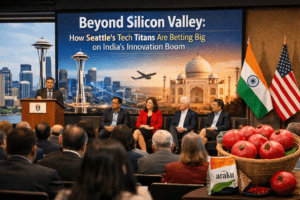
Beyond Silicon Valley: How Seattle’s Tech Titans Are Betting Big on India’s Innovation Boom
In a telling shift of global economic corridors, the heart of the Pacific Northwest is beating in rhythm with India’s ascendant market. On January 24, 2026, the Bell Harbor International Conference Center in Seattle became the unlikely epicenter for a forward-looking dialogue on trans-Pacific partnership, as the second Invest India Business Forum (IIBF) unfolded. But this was more than just another diplomatic meet-and-greet. The forum, and the monumental trade mission it heralds, signals a strategic recalibration. Seattle, home to cloud computing giants and aerospace legends, is not merely looking at India as an outsourcing destination but as a critical partner in core innovation, a testing ground for advanced technology, and a gateway to a rebalanced global supply chain.
The Forum: A Prelude to a Historic Trade Mission
Organized by the Consulate General of India in Seattle with the Montana World Affairs Council and ZOHO, the IIBF served as the intellectual and strategic launchpad for what is poised to be Washington State’s largest-ever trade delegation to India. From January 28 to February 7, a cohort of over 30 key leaders—including heavyweights from Microsoft, Amazon, Boeing, the Port of Seattle, and city mayors—will traverse India, exploring synergies far beyond the traditional IT service model.
This move is profound. It represents a maturation of the economic relationship, moving from transactional to transformational. As Rebecca Lovell, Interim President and CEO of Greater Seattle Partners, expressed at the forum, the goal is to develop “stronger commercial and investment ties.” In practice, this means Seattle’s expertise in cloud infrastructure, AI, and logistics meeting India’s explosive digital adoption, vast talent pool, and ambitious infrastructure and sustainability goals.
Decoding the Priority Sectors: Where Synergy Meets Sovereignty
The expert panels at IIBF zeroed in on sectors that reveal a dual strategy: leveraging Indian talent for global solutions while supporting India’s own self-reliance goals.
- Artificial Intelligence & Quantum Computing: A representative from ZOHO provided a crucial insight into India’s drive for digital sovereignty. By showcasing AI-driven, locally developed data models, the presentation highlighted a national imperative to control and cultivate its own digital ecosystem. The fact that the Indian government has adopted Zoho’s office suite is a powerful signal: it’s an endorsement of homegrown, secure platforms that can compete with global giants. For Seattle’s tech firms, this creates both a challenge and an opportunity—to collaborate on terms that align with India’s data governance frameworks and to co-innovate in a vast, complex market.
- Healthcare Technology: Eric Wexler, CEO of Providence, illuminated another key pillar. The opening of Providence’s Global Capability Center in Hyderabad, aiming to create 2,000+ jobs focused on AI-enabled healthcare tech, is a blueprint. It’s not a back-office operation; it’s a strategic R&D hub. India’s combination of high-volume clinical data, engineering prowess, and cost-innovation makes it an ideal lab for developing next-gen diagnostic tools, telehealth platforms, and hospital management systems that can be scaled globally.
- Agriculture Technology (Ag-Tech): The forum’s tasting session was itself a strategic display. The imminent arrival of India’s ‘Bhagwa Variety’ pomegranates in U.S. supermarkets is a small banner for a larger story. Gaining U.S. market access in 2023 was a hard-won diplomatic and scientific achievement, involving rigorous phytosanitary standards. This paves the way for more high-value, niche agricultural exports. For the Pacific Northwest, a region keen on food security and diversified sourcing, India represents a new origin for premium, sustainably grown produce. The displayed Araku coffee—a single-origin, tribal-grown product—further underscores this shift towards specialty, story-driven exports that command premium shelf space.
The “3Ts” Framework: A Cohesive Diplomacy Strategy
The Consulate’s focus on Trade, Tourism, and Technology (the 3Ts) was evident in every detail of the forum. It was a holistic showcase:
- Trade: The ODOP (One District One Product) artifacts and gourmet products were tangible, export-ready candidates for the discerning Pacific Northwest consumer market.
- Technology: The deep-dive presentations on photonics, quantum, and AI framed India as a knowledge partner.
- Tourism: While less explicit, the cultural undertones and the discussion around the Montana youth delegation’s recent visit to India feed into building people-to-people bonds that underpin all economic relations.
The Subnational Angle: Montana’s Unexpected Role
The presence of a large Montana delegation is a fascinating subplot. It highlights an often-overlooked aspect of India’s economic diplomacy: engaging at the state-to-state level. Governor Greg Gianforte’s reception for a returning youth delegation indicates a long-term play. Montana, with strengths in agriculture, renewable energy, and education, may find unexpected complementarities with Indian states. This decentralized approach allows for more tailored, agile partnerships that bypass the noise of federal-level politics.
The Bigger Picture: A Multipolar Tech Ecosystem in the Making
The Seattle-India corridor is emerging as a microcosm of a changing world order. With global supply chains diversifying away from concentration and a renewed emphasis on trusted, democratic tech partnerships, India and the U.S. West Coast are natural allies.
For American companies, India offers:
- A de-risked alternative for manufacturing and innovation outside traditional hubs.
- A massive, digitally-savvy domestic market to test and scale products.
- A deep bench of STEM talent driving foundational R&D.
For India, engagement with Seattle provides:
- Cutting-edge technology infusion in critical sectors like cloud, AI, and aerospace.
- Pathways to global markets for its products, from pomegranates to software platforms.
- Validation of its “Make in India for the World” and “Atmanirbhar Bharat” (self-reliant India) initiatives through serious investment and joint development.
Conclusion: Beyond a Forum, a Foundation
The 2026 Invest India Business Forum was ultimately a statement of intent. The handshakes in Seattle’s conference center will soon translate into site visits in Hyderabad, Mumbai, and Bengaluru. The discussed partnerships around quantum computing, ethical AI, and sustainable agriculture have the potential to address some of the century’s greatest challenges.
As the Washington State delegation embarks on its journey, they are navigating more than just a business trip. They are participating in the deliberate construction of a new innovation bridge across the Pacific—one built not on cost arbitrage, but on mutual capability, strategic trust, and a shared vision for a technology-driven future. The seeds planted in Seattle, much like the Bhagwa pomegranates on display, are poised for a rich and fruitful yield.
You must be logged in to post a comment.